Climate change threatens many tree species: researchers
Global warming is already affecting the earth in a variety of ways that demand our attention. Now, research carried out at the Hebrew University of Jerusalem indicates that many tree species might become extinct due to climate change if no action is taken in time.
According to the research, trees which disperse their seeds by wind, such as pines and maples, will be unable to spread at a pace that can cope with expected climate changes.
The research, which focused on the ecological consequences of expected changes in the climate and the environment on tree spread, was conducted by Prof. Ran Nathan, head of the Alexander Silberman Institute of Life Science at the Hebrew University; his student, Nir Horvitz; and researchers from abroad.
Climate changes, which can be sensed already today and which are expected to continue in the next 50 years, include the increase of carbon dioxide concentration in the air and a reduction of surface wind speed in many areas. On the basis of earlier work, elevated concentration of carbon dioxide is expected to cause trees to produce many more seeds and to reach maturity earlier than under current conditions, hence speeding up their spread. On the other hand, the weakening of wind speed in certain areas should reduce spread rate of these trees. The balance between these opposing forces remained unknown.
Furthermore, it was unclear whether even the projected increase in wind speed in certain areas, together with the higher seed production and earlier maturation, will result in a fast enough spread of trees in order to be sufficient to match the climate changes.
These questions were examined in this study for the first time. Surprisingly, the results show that changes in wind speed, either the projected increase or decrease, have negligible effects on the rate of wind-driven spread of these species. The effects of increased seed production and earlier maturation is that which prevails, giving rise to faster spread in the future compared to current conditions. Still, this research showed that the faster spread predicted for these trees in the future will be much slower than the expected poleward shift of climate (temperature) ranges. Consequently, these tree species might not be able to withstand the climate change.
"Our research indicates that the natural wind-driven spread of many species of trees will increase, but will occur at a significantly lower pace than that which will be required to cope with the changes in surface temperature," said Prof. Nathan. "This will raise extinction risk of many tree populations because they will not be able to track the shift in their natural habitats which currently supply them with favorable conditions for establishment and reproduction. As a result, the composition of different tree species in future forests is expected to change and their areas might be reduced, the goods and services that these forests provide for man might be harmed, and wide-ranging steps will have to be taken to ensure seed dispersal in a controlled, directed manner."
The new research, published in the journal Ecology Letters is based on a unique, fully mechanistic model developed to predict trends in plant spread. This model is the first to consider how projected changes in biological and environmental factors would impact tree spread in future environments. Predictions which were made until now were founded on past trends and did not take into consideration the expected future changes in the key biological and environmental factors that determine plant spread.
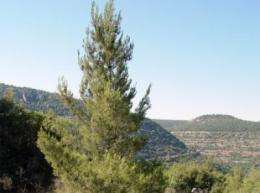
In Israel, the research has bearing on various native tree species whose seeds are dispersed by the wind, such as Aleppo pine, Syrian maple and Syrian ash. The model that has been developed will be useful also in predicting the invasive spread of alien tree species, such as the tree of heaven, into Israeli natural habitats.
Trees with wind-dispersed seeds are mainly common in forests of North America and Eurasia. The current research points to the need to take human action to insure the dispersal of the seeds of these trees within the next half century, in view of the expected climate changes.
"It is important for those responsible for forest management in many parts of the world to understand that nature alone will not do the job," said Prof. Nathan. "Human action will be required to ensure in a controlled manner the minimization of unexpected detrimental byproducts, and that those trees which are very important for global ecological processes will not become extinct," he said. "These forests are important in many ways to man, including the supply of wood, the safeguarding of water quality, and the provision of recreation and tourism facilities."
Provided by Hebrew University of Jerusalem


