Making light work of artificial muscles
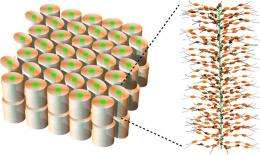
The light-responsive film is made up of polymer brushes (right) that have self-assembled into a two-layer, three-dimensional array (left). Credit: Reproduced, with permission, from Ref. 1 2011 American Association for the Advancement of Science
A new form of self-assembling polymer film that bends and stretches when hit by light is pointing the way to a new family of functional materials. This flexing film is the first material to have been made by coaxing complex molecules to form large-scale, highly ordered three dimensional arrays -- a discovery that could change the way that many active material are made, from artificial muscles to solar cells.
Nobuhiko Hosono, Takuzo Aida and colleagues at RIKEN Advanced Science Institute in Wako and The University of Tokyo developed the self-assembly protocol. The researchers found that brush-shaped polymers would form an orderly film when hot-pressed between two sheets of Teflon.
They made their discovery while studying a polymer in which each side chain, or bristle, of the brush structure incorporates light-responsive azobenzenestwo benzene rings separated by a pair of nitrogen atoms. When hit by UV light, the bond between the nitrogens rearranges, contracting the side chain.
The researchers used this photoisomerization behavior to confirm the remarkable long-range order of the polymer structure. Because the side chains were all aligned, when those at the surface were hit by light they curled up in concert, bending the film. A second beam of light at a different wavelength reversed the isomerization process, and the film relaxed back to its original shape.
The trick to making the material is to heat it between two sheets of Teflon that have been drawn tight in one direction, says Hosono. This tension orients the Teflon sheets internal structure along a single axis, which acts as a template for the molten polymer brushes sandwiched in between. The side chains of the polymer brush align with the Teflon, pulling each brush upright. As each polymer brush aligns in the same way, it forms a repeating three-dimensional array.
Hosono, Aida and colleagues expect the technique to work for other polymer brushes with similar side chains. To improve the artificial muscle-like behavior of their polymer film, Hosono says the team will try cross-linking the polymer side chains. This will prevent the molecular structure from becoming disordered as the polymer repeatedly curls and relaxes over many cycles, giving the muscle a longer lifetime.
The team is already assessing other potential applications. The wide-area three-dimensional molecular ordering of the polymer brush has great potential for building electronic devices, says Hosono. We now have designed a new type of polymer brush for development of highly efficient thin-layer organic solar cells.
More information: Hosono, N., et al. Large-area three-dimensional molecular ordering of a polymer brush by one-step processing. Science 330, 808-811 (2010).
Read the article here: http://www.science … 05/808.short
Provided by RIKEN
-
From lemons to lemonade: Reaction uses carbon dioxide to make carbon-based semiconductor,
28 comments
-
Thioridazine kills cancer stem cells in human while avoiding toxic side-effects of conventional cancer treatments,
3 comments
-
SpaceX private rocket blasts off for space station (Update),
41 comments
-
Climate scientists say they have solved riddle of rising sea,
30 comments
-
Scotland passes turbine test to harness tidal power,
40 comments
-
Force in a magnetic coupling
3 hours ago
-
Sign of scalar product in electric potential integral?
10 hours ago
-
Heat engines: how can we yield work?
11 hours ago
-
What capacitors to use in a Tesla coil...?
21 hours ago
-
Work done by us on the spring
22 hours ago
-
Surface current density
May 25, 2012
- More from Physics Forums - Classical Physics
More news stories
High-speed method to aid search for solar energy storage catalysts
Eons ago, nature solved the problem of converting solar energy to fuels by inventing the process of photosynthesis.
19 hours ago |
5 / 5 (3) |
1
|
From lemons to lemonade: Reaction uses carbon dioxide to make carbon-based semiconductor
(Phys.org) -- A materials scientist at Michigan Technological University has discovered a chemical reaction that not only eats up the greenhouse gas carbon dioxide, it also creates something useful. And, by ...
May 21, 2012 |
4.7 / 5 (88) |
28
|
Researchers demonstrate possible primitive mechanism of chemical info self-replication
(Phys.org) -- When scientists think about the replication of information in chemistry, they usually have in mind something akin to what happens in living organisms when DNA gets copied: a double-stranded molecule ...
May 25, 2012 |
5 / 5 (4) |
2
|
New CO2-removing catalyst can take the heat
(Phys.org) -- The current method of removing the greenhouse gas carbon dioxide (CO2) from the flues of coal-fired power plants uses so much energy that no one bothers to use it. So says Roger Aines, principal ...
May 24, 2012 |
5 / 5 (7) |
7
|
Castor oil: Action mechanism of one of the oldest drugs known to man elucidated
Castor oil is known primarily as an effective laxative; however, it was also used in ancient times with pregnant women to induce labour. Only now have scientists at the Max Planck Institute for Heart and Lung ...
May 21, 2012 |
3 / 5 (2) |
3
|
SpotterRF debuts Radar Backpack Kit (w/ Video)
(Phys.org) -- SpotterRF has announced a special radar backpack kit designed to enhance situational awareness for soldiers on the ground. The company says its special radar is designed for warfighters as part ...
Family history of Alzheimer's affects functional connectivity
(HealthDay) -- Cognitively normal individuals with a family history of late-onset Alzheimer's disease (AD) may display lower resting state functional connectivity in the default mode network (DMN) of the brain, ...
Transvaginal mesh op restores pelvic organ prolapse at price
(HealthDay) -- Transvaginal mesh (TVM) procedures are effective for anatomical restoration of pelvic organ prolapse (POP), but patients report a worsening of sexual function following surgery, according to ...
Travel to high altitudes tied to Crohn's, colitis flare-ups
(HealthDay) -- People with inflammatory bowel disease, which includes Crohn's disease and colitis, may be at increased risk for flare-ups when they fly or travel to high altitudes for skiing or mountain climbing, ...
Thousands of shellfish found dead in Peru
Thousands of crustaceans were found dead off the coast of Lima following the mystery mass death of dolphins and pelicans, the Peruvian Navy said Friday.
Astronomers seize last chance in lifetime for Venus Transit
Astronomers are gearing for one the rarest events in the Solar System: an alignment of Earth, Venus and the Sun that will not be seen for another 105 years.