3D X-rays piece together the evolution of flight from fossils
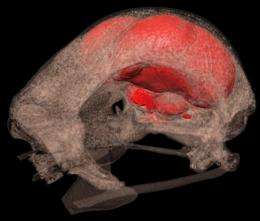
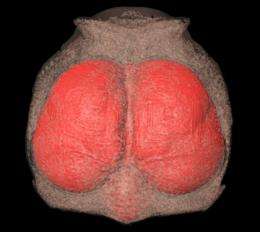
(PhysOrg.com) -- In a collaborative project between National Museums Scotland and the University of Abertay Dundee, researchers are using an incredibly sensitive CT (computerised tomography) scanner to analyse whole skulls and fossilised fragments and recreate accurate 3D models of extinct birds brains.
Bird skulls grow to a fixed size before they leave the nest, with the brain then growing to almost completely fill the cavity space. This means that bird skulls can be used to accurately calculate the size and shape of the brain.
By working this out, the size of part of the brain called the flocculus can be established. This small part of the cerebellum is responsible for integrating visual and balance signals during flight, allowing birds to focus on objects moving in three dimensions while they are flying.
Dr. Stig Walsh, project leader and Senior Curator of Vertebrate Palaeobiology at National Museums Scotland, said: By charting the relative size of parts of the avian brain we believe we can discover how the flocculus has evolved to deal with different flying abilities, giving us new information about when birds first evolved the power of flight.
The central research question is whether a larger flocculus is directly linked to a greater ability to process the visual and balance signals during flight. If proven, this could mark a major step forward in understanding bird evolution, and may shed light on whether some remarkably bird-like dinosaurs were truly dinosaurs or actually secondarily flightless birds.
He added: This research has only been recently made possible through advances in X-ray micro-CT scanning. Unlike medical scanners, which take a series of slice images through an object that may be up to 1.5 millimetres apart, the 3D scanner at Abertay University can be accurate up to 6 microns.
By using such powerful equipment and around 100 different modern species were beginning to understand much, much more about the evolution of flight.
The project is also looking at some of the rarest fossils in the world including the only two skulls of a flightless sea bird from the Cretaceous Period around 100 million years ago.
What makes the fossils so rare is they were preserved in three dimensions in soft clay, not flattened by the pressure of earth above them like most bird fossils.
Patsy Dello Sterpaio, joint project researcher at Abertay University, said: This is a hugely exciting project, which benefits greatly from Abertays high-powered micro-CT scanner. We hope that this joint project can produce not only incredible images, but also helps answer some of these important unresolved questions about the evolution of flight.
Dr. Wilfred Otten, leader of the X-ray CT scanning facility at Abertay University, added: The CT facilities at Abertay University are part of the SIMBIOS Centre for understanding complex ecological and environmental issues, which has an impressive team of experienced and successful experimentalists and modellers supporting its activities.
Building from our expertise in environmental and soil science, were able to offer unrivalled expertise in capturing and quantifying interior structures of a wide range of materials.
The computer analysis digitally reconstructs the shape and size of the skull, and creates a 3D virtual brain model from the cavity inside the skull that housed the brain in life.
The project is also looking at flightless birds such as the dodo, to see whether the flocculus has become smaller with the loss of flight. The researchers believe that the brain power required for flight may have become reduced in such species.
The project is scheduled to run until early 2012.
Provided by University of Abertay Dundee
-
From lemons to lemonade: Reaction uses carbon dioxide to make carbon-based semiconductor,
28 comments
-
Thioridazine kills cancer stem cells in human while avoiding toxic side-effects of conventional cancer treatments,
3 comments
-
SpaceX private rocket blasts off for space station (Update),
41 comments
-
Climate scientists say they have solved riddle of rising sea,
30 comments
-
Scotland passes turbine test to harness tidal power,
40 comments
-
How do I identify different bacteria on culture plates?
3 hours ago
-
Why Do Dogs do Strange things...
19 hours ago
-
What does exophillic and endophillic mean in terms of mosquito and their control?
May 24, 2012
-
Semen stains glows under black lights (uv light)?
May 23, 2012
-
Question on Human Chromosome 2
May 23, 2012
-
How important is composition of TBST in diluting antibodies and Western Blotting?
May 22, 2012
- More from Physics Forums - Biology
More news stories
Math predicts size of clot-forming cells
UC Davis mathematicians have helped biologists figure out why platelets, the cells that form blood clots, are the size and shape that they are. Because platelets are important both for healing wounds and in strokes and other ...
20 hours ago |
not rated yet |
0
|
Social welfare cuts ultimately come with heavy price, researchers say
(Phys.org) -- Slashing government funding for Medicaid, food stamps and other programs that serve the poor while politically popular with some lawmakers and many conservatives may do more harm ...
Other Sciences / Social Sciences
May 24, 2012 |
4.3 / 5 (11) |
86
Ancient Bethlehem seal unearthed in Jerusalem
Israeli archaeologists have discovered a 2,700-year-old seal that bears the inscription "Bethlehem," the Israel Antiquities Authority announced Wednesday, in what experts believe to be the oldest artifact ...
Other Sciences / Archaeology & Fossils
May 23, 2012 |
3.5 / 5 (13) |
22
Oldest Jewish archaeological evidence on the Iberian Peninsula
German archaeologists of the Friedrich Schiller University Jena found one of the oldest archaeological evidence so far of Jewish Culture on the Iberian Peninsula at an excavation site in the south of Portugal, ...
Other Sciences / Archaeology & Fossils
May 25, 2012 |
4.3 / 5 (4) |
12
Dollars and sense: Why are some people morally against tax?
As the U.S. presidential election campaigns heat up, the economic debate is dominated by bailouts, austerity and, inevitably, taxation. Now a new study published in Symbolic Interaction asks why tax is such an important issue ...
Other Sciences / Social Sciences
May 23, 2012 |
3 / 5 (2) |
12
SpotterRF debuts Radar Backpack Kit (w/ Video)
(Phys.org) -- SpotterRF has announced a special radar backpack kit designed to enhance situational awareness for soldiers on the ground. The company says its special radar is designed for warfighters as part ...
Family history of Alzheimer's affects functional connectivity
(HealthDay) -- Cognitively normal individuals with a family history of late-onset Alzheimer's disease (AD) may display lower resting state functional connectivity in the default mode network (DMN) of the brain, ...
Transvaginal mesh op restores pelvic organ prolapse at price
(HealthDay) -- Transvaginal mesh (TVM) procedures are effective for anatomical restoration of pelvic organ prolapse (POP), but patients report a worsening of sexual function following surgery, according to ...
Travel to high altitudes tied to Crohn's, colitis flare-ups
(HealthDay) -- People with inflammatory bowel disease, which includes Crohn's disease and colitis, may be at increased risk for flare-ups when they fly or travel to high altitudes for skiing or mountain climbing, ...
Thousands of shellfish found dead in Peru
Thousands of crustaceans were found dead off the coast of Lima following the mystery mass death of dolphins and pelicans, the Peruvian Navy said Friday.
Astronomers seize last chance in lifetime for Venus Transit
Astronomers are gearing for one the rarest events in the Solar System: an alignment of Earth, Venus and the Sun that will not be seen for another 105 years.