Windowfarms unveils new garden kits that grow up to 32 plants per window
December 16, 2010 by Lisa Zyga
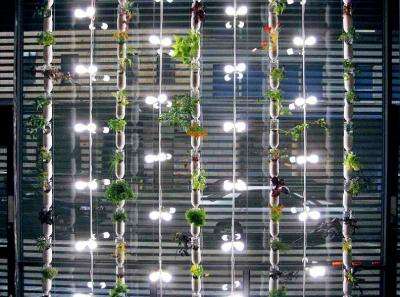
Windowfarms are vertical, hydroponic, modular, low-energy, high-yield edible window gardens built using low-impact or recycled local materials. Image credit: Windowfarms.
(PhysOrg.com) -- Whether it's the cold weather or a lack of outdoor space that prevents you from growing a vegetable garden, if you have a window, you can grow a garden by using a Windowfarm. Windowfarms, which are gardens that hang on the inside of windows, can grow dozens of plants per window. Recently, the Windowfarms project has unveiled two new garden kits for home use, in addition to the educational kits they already sell.
In a Windowfarm, plants hang in vertical columns, with each plant growing inside its own 1.5-liter recycled plastic bottle filled with soil. Large plants can be grown in small containers due to the use of the hydroponic system. The system involves a tub of water elevated above the garden that drips water through the vertical columns into each plant. A basin at the bottom catches water that is not absorbed by the plants, and a pump cycles the water back to the top of the system. The water also contains a nutrient solution.
Windowfarms can grow a variety of vegetables, including tomatoes, swiss chard, lettuce, kale, strawberries, marigolds, squash, sugar peas, and more, according to its website. Sometimes, if there is not enough sunlight coming in, a full-spectrum CFL bulb can provide additional lighting.
The Windowfarms project originally started as a web-based social collaboration experiment, in which more than 15,000 citizen scientists shared ideas and discussed urban agriculture. Windowfarm inventor Britta Riley explains that the project is based on an R&DIY (Research and Develop-It-Yourself) model, and has successfully demonstrated the possibility of growing food in urban environments.
Windowfarms range in price, starting from $140 for 16-plant home kits, $240 for 32-plant home kits, and up to $1260 for 60-plant educational kits. The project also provides free instructions on how to build the kits.
More information: Windowfarms.org
via: Inhabitat
© 2010 PhysOrg.com
-
From lemons to lemonade: Reaction uses carbon dioxide to make carbon-based semiconductor,
28 comments
-
Thioridazine kills cancer stem cells in human while avoiding toxic side-effects of conventional cancer treatments,
3 comments
-
SpaceX private rocket blasts off for space station (Update),
41 comments
-
Climate scientists say they have solved riddle of rising sea,
30 comments
-
Scotland passes turbine test to harness tidal power,
40 comments
-
How do I identify different bacteria on culture plates?
3 hours ago
-
Why Do Dogs do Strange things...
19 hours ago
-
What does exophillic and endophillic mean in terms of mosquito and their control?
May 24, 2012
-
Semen stains glows under black lights (uv light)?
May 23, 2012
-
Question on Human Chromosome 2
May 23, 2012
-
How important is composition of TBST in diluting antibodies and Western Blotting?
May 22, 2012
- More from Physics Forums - Biology
More news stories
Thousands of shellfish found dead in Peru
Thousands of crustaceans were found dead off the coast of Lima following the mystery mass death of dolphins and pelicans, the Peruvian Navy said Friday.
2 hours ago |
not rated yet |
0
Researchers solve structure of human protein critical for silencing genes
In a study published in the journal Cell on May 24, Cold Spring Harbor Laboratory (CSHL) scientists describe the three-dimensional atomic structure of a human protein bound to a piece of RNA that "guides" the pr ...
18 hours ago |
4.7 / 5 (7) |
0
|
It's in the genes: Research pinpoints how plants know when to flower
Scientists believe they've pinpointed the last crucial piece of the 80-year-old puzzle of how plants "know" when to flower.
17 hours ago |
3.9 / 5 (8) |
1
|
Copy of the genetic makeup travels in a protein suitcase
Scientists from the Institute for Physical and Theoretical Chemistry at the University of Bonn have succeeded for the first time in the real time filming of the transport of an important information carrier in biological ...
23 hours ago |
not rated yet |
0
|
More plant species responding to global warming than previously thought
(Phys.org) -- Far more wild plant species may be responding to global warming than previous large-scale estimates have suggested.
May 22, 2012 |
4.7 / 5 (13) |
16
|
SpotterRF debuts Radar Backpack Kit (w/ Video)
(Phys.org) -- SpotterRF has announced a special radar backpack kit designed to enhance situational awareness for soldiers on the ground. The company says its special radar is designed for warfighters as part ...
Family history of Alzheimer's affects functional connectivity
(HealthDay) -- Cognitively normal individuals with a family history of late-onset Alzheimer's disease (AD) may display lower resting state functional connectivity in the default mode network (DMN) of the brain, ...
Transvaginal mesh op restores pelvic organ prolapse at price
(HealthDay) -- Transvaginal mesh (TVM) procedures are effective for anatomical restoration of pelvic organ prolapse (POP), but patients report a worsening of sexual function following surgery, according to ...
Oldest Jewish archaeological evidence on the Iberian Peninsula
German archaeologists of the Friedrich Schiller University Jena found one of the oldest archaeological evidence so far of Jewish Culture on the Iberian Peninsula at an excavation site in the south of Portugal, ...
Travel to high altitudes tied to Crohn's, colitis flare-ups
(HealthDay) -- People with inflammatory bowel disease, which includes Crohn's disease and colitis, may be at increased risk for flare-ups when they fly or travel to high altitudes for skiing or mountain climbing, ...
Astronomers seize last chance in lifetime for Venus Transit
Astronomers are gearing for one the rarest events in the Solar System: an alignment of Earth, Venus and the Sun that will not be seen for another 105 years.
Dec 16, 2010
Rank: 5 / 5 (1)
Dec 16, 2010
Rank: 5 / 5 (1)
Dec 17, 2010
Rank: 5 / 5 (2)