Where have all the flowers gone?
December 3, 2010

Where have all the flowers gone?

Katharina Ullmann

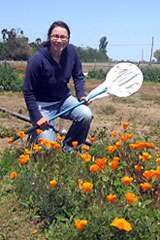
Katharina Ullmann is on a mission. "Where have all the flowers gone?" she asks.

Ullmann, a pollination ecologist seeking a master's degree in entomology at the University of California, Davis, wants to enhance floral resources for honey bees and native bees in agricultural landscapes.

"Pollinators play an important role in crop production and in maintaining wildflower populations," said Ullmann, who studies with major professor and native pollinator specialist Neal Williams. "However, habitat destruction and agricultural intensification has modified the floral resources available in agricultural landscapes. Ensuring that pollen and nectar resources are available throughout the year is important for both honey bees and wild native bees."

As part of her research, she and her colleagues from the Williams' lab are seasonally monitoring floral visitors and floral resources at three experimental sites in Yolo County and developing wildflower mixes that attract pollinators. She wants to know what native flowers are most visited by honey bees, pests and natural enemies; when they bloom, and what resources the flowers are providing.

The results will be submitted to peer-reviewed journals and made accessible to California and land managers.

"An estimated 30 percent of our global crop production is at least partially dependent on animal pollinators," said Ullmann. "The European honey bee (also called the Western honey bee) remains the most relied-upon crop pollinator. However, managed honey bees have declined by more than 50 percent since the 1950s.

"Supplemental plantings with native pollen and nectar-rich plants in agricultural areas may benefit honey bees by relieving floral resource scarcity and thus reducing bee nutritional stress at critical times of the season," she said. "However, floral resources may also attract pests."

Ullmann said that intensive agriculture "transforms complex, heterogeneous landscapes with nature mixtures of natural habitat and diverse cropping systems into simple, homogenous landscapes consisting of large monocultures and little natural habitat."

Floral resources used by bees do not persist throughout the flight season of most bees, particularly the , she said. "As a result, there are times in the year where few flowering plant species provide pollen and nectar. During these times, bees experience nutritional stress which beekeepers combat by supplementing colonies with artificial diets."

Ullmann and her colleagues are monitoring 18 native annual and perennial forb species. Forbs, herbaceous flowering plants, include clover, lupine and California poppies.

The pollination ecologist recently received three scholarships to fund her research: the George H. Vansell Scholarship for $4,435, the John S. Harbison Scholarship for $1000; and the Teledyne Entomology Fellowship for $1000.

A 2002 graduate of the University of St. Andrews, Scotland, Ullmann received her bachelor of science degree in environmental biology, with honors, and a minor in French, with honors. In 2001, she was involved in a six-month study program on the ecology and conservation of Madagascar.

Provided by University of California - Davis


Rank 4 /5 (1 vote)
Relevant PhysicsForums posts

More news stories

Thousands of shellfish found dead in Peru

Thousands of crustaceans were found dead off the coast of Lima following the mystery mass death of dolphins and pelicans, the Peruvian Navy said Friday.

Biology / Ecology

created 2 hours ago | popularity not rated yet | comments 0

Researchers solve structure of human protein critical for silencing genes

In a study published in the journal Cell on May 24, Cold Spring Harbor Laboratory (CSHL) scientists describe the three-dimensional atomic structure of a human protein bound to a piece of RNA that "guides" the pr ...

Biology / Cell & Microbiology

created 18 hours ago | popularity 4.7 / 5 (7) | comments 0 | with audio podcast

It's in the genes: Research pinpoints how plants know when to flower

Scientists believe they've pinpointed the last crucial piece of the 80-year-old puzzle of how plants "know" when to flower.

Biology / Biotechnology

created 17 hours ago | popularity 3.9 / 5 (8) | comments 1 | with audio podcast

Copy of the genetic makeup travels in a protein suitcase

Scientists from the Institute for Physical and Theoretical Chemistry at the University of Bonn have succeeded for the first time in the real time filming of the transport of an important information carrier in biological ...

Biology / Cell & Microbiology

created 23 hours ago | popularity not rated yet | comments 0 | with audio podcast

More plant species responding to global warming than previously thought

(Phys.org) -- Far more wild plant species may be responding to global warming than previous large-scale estimates have suggested.

Biology / Ecology

created May 22, 2012 | popularity 4.7 / 5 (13) | comments 16 | with audio podcast


SpotterRF debuts Radar Backpack Kit (w/ Video)

(Phys.org) -- SpotterRF has announced a special radar backpack kit designed to enhance situational awareness for soldiers on the ground. The company says its special radar is designed for warfighters as part ...

Family history of Alzheimer's affects functional connectivity

(HealthDay) -- Cognitively normal individuals with a family history of late-onset Alzheimer's disease (AD) may display lower resting state functional connectivity in the default mode network (DMN) of the brain, ...

Transvaginal mesh op restores pelvic organ prolapse at price

(HealthDay) -- Transvaginal mesh (TVM) procedures are effective for anatomical restoration of pelvic organ prolapse (POP), but patients report a worsening of sexual function following surgery, according to ...

Oldest Jewish archaeological evidence on the Iberian Peninsula

German archaeologists of the Friedrich Schiller University Jena found one of the oldest archaeological evidence so far of Jewish Culture on the Iberian Peninsula at an excavation site in the south of Portugal, ...

Travel to high altitudes tied to Crohn's, colitis flare-ups

(HealthDay) -- People with inflammatory bowel disease, which includes Crohn's disease and colitis, may be at increased risk for flare-ups when they fly or travel to high altitudes for skiing or mountain climbing, ...

Astronomers seize last chance in lifetime for Venus Transit

Astronomers are gearing for one the rarest events in the Solar System: an alignment of Earth, Venus and the Sun that will not be seen for another 105 years.