Supercomputing research opens doors for drug discovery
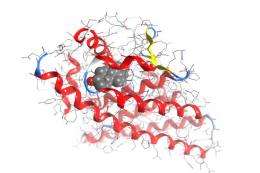
A quicker and cheaper technique to scan molecular databases developed at the Department of Energy's Oak Ridge National Laboratory could put scientists on the fast track to developing new drug treatments.
A team led by Jerome Baudry of the University of Tennessee-ORNL Center for Molecular Biophysics adapted a widely used existing software to allow supercomputers such as ORNL's Jaguar to sift through immense molecular databases and pinpoint chemical compounds as potential drug candidates.
The research was published in the Journal of Computational Chemistry as "Task-parallel MPI implementation of Autodock4 for docking of very large databases of compounds using High Performance Super-Computers."
"Our research is the missing link between supercomputers and the huge data available in molecular databases like the Human Genome Project," Baudry said. "We have an avalanche of data available to us, and now we need to translate that data into knowledge."
Such translation is critical for the first stages of drug development, in which researchers look for appropriate chemicals that interact with a target in the body, typically a protein. If the chemical is suitable, it attaches onto the protein and produces a desirable effect in the cell.
But with thousands of known proteins and millions of chemicals as potential drugs, the number of possible combinations is astronomical.
"It is very expensive and time-consuming to measure these interactions experimentally," Baudry said. "But with supercomputers, we can process millions of molecules a day."
The quick and efficient processing of molecules offers scientists an opportunity to take risks on previously unexamined drug candidates, which could lead to diverse and innovative classes of drugs.
"Before, we threw away a lot of information because molecules did not have a preferred profile," Baudry said. "Now, every molecule can be examined without worrying about wasting resources."
The researchers have already started work to launch the research into reality through a new collaboration supported by the National Institutes of Health. The project team plans to put the computational development to work on ORNL supercomputers to look for chemicals that could treat prostate cancer. The research is funded by a NIH Clinical Translational Science Award, which was awarded to Georgetown and Howard Universities and includes ORNL, Med/Star Health and the Washington D.C. Veterans Affairs Medical Center as key partners.
"Our development work is the computational equivalent of building the Saturn V rocket," Baudry said. "Now we want to fly it to the moon."
Provided by
Oak Ridge National Laboratory
-
From lemons to lemonade: Reaction uses carbon dioxide to make carbon-based semiconductor,
28 comments
-
Thioridazine kills cancer stem cells in human while avoiding toxic side-effects of conventional cancer treatments,
3 comments
-
SpaceX private rocket blasts off for space station (Update),
41 comments
-
Climate scientists say they have solved riddle of rising sea,
30 comments
-
Scotland passes turbine test to harness tidal power,
40 comments
-
Inversion temp
3 hours ago
-
High school chemistry EEI
10 hours ago
-
oxidation of I- by KMnO4
22 hours ago
-
Invesion temp
May 25, 2012
-
Hybridization of SnCl3 -
May 25, 2012
-
Electrons And Radiation
May 25, 2012
- More from Physics Forums - Chemistry
More news stories
High-speed method to aid search for solar energy storage catalysts
Eons ago, nature solved the problem of converting solar energy to fuels by inventing the process of photosynthesis.
16 hours ago |
5 / 5 (2) |
1
|
From lemons to lemonade: Reaction uses carbon dioxide to make carbon-based semiconductor
(Phys.org) -- A materials scientist at Michigan Technological University has discovered a chemical reaction that not only eats up the greenhouse gas carbon dioxide, it also creates something useful. And, by ...
May 21, 2012 |
4.7 / 5 (88) |
28
|
Researchers demonstrate possible primitive mechanism of chemical info self-replication
(Phys.org) -- When scientists think about the replication of information in chemistry, they usually have in mind something akin to what happens in living organisms when DNA gets copied: a double-stranded molecule ...
May 25, 2012 |
5 / 5 (4) |
2
|
New CO2-removing catalyst can take the heat
(Phys.org) -- The current method of removing the greenhouse gas carbon dioxide (CO2) from the flues of coal-fired power plants uses so much energy that no one bothers to use it. So says Roger Aines, principal ...
May 24, 2012 |
5 / 5 (7) |
7
|
Castor oil: Action mechanism of one of the oldest drugs known to man elucidated
Castor oil is known primarily as an effective laxative; however, it was also used in ancient times with pregnant women to induce labour. Only now have scientists at the Max Planck Institute for Heart and Lung ...
May 21, 2012 |
3 / 5 (2) |
3
|
SpotterRF debuts Radar Backpack Kit (w/ Video)
(Phys.org) -- SpotterRF has announced a special radar backpack kit designed to enhance situational awareness for soldiers on the ground. The company says its special radar is designed for warfighters as part ...
Astronauts enter world's 1st private supply ship
(AP) -- Space station astronauts floated into the Dragon on Saturday, a day after its heralded arrival as the world's first commercial supply ship.
Australia hails surprise super-telescope decision
Australia has hailed a surprise decision giving it a role in a radio telescope project aimed at revolutionising astronomy, vowing to draw on its decades of experience in space science.
SpaceX capsule has 'new car' smell, astronauts say
SpaceX's Dragon cargo vessel smells like a new car, said astronauts at the International Space Station after opening the hatches Saturday following the spacecraft's landmark mission to the orbiting lab.
Thousands of shellfish found dead in Peru
Thousands of crustaceans were found dead off the coast of Lima following the mystery mass death of dolphins and pelicans, the Peruvian Navy said Friday.
Astronomers seize last chance in lifetime for Venus Transit
Astronomers are gearing for one the rarest events in the Solar System: an alignment of Earth, Venus and the Sun that will not be seen for another 105 years.