New species of Pleistocene stork found on 'hobbit' island
December 8, 2010 by Lin Edwards report

Marabou Stork

Enlarge

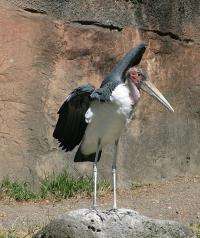
Marabou Stork (Leptoptilos crumeniferus) in the Oregon Zoo. Image: Wikipedia.

(PhysOrg.com) -- Fossils of a giant Pleistocene stork found on Flores island, Indonesia, belong to a new species according to scientists. The now extinct bird was probably flightless, and lived on the same island as Homo floresiensis, a small hominin species that has come to be nicknamed the "hobbit".

The fragments of were found by Dr. Hanneke Meijer of the Smithsonian National Museum of Natural History in Washington DC and her colleague Rokus Due of the National Center for Archaeology in Jakarta, Indonesia. Dr. Meijer is a paleontologist specializing in fossils of birds found on islands. The giant stork fossils were located in sediments dated at 20-50,000 years old in the Liang Bua cave in which H.floresiensis was found in 2004.

Dr. Meijer said bird fossils are distributed throughout the sediments found in the cave and and provide a unique opportunity to study how birds evolved in an insular environment, including their increasing size and loss of flight. Fossils of other giant species have also been found, including giant rats and lizards, but the island was also home to pygmy elephants as well as the hobbits.

Giant stork once roamed Indonesian island (AP)
Enlarge

In this undated sketch by Inge van Noortwijk and released by John Wiley & Sons, a six-foot (180 centimeters)-tall giant stork stands next to a dwarf Homo floresiensis that had lived on the remote island of Flores in Indonesia. According to the December 2010 issue of the Zoological Journal of the Linnean Society, fossils of the giant stork, which lived 20,000 to 50,000 years ago, have been discovered on the far-flung Indonesian island that has been home to many extreme-sized creatures, from tiny human-like "hobbits" and dwarf elephants to the world's largest-known rats and lizards. Picture: John Wiley & Sons, Inge van Noortwijk

The extinct marabou stork, Leptoptilos robustus, was around 1.8 meters long and weighed about 16 kg, which makes it larger than modern stork species. It was probably capable of preying on juvenile hobbits, since the adult hobbits were only about one meter tall, but there is no evidence that it did. Modern marabou storks feed mostly on carrion meat but they also eat small mammals, birds, fish and frogs.

Dr. Meijer said it is not unusual to find large birds on islands, especially if prey species are plentiful and mammalian predator species are scarce, but she said she had not expected to find a giant marabou stork on Flores. The size and weight of the bones suggest the stork was probably too heavy to fly, but it probably evolved from ancestors that flew to the isolated island and colonized it.

Dr. Meijer said the island has always been isolated from other islands in the region and has never been connected to the mainland. She said the isolation had played an important role in shaping the evolution of the fauna on the island.

It is not known why the giant and dwarf species on the island became extinct, but Dr. Meijer said all the fossils of the giant stork, the pygmy elephants and hobbits were found in sediments beneath a layer of volcanic ash, which suggests a volcanic eruption may have caused a major extinction in the region.

The findings, published in the Zoological Journal of the Linnean Society, help explain how wildlife in the Pleistocene adapted to island life.

More information: A new species of giant marabou stork (Aves: Ciconiiformes) from the Pleistocene of Liang Bua, Flores (Indonesia), Zoological Journal of the Linnean Society, 2010, 160, 707–724. DOI:10.1111/j.1096-3642.2010.00616.x

© 2010 PhysOrg.com


Rank 5 /5 (7 votes)
Relevant PhysicsForums posts

More news stories

Oldest Jewish archaeological evidence on the Iberian Peninsula

German archaeologists of the Friedrich Schiller University Jena found one of the oldest archaeological evidence so far of Jewish Culture on the Iberian Peninsula at an excavation site in the south of Portugal, ...

Other Sciences / Archaeology & Fossils

created 21 hours ago | popularity 4.3 / 5 (4) | comments 12

Math predicts size of clot-forming cells

UC Davis mathematicians have helped biologists figure out why platelets, the cells that form blood clots, are the size and shape that they are. Because platelets are important both for healing wounds and in strokes and other ...

Other Sciences / Mathematics

created 18 hours ago | popularity not rated yet | comments 0 | with audio podcast

Social welfare cuts ultimately come with heavy price, researchers say

(Phys.org) -- Slashing government funding for Medicaid, food stamps and other programs that serve the poor – while politically popular with some lawmakers and many conservatives – may do more harm ...

Other Sciences / Social Sciences

created May 24, 2012 | popularity 4.3 / 5 (11) | comments 79

Ancient Bethlehem seal unearthed in Jerusalem

Israeli archaeologists have discovered a 2,700-year-old seal that bears the inscription "Bethlehem," the Israel Antiquities Authority announced Wednesday, in what experts believe to be the oldest artifact ...

Other Sciences / Archaeology & Fossils

created May 23, 2012 | popularity 3.5 / 5 (13) | comments 22

Dollars and sense: Why are some people morally against tax?

As the U.S. presidential election campaigns heat up, the economic debate is dominated by bailouts, austerity and, inevitably, taxation. Now a new study published in Symbolic Interaction asks why tax is such an important issue ...

Other Sciences / Social Sciences

created May 23, 2012 | popularity 3 / 5 (2) | comments 12


SpotterRF debuts Radar Backpack Kit (w/ Video)

(Phys.org) -- SpotterRF has announced a special radar backpack kit designed to enhance situational awareness for soldiers on the ground. The company says its special radar is designed for warfighters as part ...

Astronauts enter world's 1st private supply ship

(AP) -- Space station astronauts floated into the Dragon on Saturday, a day after its heralded arrival as the world's first commercial supply ship.

Australia hails surprise super-telescope decision

Australia has hailed a surprise decision giving it a role in a radio telescope project aimed at revolutionising astronomy, vowing to draw on its decades of experience in space science.

SpaceX capsule has 'new car' smell, astronauts say

SpaceX's Dragon cargo vessel smells like a new car, said astronauts at the International Space Station after opening the hatches Saturday following the spacecraft's landmark mission to the orbiting lab.

Thousands of shellfish found dead in Peru

Thousands of crustaceans were found dead off the coast of Lima following the mystery mass death of dolphins and pelicans, the Peruvian Navy said Friday.

Astronomers seize last chance in lifetime for Venus Transit

Astronomers are gearing for one the rarest events in the Solar System: an alignment of Earth, Venus and the Sun that will not be seen for another 105 years.