No more solar wind for Voyager 1 spacecraft
December 13, 2010

Voyager spacecraft

Enlarge

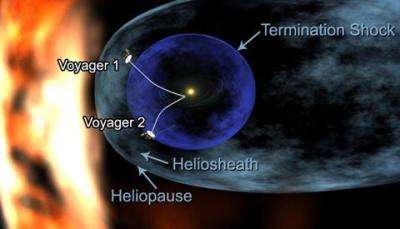
Artist concept of the two Voyager spacecraft as they approach interstellar space. Image credit: NASA/JPL

(PhysOrg.com) -- The 33-year odyssey of NASA's Voyager 1 spacecraft has reached a distant point at the edge of our solar system where there is no outward motion of solar wind.

Now hurtling toward some 10.8 billion miles from the sun, Voyager 1 has crossed into an area where the velocity of the hot ionized gas, or plasma, emanating directly outward from the sun has slowed to zero. Scientists suspect the has been turned sideways by the pressure from the interstellar wind in the region between stars.

The event is a major milestone in Voyager 1's passage through the heliosheath, the turbulent outer shell of the sun's sphere of influence, and the spacecraft's upcoming departure from our solar system.

"The solar wind has turned the corner," said Ed Stone, Voyager project scientist based at the California Institute of Technology in Pasadena, Calif. "Voyager 1 is getting close to interstellar space."

Our sun gives off a stream of charged particles that form a bubble known as the around our . The solar wind travels at until it crosses a shockwave called the termination shock. At this point, the solar wind dramatically slows down and heats up in the heliosheath.

Launched on Sept. 5, 1977, Voyager 1 crossed the in December 2004 into the heliosheath. Scientists have used data from Voyager 1's Low-Energy Charged Particle Instrument to deduce the solar wind's velocity.

When the speed of the charged particles hitting the outward face of Voyager 1 matched the spacecraft's speed, researchers knew that the net outward speed of the solar wind was zero. This occurred in June, when Voyager 1 was about 10.6 billion miles from the sun.

Because the velocities can fluctuate, scientists watched four more monthly readings before they were convinced the solar wind's outward speed actually had slowed to zero. Analysis of the data shows the velocity of the solar wind has steadily slowed at a rate of about 45,000 mph each year since August 2007, when the solar wind was speeding outward at about 130,000 mph. The outward speed has remained at zero since June.

The results were presented at the American Geophysical Union meeting in San Francisco.

"When I realized that we were getting solid zeroes, I was amazed," said Rob Decker, a Voyager Low-Energy Charged Particle Instrument co-investigator and senior staff scientist at the Johns Hopkins University Applied Physics Laboratory in Laurel, Md. "Here was Voyager, a spacecraft that has been a workhorse for 33 years, showing us something completely new again."

Scientists believe Voyager 1 has not crossed the heliosheath into interstellar space. Crossing into interstellar space would mean a sudden drop in the density of hot particles and an increase in the density of cold particles. Scientists are putting the data into their models of the heliosphere's structure and should be able to better estimate when Voyager 1 will reach interstellar space. Researchers currently estimate Voyager 1 will cross that frontier in about four years.

"In science, there is nothing like a reality check to shake things up, and Voyager 1 provided that with hard facts," said Tom Krimigis, principal investigator on the Low-Energy Charged Particle Instrument, who is based at the Applied Physics Laboratory and the Academy of Athens, Greece. "Once again, we face the predicament of redoing our models."

A sister spacecraft, Voyager 2, was launched in Aug. 20, 1977 and has reached a position 8.8 billion miles from the sun. Both spacecraft have been traveling along different trajectories and at different speeds. Voyager 1 is traveling faster, at a speed of about 38,000 mph, compared to Voyager 2's velocity of 35,000 mph. In the next few years, scientists expect Voyager 2 to encounter the same kind of phenomenon as Voyager 1.

Provided by JPL/NASA search and more info website

4.9 /5 (48 votes)  

Filter


Move the slider to adjust rank threshold, so that you can hide some of the comments.


Display comments: newest first

Quantum_Conundrum
Dec 13, 2010

Rank: 2.2 / 5 (6)
Imagine how powerful an observatory would be out there about the same distance, or maybe slightly farther, with no interference. Like one telescope in each of the major spectra per space craft, and send one out in both directions alng each of three axis. You could do some incredible inter-stellar and inter-galactic astronomy.
ihatelolcats
Dec 13, 2010

Rank: 5 / 5 (4)
Imagine how powerful an observatory would be out there about the same distance, or maybe slightly farther, with no interference. Like one telescope in each of the major spectra per space craft, and send one out in both directions alng each of three axis. You could do some incredible inter-stellar and inter-galactic astronomy.


i think the data transmission rate is too low at that distance to be viable
i dont think there would be much of an advantage over even the hubble either
Terrible_Bohr
Dec 13, 2010

Rank: 5 / 5 (2)
"Once again, we face the predicament of redoing our models."

Why?

I didn't see what information overturned which assumption about space. Did I overlook something in this article?
rwinners
Dec 13, 2010

Rank: 2.3 / 5 (3)
Well, if the solar wind is being measured by its impact.. or lack of it on Voyager, then the speed is actually the same as Voyager's. Not zero, but 38k mph. And even as Voyager enters 'intersolar' space, there will be a meshing of the winds, those outward bound and those inward. Of course wind is a earth centric word. I wonder just how many particles per square centimeter are in the space around Voyager right now.
LivaN
Dec 14, 2010

Rank: 1 / 5 (2)
Imagine how powerful an observatory would be out there about the same distance, or maybe slightly farther, with no interference. Like one telescope in each of the major spectra per space craft, and send one out in both directions alng each of three axis. You could do some incredible inter-stellar and inter-galactic astronomy.


i think the data transmission rate is too low at that distance to be viable
i dont think there would be much of an advantage over even the hubble either


I don't think the transmission rate is that much of a concern. Sure it may take a day or so to receive data, but the quality could be extraordinary. Only downfall is maintenance...how long did it take voyager to get to that distance?
Mercury_01
Dec 14, 2010

Rank: 4.8 / 5 (6)
This floors me. I cant wait till one of our craft actually leaves the system. And it still works! Awesome.
plasticpower
Dec 14, 2010

Rank: 4.9 / 5 (16)
Voyager crafts are amazing pieces of human engineering. 33 years later and they still work. That's saying a lot, considering the space age isn't much older than the spacecraft themselves. Imagine the kinds of probes we could create today, if only our governments still cared about space exploration..
Skepticus_Rex
Dec 14, 2010

Rank: 2.7 / 5 (7)
Forget probes...let's get out there and see things with our own eyes.

Probes are cool when they work as expected and even beyond expectations but we also should be working on technologies that will allow for something like that.
kaasinees
Dec 14, 2010

Rank: 5 / 5 (1)
@Skepticus Rex
Not much of a skepticus are you? Why dont you volentuur for this suicide mission?
/@

I say make high-tech probes. Who knows what kind of mineral deposits we can discover close by with these probes. Then we can send miners there and gain alot, maybe enough to create advanced alloys for spaceships.
We could also send particle accelators in to space to create uranium or other nuclear fuels from solar power.
edit: That gave me an idea; particle accelerators in probes, so they can create gasic fuels for manouvering, it would expand their life time by alot.
Quantum_Conundrum
Dec 14, 2010

Rank: 1.5 / 5 (2)
I don't think the transmission rate is that much of a concern. Sure it may take a day or so to receive data, but the quality could be extraordinary. Only downfall is maintenance...how long did it take voyager to get to that distance?


It took 33 years. However, some of the next generation prototype rocket engines currently in development by the ESA and NASA are going to be capable of propelling a space craft to the same distance in about 1/5th the time, and that's without gravity assist.

I don't know how long it will be before we see the first outer solar system or interstellar probes with these new technologies, but even if they weren't launched for another 10 years, they would still be able to completely over-take the voyagers within 9 years.

So if you launched today, they'd overtake voyager 1 in 6.5 years (2017). If you launched ten years from now, they'd overtake voyager 1 in 2030.
danman5000
Dec 14, 2010

Rank: 5 / 5 (5)
Well, if the solar wind is being measured by its impact.. or lack of it on Voyager, then the speed is actually the same as Voyager's. Not zero, but 38k mph.

From the article:
When the speed of the charged particles hitting the outward face of Voyager 1 matched the spacecraft's speed, researchers knew that the net outward speed of the solar wind was zero.

If the measured speed of the particles hitting the front of Voyager equals the known speed of the spacecraft, that means Voyager is "running into" the relatively stationary particles. So the speed of the particles actually is zero.
danman5000
Dec 14, 2010

Rank: not rated yet
So the speed of the particles actually is zero.

Well, zero-ish. Unless they are at absolute zero, they'll always have a little thermal movement. Also they say "net outward speed," which to me suggests that while their distance from the Sun doesn't change by much, they still probably have some velocity in other directions (sort of like they are orbiting the Sun at a constant distance).
El_Nose
Dec 14, 2010

Rank: not rated yet
Imagine how powerful an observatory would be out there about the same distance, or maybe slightly farther, with no interference. Like one telescope in each of the major spectra per space craft, and send one out in both directions alng each of three axis. You could do some incredible inter-stellar and inter-galactic astronomy.


We could build a craft to get out that far -- and we could get it to stop so that it could take good pictures of the universe -- the issue is IMHO energy. the Voyager craft are nuclear powered with a limited amount of energy - there is themocouple degredation as well as fuel decay. --

I am just saying that an obervatory takes a good bit of power -- Hubble's solar cells produce 2800W of electricity - no clue on Whrs in a day but lets assume thats constant -- Voyager on the ofter hand produces less than 320W on nuclear power.
Sanescience
Dec 14, 2010

Rank: 5 / 5 (2)
To people who think you have to get out of the solar system to take good pictures, permanent shadowed craters of the moon should work pretty darn good in the mean time.
Quantum_Conundrum
Dec 14, 2010

Rank: not rated yet
To people who think you have to get out of the solar system to take good pictures, permanent shadowed craters of the moon should work pretty darn good in the mean time.


Well, I think we should do some of both, eventually.

Observatories on the far side of the moon would be in total darkness for 14 days at a time, and would have the added benefit of being shielded from all normal earth communications. They could use solar panels to charge capacitors or batteries for power during the 14 days in the sun, to be used during the dark phase.
Sanescience
Dec 14, 2010

Rank: 3 / 5 (2)
To people who think we should put humans in deep space... not likely for quite a while. Nor should we. The human body as it is now is wholly unsuited (pun not intended) to venture into a radioactive toxic wasteland of extreme temperatures and pressure differentials.
Skepticus_Rex
Dec 14, 2010

Rank: 1 / 5 (1)
@Skepticus Rex
Not much of a skepticus are you? Why dont you volentuur for this suicide mission?
/@

I say make high-tech probes. Who knows what kind of mineral deposits we can discover close by with these probes. Then we can send miners there and gain alot, maybe enough to create advanced alloys for spaceships.
...edit: That gave me an idea; particle accelerators in probes, so they can create gasic fuels for manouvering, it would expand their life time by alot.


That is exactly why I said above that we should be working toward technlogies that would make that happen. We are incapable of doing it now. If we spend all the money building probes and not developing technology, where will we go? Nowhere!

As to probes with particle accelerators... You are aware of how large they are, aren't you?

And, I've already volunteered. I have an email from NASA sitting in front of me requesting a proposal for a rather dangerous mission involving me. No, I cannot give details.
Bog_Mire
Dec 14, 2010

Rank: 5 / 5 (1)
*sigh* OK SR, does it involve a rogue asteroid, a drill ship, nuclear warheads, and a shaved monkey called Bruce?
Skepticus_Rex
Dec 14, 2010

Rank: not rated yet
I can say that it does not involve asteroids. I also can say that it does not involve a drill ship, nuclear warheads or monkeys.

Sorry, but I cannot say more. You can sigh all you want but I have the email sitting right in front of me. Whether you believe it or not is irrelevant.

And, no, I do not have to prove anything to you or to anyone else. Mine is just to write the proposal in one of the two formats required, submit it for consideration and wait for the answer at the end of all the red tape.

I will not leak information. Look elsewhere because it isn't coming from me. If the proposal is accepted and the planning stage begins, I am sure you can read about it in the newspaper should it be deemed appropriate for public consumption.
Bog_Mire
Dec 15, 2010

Rank: not rated yet
wellll, doesn't sound particularly dangerous for you, but good luck!
stealthc
Dec 15, 2010

Rank: 1 / 5 (1)
Voyager crafts are amazing pieces of human engineering. 33 years later and they still work. That's saying a lot, considering the space age isn't much older than the spacecraft themselves. Imagine the kinds of probes we could create today, if only our governments still cared about space exploration..


That was before china started making integral components of our missiles and space craft for us, I bet you voyager wouldn't have lasted even 10 years if it were built nowadays.
stealthc
Dec 15, 2010

Rank: 5 / 5 (1)
I can say that it does not involve asteroids. I also can say that it does not involve a drill ship, nuclear warheads or monkeys.

Sorry, but I cannot say more. You can sigh all you want but I have the email sitting right in front of me. Whether you believe it or not is irrelevant.

And, no, I do not have to prove anything to you or to anyone else. Mine is just to write the proposal in one of the two formats required, submit it for consideration and wait for the answer at the end of all the red tape.

I will not leak information. Look elsewhere because it isn't coming from me. If the proposal is accepted and the planning stage begins, I am sure you can read about it in the newspaper should it be deemed appropriate for public consumption.


You forget to take your medication today? There's an article somewhere around here about how lithium is good for you and should be fed to the general masses to lower suicidality rates... take your lithium it is good for you, nasa likes you.
Skepticus_Rex
Dec 15, 2010

Rank: 1 / 5 (1)
Yeah, yeah, blah, blah, blah, whatever you say...

If I had to take lithium any proposed mission involving me would be scrubbed without a second thought. Nice try, though.

Thing is, I have the email sitting here in front of me. You do not. Just because you cannot see what is on my desk, do not assume that the email does not exist.

But, if it made you feel better about yourself to act as you have, I suppose it is so much the better. :)
Mira_Musiclab
Dec 16, 2010

Rank: not rated yet
Take your protein pills, and put your helmet on...
Skeptic_Heretic
Dec 16, 2010

Rank: not rated yet
@Skepticus Rex
Not much of a skepticus are you? Why dont you volentuur for this suicide mission?
I'd gladly voluteer to be the first man to leave the solar system regardless of whether I died or not. Just imagine what you could see without local interference.
SteveL
Dec 16, 2010

Rank: 5 / 5 (1)
@Skepticus Rex
Not much of a skepticus are you? Why dont you volentuur for this suicide mission?
I'd gladly voluteer to be the first man to leave the solar system regardless of whether I died or not. Just imagine what you could see without local interference.


Me also. I've had my kids. Biologically my job is done, and we are all going to die anyhow, so why not achieve something with what's left to us?
CHollman82
Dec 17, 2010

Rank: 5 / 5 (1)
I found it interesting that the picture at the top of the article is from the wikipedia heliosphere page... at the bottom... in the section labeled "outdated models"

http://en.wikiped...iosphere
GSwift7
Dec 17, 2010

Rank: 3 / 5 (2)
Transcript from the final radio messages received from intrepid explorers Skeptic Heretic and SteveL, just days after the launch of their scheduled 30 year voyage to the edge of our solar system. Little is know about the fate of the astronauts:

"Ground control, this is Skeptic, we are having a problem with the audio system in the spacecraft.

Ground control here, can you describe the problem?

SteveL here, It sounds a lot like the Macarena, playing over and over. Can you make it stop?

(after a long pause)

Ground control here, I have some bad news for you, guys."
Kikora
Dec 19, 2010

Rank: not rated yet
Nice! Now to wait 4 years later! Cheers
MorituriMax
Dec 19, 2010

Rank: 1 / 5 (1)
Skepticus Rex,
And, I've already volunteered. I have an email from NASA sitting in front of me requesting a proposal for a rather dangerous mission involving me. No, I cannot give details.

Thing is, I have the email sitting here in front of me. You do not. Just because you cannot see what is on my desk, do not assume that the email does not exist.

I will not leak information.


Pretty free with information for someone who does not leak information, Letter, NASA, you're posting all this after mentioning sending something out into deep space. Good job not leaking anything.
Skepticus_Rex
Dec 19, 2010

Rank: not rated yet
Nothing has been leaked. You just think something has been leaked because you are trying to read between the lines.

By the way, if the email had said 'classified' (or anything like it) the existence of the email never would have been mentioned at all.
Uncle_Bex
Dec 19, 2010

Rank: not rated yet
We could build a craft to get out that far -- and we could get it to stop so that it could take good pictures of the universe -- the issue is IMHO energy. the Voyager craft are nuclear powered with a limited amount of energy - there is themocouple degredation as well as fuel decay. --

I am just saying that an obervatory takes a good bit of power -- Hubble's solar cells produce 2800W of electricity - no clue on Whrs in a day but lets assume thats constant -- Voyager on the ofter hand produces less than 320W on nuclear power.


Not to mention the trouble with maintenance on something like Hubble as compared to Voyager 1 (which is much less complicated). Observatories seem to have a much shorter shelf-life compared to something like Voyager, if only because there is so much more which can go wrong. Although every penny and maintenance mission to restore and upgrade Hubble has been more than worth it.
BillFox
Dec 20, 2010

Rank: not rated yet
If only people could even realize the baiting and jokery lol.
Rank 4.9 /5 (48 votes)
Relevant PhysicsForums posts
  • revamping general concept and cosmological principle
    created19 hours ago
  • Transiting Exoplanet Light Curve
    createdMay 25, 2012
  • Math behind Theoretical Physics
    createdMay 24, 2012
  • Do we know whats at the center of galaxies yet?
    createdMay 23, 2012
  • Structure of the Milky Way?
    createdMay 20, 2012
  • What would it take to terraform Pluto and Charon?
    createdMay 19, 2012
  • More from Physics Forums - General Astronomy

More news stories

Astronauts enter world's 1st private supply ship

(AP) -- Space station astronauts floated into the Dragon on Saturday, a day after its heralded arrival as the world's first commercial supply ship.

Space & Earth / Space Exploration

created 50 minutes ago | popularity 5 / 5 (1) | comments 0

Australia hails surprise super-telescope decision

Australia has hailed a surprise decision giving it a role in a radio telescope project aimed at revolutionising astronomy, vowing to draw on its decades of experience in space science.

Space & Earth / Astronomy

created 48 minutes ago | popularity not rated yet | comments 0

SpaceX capsule has 'new car' smell, astronauts say

SpaceX's Dragon cargo vessel smells like a new car, said astronauts at the International Space Station after opening the hatches Saturday following the spacecraft's landmark mission to the orbiting lab.

Space & Earth / Space Exploration

created 48 minutes ago | popularity not rated yet | comments 0

Astronomers seize last chance in lifetime for Venus Transit

Astronomers are gearing for one the rarest events in the Solar System: an alignment of Earth, Venus and the Sun that will not be seen for another 105 years.

Space & Earth / Astronomy

created 45 minutes ago | popularity 5 / 5 (1) | comments 0

Dragon arrives at space station in historic 1st (Update 2)

The privately bankrolled Dragon capsule made a historic arrival at the International Space Station on Friday, triumphantly captured by astronauts wielding a giant robot arm.

Space & Earth / Space Exploration

created 22 hours ago | popularity 5 / 5 (8) | comments 16


SpotterRF debuts Radar Backpack Kit (w/ Video)

(Phys.org) -- SpotterRF has announced a special radar backpack kit designed to enhance situational awareness for soldiers on the ground. The company says its special radar is designed for warfighters as part ...

Thousands of shellfish found dead in Peru

Thousands of crustaceans were found dead off the coast of Lima following the mystery mass death of dolphins and pelicans, the Peruvian Navy said Friday.

Travel to high altitudes tied to Crohn's, colitis flare-ups

(HealthDay) -- People with inflammatory bowel disease, which includes Crohn's disease and colitis, may be at increased risk for flare-ups when they fly or travel to high altitudes for skiing or mountain climbing, ...

Transvaginal mesh op restores pelvic organ prolapse at price

(HealthDay) -- Transvaginal mesh (TVM) procedures are effective for anatomical restoration of pelvic organ prolapse (POP), but patients report a worsening of sexual function following surgery, according to ...

Oldest Jewish archaeological evidence on the Iberian Peninsula

German archaeologists of the Friedrich Schiller University Jena found one of the oldest archaeological evidence so far of Jewish Culture on the Iberian Peninsula at an excavation site in the south of Portugal, ...

MIT researchers devise new means to synchronize a group of robots (w/ Video)

(Phys.org) -- For several years, roboticists have been working out ways to get a group of robots to perform synchronized activities as demonstrated most often in dance routines. It’s not just about trying ...