Sleepless honey bees miscommunicate, too, research shows
December 13, 2010

Sleepless honey bees miscommunicate, too, research at the University of Texas at Austin shows

Enlarge

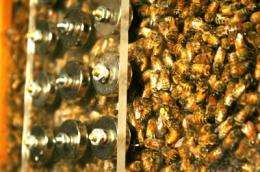
To deprive honey bees of sleep, Dr. Barrett Klein used a magnetic contraption called the "insominator" (on the left). Sleeping bees affixed with a small piece of metal were jostled awake when the insominator passed over them. Klein found that sleeplessness led to poor signaling by foraging bees about the location of food sources. Credit: Dr. Barrett Klein, pupating.org.

In the busy world of a honey bee hive, worker bees need their rest in order to best communicate the location of food to their hive mates, research from The University of Texas at Austin shows.

"When deprived of sleep, humans typically experience a diminished ability to perform a variety of tasks, including communicating as clearly or as precisely," said Dr. Barrett Klein, a former ecology, evolution and behavior graduate student at the university. "We found that sleep-deprived honey bees also experienced communication problems. They advertised the direction to a food site less precisely to their fellow bees."

For humans, imprecise communication can reduce efficiency, cost money, and in some cases, cost lives. For honey bees, Klein says it could affect their success in locating food, which could lead to a less competitive colony.

"While the importance of sleep has been studied in Drosophila flies for several years," said Dr. Ulrich Mueller, professor of biology and study coauthor, "Barrett's study is the first to address the function of sleep in a social insect in the context of its society, and the first to show that sleep deprivation impairs precision of communication in an insect."

This video is not supported by your browser at this time.

This movie spotlights one waggle dance by a forager that had been sleep-deprived the previous night. The average dance angle of this dance is superimposed over the dancer and variance around this angle indicates imprecision of signaling direction information. Credit: Dr. Barrett Klein. Pupating.org.

The research was published in PNAS Early Edition this week.

There are various ways to poke and prod humans to force them to stay awake prior to measuring the effects of sleep deprivation. But how to make bees in a hive lose sleep?

Klein invented a magnetic machine aptly named the "insominator," a contraption he passed over quietly resting bees during the night to deprive them of sleep. The bees, outfitted with small metallic backpacks, were jostled into activity by magnets in the insominator, and this was repeated over the course of normal time.

Barrett then recorded the behaviors of the sleepless bees and discovered they weren't able to communicate as well the direction of nectar-filled flower patches to their sisters through their usual waggle dance.

"The dance was not necessarily wrong, but it was less precise than dances performed by bees that were not sleep-deprived," says Klein. "We expect that a less precise dance would lead to fewer followers making it to the food source, and we hope to test this in the future."

Provided by University of Texas at Austin search and more info website

4.5 /5 (2 votes)  

Filter


Move the slider to adjust rank threshold, so that you can hide some of the comments.


Display comments: newest first

gmurphy
Dec 13, 2010

Rank: not rated yet
the video is good, once you know how to spot the "dancers", you can see them in all areas of the frame, pointing towards sweet nectar :)
Rank 4.5 /5 (2 votes)
Relevant PhysicsForums posts

More news stories

Thousands of shellfish found dead in Peru

Thousands of crustaceans were found dead off the coast of Lima following the mystery mass death of dolphins and pelicans, the Peruvian Navy said Friday.

Biology / Ecology

created 17 minutes ago | popularity not rated yet | comments 0

Researchers solve structure of human protein critical for silencing genes

In a study published in the journal Cell on May 24, Cold Spring Harbor Laboratory (CSHL) scientists describe the three-dimensional atomic structure of a human protein bound to a piece of RNA that "guides" the pr ...

Biology / Cell & Microbiology

created 15 hours ago | popularity 4.7 / 5 (6) | comments 0 | with audio podcast

It's in the genes: Research pinpoints how plants know when to flower

Scientists believe they've pinpointed the last crucial piece of the 80-year-old puzzle of how plants "know" when to flower.

Biology / Biotechnology

created 15 hours ago | popularity 4 / 5 (5) | comments 1 | with audio podcast

Copy of the genetic makeup travels in a protein suitcase

Scientists from the Institute for Physical and Theoretical Chemistry at the University of Bonn have succeeded for the first time in the real time filming of the transport of an important information carrier in biological ...

Biology / Cell & Microbiology

created 21 hours ago | popularity not rated yet | comments 0 | with audio podcast

'Transformer' protein makes different sized transport pods

These spheres may look almost identical, but subtle differences between them revealed a molecular version of the robots from Transformers. Each sphere is a vesicle, a pod that cells use to transport materials ...

Biology / Cell & Microbiology

created 21 hours ago | popularity not rated yet | comments 0


SpotterRF debuts Radar Backpack Kit (w/ Video)

(Phys.org) -- SpotterRF has announced a special radar backpack kit designed to enhance situational awareness for soldiers on the ground. The company says its special radar is designed for warfighters as part ...

Astronauts enter world's 1st private supply ship

(AP) -- Space station astronauts floated into the Dragon on Saturday, a day after its heralded arrival as the world's first commercial supply ship.

Australia hails surprise super-telescope decision

Australia has hailed a surprise decision giving it a role in a radio telescope project aimed at revolutionising astronomy, vowing to draw on its decades of experience in space science.

SpaceX capsule has 'new car' smell, astronauts say

SpaceX's Dragon cargo vessel smells like a new car, said astronauts at the International Space Station after opening the hatches Saturday following the spacecraft's landmark mission to the orbiting lab.

Astronomers seize last chance in lifetime for Venus Transit

Astronomers are gearing for one the rarest events in the Solar System: an alignment of Earth, Venus and the Sun that will not be seen for another 105 years.

Travel to high altitudes tied to Crohn's, colitis flare-ups

(HealthDay) -- People with inflammatory bowel disease, which includes Crohn's disease and colitis, may be at increased risk for flare-ups when they fly or travel to high altitudes for skiing or mountain climbing, ...