SARTRE car platoon road tests to begin (w/ Video)
December 10, 2010 by Lin Edwards
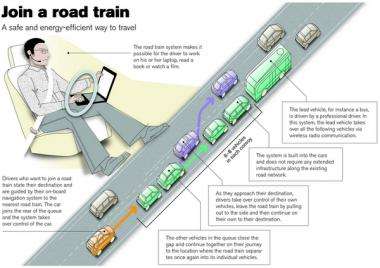
(PhysOrg.com) -- The Safe Road Trains for the Environment (SARTRE) project in Europe aims to develop a wireless system that will allow cars on a public highway or motorway to join in a platoon, or semi-autonomous road train of vehicles with a professional driver in a single vehicle (such as a bus or truck) at the front driving for all vehicles in the platoon. The project will reach a major milestone of its first on-road tests before the end of this year.
The SARTRE system, described earlier in PhysOrg when the project began, will proceed to road tests of a leading vehicle and one following vehicle before the end of December. The required hardware will be installed into the two vehicles, including communications equipment and sensors. The required software integration has already begun. The road tests are intended to validate the sensors, actuators and control system in the two-vehicle platoon.
This video is not supported by your browser at this time.
The three-year project aims to provide improvements in traffic flow, faster journey times and savings in fuel consumption while allowing drivers to relax and arrive at their destinations with less stress, which it is hoped will also reduce the number of traffic accidents. It will operate on ordinary, unmodified public highways on which other vehicles are traveling.Drivers will be free to join and leave the single-file platoon at any point, but while in the platoon their car will be driven for them. Once the vehicle joins the platoon a computer will take over steering, braking and acceleration, allowing the driver to carry out other activities that would normally be too dangerous, such as reading a book, watching TV, operating a phone or computer, or eating breakfast. The lead vehicle of the platoon will follow a set route and speed.
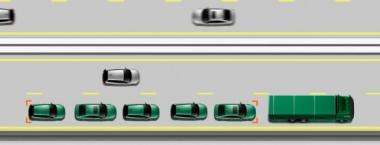
The first year of the project concentrated on refining the concept and investigating the most feasible means of creating a platooning system. Realistic simulations have also been carried out at Tecnalia in Bilbao, Spain, to gauge the reactions of a wide variety of drivers to being placed in a platoon in which they travel at high speed close behind another vehicle but without controlling their vehicle themselves. The simulator also monitored the reactions of drivers who were not part of the platoon, but were driving in the same environment.
In 2011 and 2012 the group aims to demonstrate the system with a five-vehicle convoy as a final goal of the project.
The SARTRE project is being funded by the European Commission under its Framework 7 program, and is being developed by seven companies, including Ricardo UK Ltd, Volvo Technology in Sweden, and Robotiker-Tecnalia in Spain. It is likely to be another decade before the system is fully operational.
More information: http://www.sartre- … default.aspx
© 2010 PhysOrg.com
-
From lemons to lemonade: Reaction uses carbon dioxide to make carbon-based semiconductor,
28 comments
-
Thioridazine kills cancer stem cells in human while avoiding toxic side-effects of conventional cancer treatments,
3 comments
-
SpaceX private rocket blasts off for space station (Update),
41 comments
-
Climate scientists say they have solved riddle of rising sea,
30 comments
-
Scotland passes turbine test to harness tidal power,
40 comments
-
magnets or EMF in car bumpers to protect from fender bender
2 hours ago
-
length of wire in a coil of known dimensions?
19 hours ago
-
India Engineering Powerhouse
May 25, 2012
-
electromagnet core dereference between hard and soft iron
May 25, 2012
-
Measuring water pressure in an open tank
May 24, 2012
-
Question from a non-engineer: Pulley Systems
May 24, 2012
- More from Physics Forums - General Engineering
More news stories
Everyone knows it's windy . . .
... And now they have the data to prove it. The middle of Lake Michigan is a vast, untapped reservoir of wind energy. The next step will be to find out if it can be harvested economically without harming ...
Technology / Energy & Green Tech
23 hours ago |
not rated yet |
3
Apple CEO Cook gives up $75M in stock dividends
(AP) -- Apple CEO Tim Cook is giving up $75 million in dividends on restricted stock that the company is awarding to all of its employees.
20 hours ago |
1.8 / 5 (4) |
2
Yahoo kills 'Livestand' just 6 months after debut
(AP) -- Yahoo is killing a tablet magazine called Livestand just six months its debut on the iPad.
14 hours ago |
not rated yet |
1
Yahoo! ditches digital newsstand for iPads
Yahoo! shuttered its fledgling digital newsstand for iPads on Friday in what it said was the start of a product purge intended to make the floundering Internet pioneer more nimble.
15 hours ago |
not rated yet |
0
Facebook IPO debacle raises investor dander
The spate of complaints and investigations over the Facebook stock offering suggests big institutions had an edge over small investors, raising questions about the process.
16 hours ago |
not rated yet |
0
Landmark calculation clears the way to answering how matter is formed
(Phys.org) -- An international collaboration of scientists, including Thomas Blum, associate professor of physics, is reporting in landmark detail the decay process of a subatomic particle called a kaon ...
Dragon arrives at space station in historic 1st (Update 2)
The privately bankrolled Dragon capsule made a historic arrival at the International Space Station on Friday, triumphantly captured by astronauts wielding a giant robot arm.
Of mice and mental models: Neuroscientific implications of risk-optimized behavior in the mouse
(Medical Xpress) -- Regardless of an organism’s biological complexity, every encephalized animal continuously makes under-informed behavioral choices that can have serious consequences. Despite its ubiquity, ...
Aliens don't want to eat us, says former SETI director
Alien life probably isnt interested in having us for dinner, enslaving us or laying eggs in our bellies, according to a recent statement by former SETI director Jill Tarter.
Researchers demonstrate possible primitive mechanism of chemical info self-replication
(Phys.org) -- When scientists think about the replication of information in chemistry, they usually have in mind something akin to what happens in living organisms when DNA gets copied: a double-stranded molecule ...
Oldest Jewish archaeological evidence on the Iberian Peninsula
German archaeologists of the Friedrich Schiller University Jena found one of the oldest archaeological evidence so far of Jewish Culture on the Iberian Peninsula at an excavation site in the south of Portugal, ...

Dec 10, 2010
Rank: 5 / 5 (1)
As things stand, even if it was 100% confirmed that cars could drive themselves, I still don't think people would want that happening.
Dec 10, 2010
Rank: 5 / 5 (1)
Dec 10, 2010
Rank: 4 / 5 (2)
Dec 10, 2010
Rank: 4 / 5 (4)
Dec 10, 2010
Rank: not rated yet
Dec 10, 2010
Rank: 2 / 5 (2)
Dec 10, 2010
Rank: 5 / 5 (3)
Of course you realize that if all cars were automated the computer would automatically "sort" the cars based on their destination and when they are expected to arrive at the relevant on/off ramps, thus causing cars to change lanes as needed,giving space to one another as needed, in an almost ideal fashion.
If everyone had automated cars, you would never need worry about any of the problems you mentioned. That's actually the point.
Dec 10, 2010
Rank: 5 / 5 (1)
The other thing is that having a truck in front is both illegal on 3-lane motorways, and bloody slow - the road train needs to be at 85-100mph to avoid being undertaken (also illegal in EU).
fantastic idea though, bring it on..
Dec 10, 2010
Rank: not rated yet
What happens if one of the platoon cars suffers some form of failure such as a blown tire or even a wheel coming off the bearing... is this system going to be able to safely respond to that with each car only inches from the next at high speed?
I don't know about Europe, but where I am from we have ice and snow covering the roads 4-5 months a year and during the rest of the year we have deer all over the place... not to mention the truck retreads (big hunks of tire rubber from tractor trailers all over the highways)...
I just think this is premature and is a disaster waiting to happen. There are too many possible catastrophic occurrences to take into account and when one inevitably happens the resulting accident will be ten times worse considering how close all of the vehicles are to each other.
God speed to the beta testers anyway...
Dec 10, 2010
Rank: 3 / 5 (2)
Dec 10, 2010
Rank: 1 / 5 (1)
You are correct. I forgot to consider the snow AND the truck retreads. The only way this thing works is if it has its OWN piece of highway, without human-driven cars intermixing, and it is "sealed" against both snow and deer / other animals. This thing is a deathtrap, unless they spend more money on it than it can possibly be worth.
Dec 10, 2010
Rank: not rated yet
Ok, I don't really like the "platooning" concept either, but that doesn't mean that automated cars wouldn't work.
I think the cars should be controlled individually be a computer system, not in a static "train".
Debris on the road is solved through a combination of Radar, Lidar, and video and infrared image-finding software. Information would be fed back to local "hubs" where the system is able to map debris on the road and notify crews (or send an automated snow plow,) to remove the debris. In any case, by constantly updating the system in this way, the computer could anticipate the debris for future vehicles passing in the area since it has already been detected.
Very similar technology to this is already in use by the Wii and Xbox gaming consoles as a live action interface.
Dec 10, 2010
Rank: not rated yet
I am not saying it's not possible, I just don't think this is the type of thing to half-ass... and this idea of only keeping track of one vehicle, the lead vehicle, and then letting the other ones simply follow each other using proximity sensors seems pretty half assed.
Dec 10, 2010
Rank: 2 / 5 (1)
The obvious place for this is not in the slow lane but in the fast lane. Or better yet in an HOV-like dedicated lane.
This could work not only for personal cars but fr long-distance trucking.
For me the biggest danger is sudden stopping. Do the cars need to be Breaking-distance apart? If not
One bad set of breaks could cause havoc
Dec 10, 2010
Rank: not rated yet
Where did you pull 20mph out from? It's your own fault if you leave 528 feet before you need to exit. That's about 6 seconds to merge over. I don't think you're one of those expert drivers you're talking about. Deer? Yeah, I don't know how'd we ever program a car to avoid a 400 lb animal. Rails? Now you need an entirely new infrastructure whereas autonomous vehicles use existing roadways. If cars were equipped with this, you'd benefit as a human driver. I actually think you signaling would alert the platoon that you need to get over and they'd all move and make a path for you. How often does that happen now? Even if you're driving, your car can still communicate.
Dec 10, 2010
Rank: not rated yet
Some time back I had proposed converting roads and freeways to maglev and cars to hybridized sleds to ride on them.
Alternatively you could do something like the bumber cars at an amusement park, which all have on-board motors, but off-board power supplies.
In this way, we have no batteries or fuel tank, but vehicles run on offboard power, which is extremely efficient since you never need to push the weight of a battery or fuel.
Dec 10, 2010
Rank: 1 / 5 (1)
'Cuz I know there's some pinhead out there that will do that (not me... I don't have a death wish and I know better...) but somebody...
Dec 10, 2010
Rank: 5 / 5 (1)
You don't understand. They're not driving. They're surfing the net, eating, maybe even asleep in the back seat depending on how far they're going. The platoon is a line of automatic cars, and you have to deal with it. Only way to get across a lane that they occupy is to drop behind them, or outrun them, but that won't be possible because of the pinhead that is pacing them up ahead.
Dec 10, 2010
Rank: not rated yet
Dec 11, 2010
Rank: not rated yet
Automating cars to this extent is asking for trouble.
Dec 11, 2010
Rank: not rated yet
No, you don't understand at all. It's not a brick on a gas pedal, it's an autonomous control system. The human is eating, sleeping, etc. The computer is driving and is perfectly capable of responding to other drivers. If you tailgated the car, it'd probably move over to increase safety by increasing headway.
Dec 11, 2010
Rank: 1 / 5 (1)
Not a bad idea, but it still takes a huge infrastructure overhaul. Also, a power grid fail can leave many stranded. Decentralized power, e.g. gas tanks and batteries provide a more robust system where massive failures are less likely to happen.
Dec 11, 2010
Rank: not rated yet
The system should start small, simply including a smarter cruise control into every car which has control of both accelerator and brakes, and a tiny dual radar system which enables the car to safely tailgate any other vehicle. Road condition broadcast stations at regular intervals disable it in event of snow / ice / etc.
It only works on freeways (no controlled intersections) and still required full attention / responsibility of every driver. Main advantage is maintaining traffic density through stop-and-go situations, thus hugely reducing the delays. (eg. the main cause of repeated stop-and-go situations on freeways is that cars presently cannot maintain the same density, or autos-per-mile, at speed as they do when stopped. This would fix that one issue).
Dec 11, 2010
Rank: not rated yet
Each car should maintain a rating system which is transmitted to the cars behind. If a driver drives erratically, doing risky lane changes or wierd stops etc., their car rates them very low, and when you pull in behind them in an attempt to train with them, you immediately learn that training with that driver is a bad idea and carry on manually until you find a high-rated driver to train behind. Rating system re-set on sale of car, and for all rentals, of course.
Dec 11, 2010
Rank: not rated yet
No, I don't think so. I believe that the individual car is fairly mindless, and is locked in on the car in front of it in order to maintain its position, and could not allow a "regular" car to join or cross the line because it's intelligence is not that advanced.
If the cars were as intelligent as you assume, there would be no need for a human-driven pace vehicle.
Dec 12, 2010
Rank: 1 / 5 (17)
Dec 12, 2010
Rank: 1 / 5 (1)
Yet after all this time, we don't have convoys of planes on autopilot everywhere, do we? You'd think with the sheer amount of air traffic and the incredible numbers of planes in the air that would have long since happened. Or we would have daily shuttle trips to the colonies on the moon. Oh wait, we've only had the technology to get to the other planets in the solar system for decades, gosh, yet it hasn't happened.
I think there is a good reason to be skeptical of some of these things. It is what keeps us from wasting money on idiotic concepts and keeps the money going where it can do some good.
Dec 12, 2010
Rank: not rated yet
Dec 12, 2010
Rank: not rated yet
Dec 12, 2010
Rank: not rated yet
Letting someone else do the driving is what rich people do, and what people who are sick of dealing with the morons on the road themselves aspire to. Getting in the back seat and going to sleep, while this thing guide me and my car to a Colorado ski vacation overnight would be way cool. But, I see too many problems if it proposes to mix regular cars and these automatons.
Dec 13, 2010
Rank: not rated yet
Dec 13, 2010
Rank: not rated yet
This style of system is already available all over the world. I drive a Lexus Ls 600hL that has a forward radar that can be programmed for distance from the vehicle in front and will match the other vehicles speed by using the throttle/brakes. It will bring the car to a standstill and then restart when the front vehicle moves off. When the road opens up the Lexus will resume the preprogrammed speed.
My last car was a 2003 Mercedes and that had the same technology.
I do admit it was nerve wracking the first time waiting for it to work.
I suspect it's the 'sue & be damned' society in the USA that holds back the possible use of this technology.