Rainforest conservation needs a new direction to address climate change
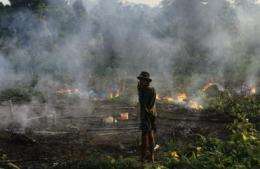
Conservation and international aid groups may be on the wrong course to address the havoc wreaked by climate change on tropical rainforests, according to a commentary appearing in the journal Nature on 2 December 2010.
"Most of the world's terrestrial biodiversity is contained in tropical rainforests, and climate change is looming ever larger as one of the major threats to these ecosystems, but how humans deal with climate change may be even more important," said Penn State University professor of biology Eric Post, one of the letter's authors. Post explained that rising temperatures and altered precipitation are important concerns; however, how humans respond to these altered conditions may be exacerbating an already bad situation.
Post's co-author, University of Montana ecologist Jedediah Brodie, formerly a Smith Conservation fellow at Penn State, commented that many tropical trees are reasonably resistant to temperature increases and even drought, but if the warming up and drying out of forests causes people to set more fires, trees could be completely unprepared. "If climate change leads to people starting more fires or doing more logging, those activities could be much more harmful to tropical biodiversity than just the simple rise in temperature," Brodie said.
The authors also explained that warming and drying conditions in parts of South America and Southeast Asia make it much easier for people to use fires to clear forests for agriculture. Unfortunately, small fires sometimes burn out of control, inadvertently destroying large areas. In addition, some tropical forests remain unlogged simply because they are inaccessible. For instance, intense rainy seasons wash out roads or make dirt tracks seasonally unusable. "The problem is that reduced precipitation could make it easier for people to access these areas," Post explained. "That increased access could lead to more logging, hunting, and burning -- a potentially destructive cycle."
In their Nature commentary, Post and Brodie argue that preventing deforestation and controlling fires are critical steps for reducing climate-change impacts on tropical biodiversity, but these steps must be deployed strategically. This caution also applies to popular new projects based on the REDD (Reduced Emissions from Deforestation and Forest Degradation) protocols. REDD projects are intended to set aside patches of forest to protect the carbon stored in the trees, but the placement of REDD projects is not coordinated at regional or international scales.
"The REDD concept has a huge potential that would be realized much better through some strategic planning," said Brodie. "Rather than using REDD to protect more-or-less random patches of forest, we could use it to link existing national parks into larger protected areas, or to span gradients in elevation or moisture." Brodie explained that preserving forest corridors along such gradients is critical to allowing tropical species to migrate or shift their ranges in response to the changing climatic conditions.
In their commentary, the authors also suggest that REDD projects or new national parks are especially important for particular areas. "One example is the Southeastern Amazon, where forests are threatened both by rapid deforestation and a drying climate," Brodie said. "Other areas that need REDD projects or parks are Southeast Asia's central Borneo region, the mountains along the Thailand-Myanmar border, and the Annamite Mountains in Vietnam and Laos."
The authors also said that while small, isolated national parks may offer some protection from climate change, large, connected landscapes would give different species the opportunity to migrate to new areas as environmental conditions change.
Provided by Pennsylvania State University


