Powdery mildew at an evolutionary dead end
December 9, 2010

Powdery mildew at an evolutionary dead end

Enlarge

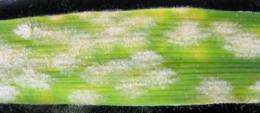
The photograph shows a section of a powdery mildew-infected barley leaf. The whitish fungal colonies on the leaf surface represent the typical disease symptoms of this widespread plant disease. Credit: Anja Reinstädler (MPI für Pflanzenzüchtungsforschung)

The size of a genome tells us nothing about the comprehensiveness of the genetic information it contains. The genome of powdery mildew, which can destroy entire harvests with its fine fungal threads, is a good example of this. Although the pathogen has almost 120 million base pairs, and therefore one of the largest genomes of the sac fungi, at barely 6,000, its gene count is far lower than that of comparable species.

It has lost many of the required for separate metabolism found in other fungi. Thus, from a genetic perspective, is stuck in an evolutionary dead end from which it is unable to liberate itself. (Science, December 10, 2010)

Based on the comparison of fungal genomes, Ralph Panstruga from the Max Planck Institute for Research in Cologne and his colleagues from an international research consortium discovered that powdery mildew forfeited a large part of its genetic complexity in the course of evolution. The considerable size of the mildew genome is largely due to so-called "jumping genes". These genes introduce new sequences into the genome and repeatedly mix up the genetic material by inserting and deleting themselves, causing errors as a result. Due to these changes, the powdery mildew gained a considerable number of new base pairs, but it also lost a lot of genes as their reading frames were interrupted by the insertion of the jumping genes.

As the international consortium of scientists succeeded in demonstrating, the plant pathogen lacks 99 genes that enable independent life, yet are still found in baker's yeast, another sac fungus. Therefore, powdery mildew cannot fix nitrogen, harness energy from alcoholic fermentation or produce certain metabolic products from inorganic compounds. As a parasite, powdery mildew does not require these synthesis processes; it obtains everything it needs from the host plant. Panstruga explains: "It can do without these genes. However, the price it pays is being forced to adhere to a particular way of life: parasitism. It has no way back to independent life. This is precisely what Dollo's Law states: once lost, the very same genetic complexity can never be regained. That's why extinct species cannot be re-established from the available genomes."

Powdery mildew also lacks many of the genes necessary for attacking the plant cell. For example, it only produces a few transport proteins; other plant diseases produce an entire collection of these proteins. They use these to infiltrate toxins into the plant cell or to pump the plant's immune defence proteins out of the cell so that they no longer pose a threat. Powdery mildew also forms very few enzymes that can be used to perforate the wall of the plant cell wall and thereby gain entry to it. "The powdery mildew fungus obviously lacks the genetic equipment to launch a broad attack on the plant cell. Instead, its strategy is to slip into the plant unobtrusively. It tries not to give the plant immune system any opportunity for a defensive reaction. This also suits its parasitic way of life. Powdery mildew is not interested in the destruction of the host plant. What it wants is the subtle and enduring subjugation of its host", says Panstruga.

The mildew pathogen colonizing barley uses just four percent of its genetic armoury for this subjugation. The Cologne-based scientists only identified 248 genes that could possibly be used for such a task. The comparison with other mildew species – for example pea or Arabidopsis mildew – revealed that the three species share only seven of these genes. All of the others are found only in the barley mildew. This exclusivity shows that its genetic equipment developed with a view to establishing a parasitic existence in close association with the relevant host plant. The other mildew species have clearly found other genetic solutions.

More information: Spanu PD et al. Genome expansion and gene loss in powdery mildew fungi reveal functional tradeoffs in extreme parasitism, Science, December 10, 2010

Provided by Max-Planck-Gesellschaft search and more info website

Filter


Move the slider to adjust rank threshold, so that you can hide some of the comments.


Display comments: newest first

gwrede
Dec 09, 2010

Rank: 1 / 5 (1)
If that's a dead end, then humans are at a dead end, too. We have lost the ability to eat grass, and billions of years ago we lost the ability to use pure rock as food.
d44x
Dec 09, 2010

Rank: 1 / 5 (1)
"Dollo's Law states: once lost, the very same genetic complexity can never be regained"

So how did it get the genetic "complexity" in the first place?
Ojorf
Dec 10, 2010

Rank: 5 / 5 (2)
Easy, small step by small step. The important bit in the quote is "very same", you missed that.
Rank 4 /5 (5 votes)
Relevant PhysicsForums posts

More news stories

Thousands of shellfish found dead in Peru

Thousands of crustaceans were found dead off the coast of Lima following the mystery mass death of dolphins and pelicans, the Peruvian Navy said Friday.

Biology / Ecology

created 1 hour ago | popularity not rated yet | comments 0

Researchers solve structure of human protein critical for silencing genes

In a study published in the journal Cell on May 24, Cold Spring Harbor Laboratory (CSHL) scientists describe the three-dimensional atomic structure of a human protein bound to a piece of RNA that "guides" the pr ...

Biology / Cell & Microbiology

created 17 hours ago | popularity 4.7 / 5 (7) | comments 0 | with audio podcast

It's in the genes: Research pinpoints how plants know when to flower

Scientists believe they've pinpointed the last crucial piece of the 80-year-old puzzle of how plants "know" when to flower.

Biology / Biotechnology

created 16 hours ago | popularity 4.3 / 5 (7) | comments 1 | with audio podcast

Copy of the genetic makeup travels in a protein suitcase

Scientists from the Institute for Physical and Theoretical Chemistry at the University of Bonn have succeeded for the first time in the real time filming of the transport of an important information carrier in biological ...

Biology / Cell & Microbiology

created 22 hours ago | popularity not rated yet | comments 0 | with audio podcast

'Transformer' protein makes different sized transport pods

These spheres may look almost identical, but subtle differences between them revealed a molecular version of the robots from Transformers. Each sphere is a vesicle, a pod that cells use to transport materials ...

Biology / Cell & Microbiology

created 23 hours ago | popularity 5 / 5 (1) | comments 0


Family history of Alzheimer's affects functional connectivity

(HealthDay) -- Cognitively normal individuals with a family history of late-onset Alzheimer's disease (AD) may display lower resting state functional connectivity in the default mode network (DMN) of the brain, ...

SpotterRF debuts Radar Backpack Kit (w/ Video)

(Phys.org) -- SpotterRF has announced a special radar backpack kit designed to enhance situational awareness for soldiers on the ground. The company says its special radar is designed for warfighters as part ...

Transvaginal mesh op restores pelvic organ prolapse at price

(HealthDay) -- Transvaginal mesh (TVM) procedures are effective for anatomical restoration of pelvic organ prolapse (POP), but patients report a worsening of sexual function following surgery, according to ...

Travel to high altitudes tied to Crohn's, colitis flare-ups

(HealthDay) -- People with inflammatory bowel disease, which includes Crohn's disease and colitis, may be at increased risk for flare-ups when they fly or travel to high altitudes for skiing or mountain climbing, ...

Astronomers seize last chance in lifetime for Venus Transit

Astronomers are gearing for one the rarest events in the Solar System: an alignment of Earth, Venus and the Sun that will not be seen for another 105 years.

Australia hails surprise super-telescope decision

Australia has hailed a surprise decision giving it a role in a radio telescope project aimed at revolutionising astronomy, vowing to draw on its decades of experience in space science.