Physicists unravel mystery of repetitive DNA segments
December 6, 2010

Rice physicists help unravel mystery of repetitive DNA segments

Enlarge

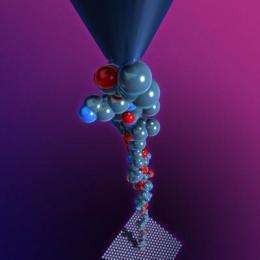
Rice physicists use an atomic force microscope to grab and stretch individual strands of DNA. Credit: C. Kiang/Rice University

With new tools that can grab individual strands of DNA and stretch them like rubber bands, Rice University scientists are working to unravel a mystery of modern genomics. Their latest findings, which appear in Physical Review Letters, offer new clues about the physical makeup of odd segments of DNA that have just one DNA base, adenine, repeated dozens of times in a row.

These mysterious "poly(dA) repeats" are sprinkled throughout the human genome. Scientists have also found them in the genomes of animals, plants and other species over the past decade. But researchers do not know why they are there, what function they perform or why they occur only with the DNA base adenine and not the other three DNA bases -- cytosine, guanine and thymine.

"Previous investigations of poly(dA) have suggested that adenine bases stack in a very uniform way," said Ching-Hwa Kiang, a co-author of the new study and assistant professor of physics and astronomy at Rice. "Our investigation focused on what happens when single strands of poly(dA) were stretched and these stacks were pulled apart."

Kiang's research group specializes in studying the physical and mechanical properties of proteins and nucleic acids, and their primary tool is one of the mainstays of nanotechnology research -- the , or AFM. The business end of an AFM is like a tiny phonograph needle. The tip of the needle is no more than a few atoms wide, and the needle is at the end of an arm that bobs up and down over the surface of what is being measured. While nanotechnologists use the device to measure the thickness of samples, Kiang's group uses it in a different way.

To begin her experiments, Kiang first places a thin coating of the proteins she wishes to study on a flat surface. This is placed under the AFM arm so the bobbing AFM needle can dip down and grab the ends of one of the proteins. As the arm retracts, it unravels the protein.

All proteins fold into a characteristic shape. Like tiny springs, they remain in this compact "lowest energy" state unless they are pried apart.

The new study on poly(dA) was conducted by Kiang, Rice graduate student Wuen-shiu Chen and colleagues at Rice and National Chung Hsing University (NCHU) in Taiwan. The team discovered that poly(dA) behaves differently depending upon the speed with which it is stretched. When the AFM bobbed rapidly, the poly(dA) segments behaved like any other segment of single-stranded DNA. But when the AFM motion was slowed, the team found that the amount of force required to stretch the poly(dA) changed. At two particular locations, the strand lengthened for a short distance without any additional force at all.

"Typically, single strands of DNA behave like a rubber band: The resistance increases as they stretch, meaning you have to pull harder and harder to continue stretching them," Kiang said. "With poly(dA), we found these two points where that doesn't apply. It's as if you have to pull harder and harder, and then for a brief time, the band stretches with no additional force whatsoever."

Kiang said the exact causes and implications of the phenomenon are unclear. But scientists know that double-stranded must be pried apart at discrete locations so that the cell's machinery can read the genetic code and convert it into proteins. There has been some speculation that the adenine repeats play a role in ordering genomic information; Kiang said the new findings raise even more questions about the role the repeats might play in gene regulation and packaging and how they might be potential targets for cancer drugs.

Provided by Rice University search and more info website


Rank 4 /5 (20 votes)
Relevant PhysicsForums posts

More news stories

Dopant gives graphene solar cells highest efficiency yet

(Phys.org) -- By taking advantage of graphene’s favorable electrical and optical properties, and then adding an organic dopant, researchers have achieved the highest power conversion efficiency yet for ...

Nanotechnology / Nanophysics

created May 21, 2012 | popularity 5 / 5 (10) | comments 14 | with audio podcast feature

Nanomedicine: Quantum dots appear safe in pioneering study on primates

A pioneering study to gauge the toxicity of quantum dots in primates has found the tiny crystals to be safe over a one-year period, a hopeful outcome for doctors and scientists seeking new ways to battle diseases ...

Nanotechnology / Bio & Medicine

created May 20, 2012 | popularity 4.3 / 5 (3) | comments 8 | with audio podcast

In nanorod crystal growth, nanoparticles seen as artificial atoms

In the growth of crystals, do nanoparticles act as "artificial atoms" forming molecular-type building blocks that can assemble into complex structures? This is the contention of a major but controversial theory ...

Nanotechnology / Nanophysics

created May 24, 2012 | popularity 4.8 / 5 (6) | comments 0 | with audio podcast

Synthetic nano-waste does not disappear

(Phys.org) -- Tiny particles of cerium oxide do not burn or change in the heat of a waste incineration plant. They remain intact on combustion residues or in the incineration system, as a new study by Swiss ...

Nanotechnology / Bio & Medicine

created May 25, 2012 | popularity 5 / 5 (1) | comments 1 | with audio podcast

First direct observation of oriented attachment in nanocrystal growth

Berkeley Lab researchers have reported the first direct observation of nanoparticles undergoing oriented attachment, the critical step in biomineralization and the growth of nanocrystals. A better understanding ...

Nanotechnology / Nanophysics

created May 24, 2012 | popularity 4.7 / 5 (3) | comments 0 | with audio podcast


Family history of Alzheimer's affects functional connectivity

(HealthDay) -- Cognitively normal individuals with a family history of late-onset Alzheimer's disease (AD) may display lower resting state functional connectivity in the default mode network (DMN) of the brain, ...

SpotterRF debuts Radar Backpack Kit (w/ Video)

(Phys.org) -- SpotterRF has announced a special radar backpack kit designed to enhance situational awareness for soldiers on the ground. The company says its special radar is designed for warfighters as part ...

Transvaginal mesh op restores pelvic organ prolapse at price

(HealthDay) -- Transvaginal mesh (TVM) procedures are effective for anatomical restoration of pelvic organ prolapse (POP), but patients report a worsening of sexual function following surgery, according to ...

Travel to high altitudes tied to Crohn's, colitis flare-ups

(HealthDay) -- People with inflammatory bowel disease, which includes Crohn's disease and colitis, may be at increased risk for flare-ups when they fly or travel to high altitudes for skiing or mountain climbing, ...

Thousands of shellfish found dead in Peru

Thousands of crustaceans were found dead off the coast of Lima following the mystery mass death of dolphins and pelicans, the Peruvian Navy said Friday.

Astronomers seize last chance in lifetime for Venus Transit

Astronomers are gearing for one the rarest events in the Solar System: an alignment of Earth, Venus and the Sun that will not be seen for another 105 years.