Physicists create supernova in a jar (w/ Video)
December 2, 2010

Physicists create supernova in a jar

Enlarge

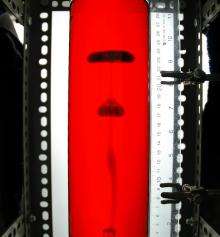
A vertical tube of viscous solution contains stable reactants for the Iodate Arsenous Acid reaction. An indicator makes the solution red. Reaction is triggered at the base of a small tube at the bottom, leading to a growing plume that sheds accelerating vortex rings. No fluid is injected: all the buoyancy is created by the reaction itself. This image shows a pair of successive accelerating vortex rings launched by the plume. The process is analogous to the nuclear deflagration leading to the detonation of a type Ia supernova. Experiment by Michael C. Rogers

(PhysOrg.com) -- A team of physicists from the University of Toronto and Rutgers University have mimicked the explosion of a supernova in miniature.

A is an . In a certain type of supernova, the detonation starts with a flame ball buried deep inside a white dwarf. The flame ball is much lighter than its surroundings, so it rises rapidly making a plume topped with an accelerating smoke ring.

"We created a smaller version of this process by triggering a special chemical reaction in a closed container that generates similar plumes and ," says Stephen Morris, a University of Toronto physics professor.

This video is not supported by your browser at this time.

A plume driven by buoyancy which is being created by a chemical reaction. The plume accelerates and sheds accelerating smoke ring vortices. The process is analogous to the detonation of a type Ia supernova. Experiment by Michael C. Rogers

Autocatalytic chemical reactions release heat and change the composition of a solution, which can create buoyancy forces that can stir the liquid, leading to more reaction and a runaway explosive process. "A supernova is a dramatic example of this kind of self-sustaining explosion in which gravity and buoyancy forces are important effects. We wanted to see what the liquid motion would look like in such a self-stirred chemical reaction," says Michael Rogers, who led the experiment as part of his PhD research, under the supervision of Morris.

"It is extremely difficult to observe the inside of a real exploding star light years away so this experiment is an important window into the complex fluid motions that accompany such an event," Morris explains. "The study of such explosions in stars is crucial to understanding the size and evolution of the universe."

The research will appear in Physics Review E in the next few weeks.

Provided by University of Toronto search and more info website

3.1 /5 (13 votes)  

Filter


Move the slider to adjust rank threshold, so that you can hide some of the comments.


Display comments: newest first

Pyle
Dec 02, 2010

Rank: 5 / 5 (7)
I love it. "It is a supernova in a jar!" This is like comparing a vote on favorite snack in a first grade classroom to a national election. Sure they voted, but it was 20 to 30 6 and 7 year-olds.

I suppose there may be lessons learned, but...

I guess you put labels like this on things to garner interest. "Exploration of the fluid dynamics of a self-sustaining explosion in a viscous medium" doesn't really catch the eye like "Supernova in a bottle!"

Love the research, but I had to react to the headline.
jselin
Dec 02, 2010

Rank: 4.5 / 5 (2)
Agreed. I'd go so far as to say that such titles are irresponsible. Sort of the like the boy who cried wolf...
KwasniczJ
Dec 02, 2010

Rank: 1 / 5 (7)
IMO supernova doesn't explode so. IMO it crushes from surface to center and the surface cone creates less or more symmetric polar jets, each of which is similar to splash, formed during throwing of dense stone into deep water (watch the video from 1:30 min).

http://www.youtub...S8xbxloI
hockart
Dec 02, 2010

Rank: not rated yet
as soon as i saw mention of the word 'rings' i immediately drew a correlation (probably erroneous, but what the hey, i'm not a theoretical physicist with a rep to think of) with an article i read on here the other day (http://www.physor...g.html). read and discuss!
Pyle
Dec 02, 2010

Rank: 5 / 5 (2)
@hockart - Oh no you didn't! I certainly hope the conversation from that other article doesn't spill into this one.

And there is a correlation only in so much that a plane splice of the supernova looks like a ring, just as a rock in a pond. The rings in the other article are thought (speculated) to be an artifact of a different and much MUCH larger phenomenon (SMBH collisions or some such).

I would be curious if the experimenters here could reproduce their experiment in a large spherical container with the reaction beginning in the center?
hockart
Dec 02, 2010

Rank: 4.5 / 5 (2)
well, i did say i was probably wrong. maybe you guys should switch to decaf and lighten up :)
barakn
Dec 03, 2010

Rank: not rated yet
I would be curious if the experimenters here could reproduce their experiment in a large spherical container with the reaction beginning in the center?

Why? Because of the Earth's gravitational field, such an experiment wouldn't have the same symmetry as a nuclear flame originating near the center of a star. It would still go up.
sender
Dec 03, 2010

Rank: not rated yet
Would like to see this in a low or near-zero-gravity environment.
Pyle
Dec 03, 2010

Rank: not rated yet
@barakn
Don't you think the outward force of the reaction would overwhelm the gravitational effects of the Earth, at least initially? I would think that the effects of gravity could be accounted for anyway.

@sender, If it worked well enough I guess we could take it out into a "weight-less" environment. Man, we would be good at spending research money.
Rank 3.1 /5 (13 votes)
Relevant PhysicsForums posts

More news stories

Landmark calculation clears the way to answering how matter is formed

(Phys.org) -- An international collaboration of scientists, including Thomas Blum, associate professor of physics, is reporting in landmark detail the decay process of a subatomic particle called a kaon – ...

Physics / General Physics

created May 25, 2012 | popularity 4.8 / 5 (12) | comments 39 | with audio podcast

Is a classical electrodynamics law incompatible with special relativity?

(Phys.org) -- The laws of classical electromagnetism that were developed in the 19th century are the same laws that scientists use today. They include Maxwell’s four equations along with the Lorentz la ...

Physics / General Physics

created May 24, 2012 | popularity 4.7 / 5 (14) | comments 30 | with audio podcast feature

Lying in wait for WIMPs: Researchers seek to dramatically increase sensitivity of Large Underground Xenon detector

Although it's invisible, dark matter accounts for at least 80 percent of the matter in the universe. No one knows what it is, but most scientists would bet on weakly interacting massive particles, or WIMPs.

Physics / General Physics

created May 23, 2012 | popularity 4 / 5 (5) | comments 14 | with audio podcast

Hall effect at the speed of light: How can you demonstrate relativistic effects with your mobile phone?

The relativistic Hall effect describing objects rotating at speeds comparable with the speed of light has been reported.

Physics / General Physics

created May 21, 2012 | popularity 4.3 / 5 (3) | comments 8

Cloak of invisibility: Engineers use plasmonics to create an invisible photodetector

A team of engineers at Stanford and the University of Pennsylvania has for the first time used "plasmonic cloaking" to create a device that can see without being seen - an invisible machine that detects light. It is the first ...

Physics / General Physics

created May 21, 2012 | popularity 4.8 / 5 (16) | comments 7 | with audio podcast


Family history of Alzheimer's affects functional connectivity

(HealthDay) -- Cognitively normal individuals with a family history of late-onset Alzheimer's disease (AD) may display lower resting state functional connectivity in the default mode network (DMN) of the brain, ...

SpotterRF debuts Radar Backpack Kit (w/ Video)

(Phys.org) -- SpotterRF has announced a special radar backpack kit designed to enhance situational awareness for soldiers on the ground. The company says its special radar is designed for warfighters as part ...

Transvaginal mesh op restores pelvic organ prolapse at price

(HealthDay) -- Transvaginal mesh (TVM) procedures are effective for anatomical restoration of pelvic organ prolapse (POP), but patients report a worsening of sexual function following surgery, according to ...

Travel to high altitudes tied to Crohn's, colitis flare-ups

(HealthDay) -- People with inflammatory bowel disease, which includes Crohn's disease and colitis, may be at increased risk for flare-ups when they fly or travel to high altitudes for skiing or mountain climbing, ...

Thousands of shellfish found dead in Peru

Thousands of crustaceans were found dead off the coast of Lima following the mystery mass death of dolphins and pelicans, the Peruvian Navy said Friday.

Astronomers seize last chance in lifetime for Venus Transit

Astronomers are gearing for one the rarest events in the Solar System: an alignment of Earth, Venus and the Sun that will not be seen for another 105 years.