Physicists use graphene to decode DNA
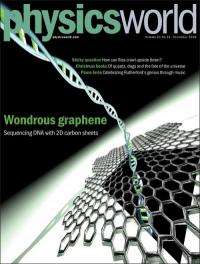
This is the cover of Physics World. Credit: Physics World
Genome sequencing will have a profound effect on our understanding of genetic biology and could usher in a day when doctor and patient are able to review individual genome sequences to fully personalise medical treatment.
As the X PRIZE FOUNDATION begins to receive nominations for its $10m prize for the first privately funded company that can accurately sequence 100 genomes in 10 days for less than $10,000 per genome, the science writer Philip Ball looks at the latest advances towards success in December Physics World's lead feature.
The baton, once firmly in the hands of chemists and biologists, has been grabbed by physicists around the world since the mid-1990s when David Deamer from the University of California, Santa Cruz imagined threading a DNA strand through a tiny pore -- reading out the chemical bases strung along the strand as it passes through. His idea was that in a salt solution, the number of dissolved ions passing through the pore would vary depending on which base was sitting in the pore.
Over the past decade, scientists have sought means to use Deamer's technique with far greater control of the pore and the movement of DNA through the pore, while also contemplating how the technique can be turned into a handy device that could be used in doctors' surgeries worldwide.
Initial thoughts were towards the use of a silicon-nitride nanopore but researchers have found the material a little too thick, meaning that more than one nucleotide -- the structural units that make up DNA -- can be in the pore at any one time.
Now, however, graphene -- one-atom thick sheets of carbon that led to this year's Nobel Prize for Physics -- is generating huge excitement as a possible DNA sequencing material following the work of three independent research groups earlier this year.
The teams -- based at the universities of Delft, Pennsylvania and Harvard -- have each drawn DNA through a nanopore drilled into graphene. As the materials is so much thinner than silicon nitride, the teams are reported to believe that graphene may be a "game changer".
Whether for the physicists it's the lure of a $10m prize, the joy of basic research, or the satisfaction of designing a technique that could revolutionize medicine, it looks like graphene -- already dubbed a "wonder material on account it being ultrathin, ultrastrong and a great electrical conductor -- could be adding one more string to its already powerful bow.
Provided by
Institute of Physics
-
From lemons to lemonade: Reaction uses carbon dioxide to make carbon-based semiconductor,
28 comments
-
Thioridazine kills cancer stem cells in human while avoiding toxic side-effects of conventional cancer treatments,
3 comments
-
SpaceX private rocket blasts off for space station (Update),
41 comments
-
Climate scientists say they have solved riddle of rising sea,
30 comments
-
Scotland passes turbine test to harness tidal power,
40 comments
-
How can squinting be used by both a myopic & hyperopic eye?
1 hour ago
-
The need for practical electronic and mechanical skills for aspiring experimentalists
6 hours ago
-
Refraction and splitting of a photon
8 hours ago
-
Total pressure load on a chain...
9 hours ago
-
Water under pressure and temperature effects
12 hours ago
-
Flow, different liquid, pressure
12 hours ago
- More from Physics Forums - General Physics
More news stories
Dopant gives graphene solar cells highest efficiency yet
(Phys.org) -- By taking advantage of graphenes favorable electrical and optical properties, and then adding an organic dopant, researchers have achieved the highest power conversion efficiency yet for ...
Nanomedicine: Quantum dots appear safe in pioneering study on primates
A pioneering study to gauge the toxicity of quantum dots in primates has found the tiny crystals to be safe over a one-year period, a hopeful outcome for doctors and scientists seeking new ways to battle diseases ...
Nanotechnology / Bio & Medicine
May 20, 2012 |
4.3 / 5 (3) |
8
|
In nanorod crystal growth, nanoparticles seen as artificial atoms
In the growth of crystals, do nanoparticles act as "artificial atoms" forming molecular-type building blocks that can assemble into complex structures? This is the contention of a major but controversial theory ...
May 24, 2012 |
4.8 / 5 (6) |
0
|
Synthetic nano-waste does not disappear
(Phys.org) -- Tiny particles of cerium oxide do not burn or change in the heat of a waste incineration plant. They remain intact on combustion residues or in the incineration system, as a new study by Swiss ...
Nanotechnology / Bio & Medicine
May 25, 2012 |
5 / 5 (1) |
1
|
First direct observation of oriented attachment in nanocrystal growth
Berkeley Lab researchers have reported the first direct observation of nanoparticles undergoing oriented attachment, the critical step in biomineralization and the growth of nanocrystals. A better understanding ...
May 24, 2012 |
4.7 / 5 (3) |
0
|
Family history of Alzheimer's affects functional connectivity
(HealthDay) -- Cognitively normal individuals with a family history of late-onset Alzheimer's disease (AD) may display lower resting state functional connectivity in the default mode network (DMN) of the brain, ...
SpotterRF debuts Radar Backpack Kit (w/ Video)
(Phys.org) -- SpotterRF has announced a special radar backpack kit designed to enhance situational awareness for soldiers on the ground. The company says its special radar is designed for warfighters as part ...
Transvaginal mesh op restores pelvic organ prolapse at price
(HealthDay) -- Transvaginal mesh (TVM) procedures are effective for anatomical restoration of pelvic organ prolapse (POP), but patients report a worsening of sexual function following surgery, according to ...
Travel to high altitudes tied to Crohn's, colitis flare-ups
(HealthDay) -- People with inflammatory bowel disease, which includes Crohn's disease and colitis, may be at increased risk for flare-ups when they fly or travel to high altitudes for skiing or mountain climbing, ...
Thousands of shellfish found dead in Peru
Thousands of crustaceans were found dead off the coast of Lima following the mystery mass death of dolphins and pelicans, the Peruvian Navy said Friday.
Astronomers seize last chance in lifetime for Venus Transit
Astronomers are gearing for one the rarest events in the Solar System: an alignment of Earth, Venus and the Sun that will not be seen for another 105 years.