Maths research aims to improve internet reliability
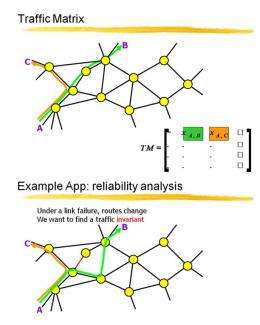
Mathematics researchers at the University of Adelaide are leading a new project aimed at improving the reliability and efficiency of Internet services.
The team includes researchers from AT&T Labs Research, the research arm of US-based global telecommunications company AT&T. They will synthesize Internet traffic matrices - based on the patterns of real network traffic - allowing network researchers to test designs of communication networks.
"People use the Internet for a range of purposes, from business to entertainment, and they want a reliable 24-hour service at reasonable cost," said Chief Investigator Associate Professor Matt Roughan, from the University's School of Mathematical Sciences.
"Internet traffic is complicated and all the different applications produce different types of traffic. It is like our road and freeway networks with a complex system of arterial and feeder routes. In traffic management and road planning, we need to know not just how much traffic there is, but where it's going and how a new road or block in an existing road may affect that traffic.
"A traffic matrix looks at the volume, movement and type of data traffic over all starting points and all destinations. There is a big array of numbers but, despite this complexity, Internet traffic displays simple patterns.
"This work is about discovering the mathematical underpinnings of these patterns and using them to generate new traffic matrices, against which network designs can be tested."
The project, 'Internet traffic-matrix synthesis', was awarded funding of $425,000 over three years in the latest round of Australian Research Council (ARC) Discovery Projects. The co-researcher is Dr. Walter Willinger, from the Information and Software Systems Research Center at AT&T Labs Research in Florham Park, New Jersey.
Associate Professor Roughan said the issue that network researchers had was not being able to use real Internet traffic data to test their designs because of commercial sensitivity and privacy issues.
"I must have seen 1000 research papers optimising designs of communication networks but this large area of research has been hampered by lack of data," he said. "If we can overcome this and have an agreed method for generating traffic matrices, this research will leap forward."
Associate Professor Roughan said this research will have significant implications for network providers who need to be able to make traffic predictions to build efficient reliable networks; for network researchers who need traffic matrices to test their designs; and in scientific understanding of what makes up traffic matrices.
"When we compare our synthetic traffic matrices with real matrices, we will be able to pick apart what's going on, which will help lead to new developments in terms of our understanding."
Provided by University of Adelaide


