Manchester professors receive their Nobel Prizes
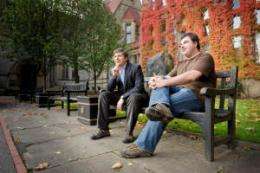
(PhysOrg.com) -- In a lavish ceremony in Stockholm, Sweden, Professor Andre Geim and Professor Konstantin Novoselov were awarded the 2010 Nobel Prize in Physics.
The ceremony, reward for the outstanding achievement by The University of Manchester academics, was watched by a worldwide audience.
Professors Geim and Novoselov were awarded the Prize for their discovery of graphene the worlds thinnest material which can be used in thousands of applications.
Attended by the King and Queen of Sweden, as well as some of the worlds most eminent scientists and statesmen, the ceremony at the Stockholm Concert Hall featured a grand banquet for guests.
Earlier in the week of celebrations, both Professor Geim and Professor Novoselov had given Nobel lectures to explain how they discovered graphene.
Professor Geims lecture detailed his varied route across universities throughout Europe before settling at The University of Manchester in 2001, and the story of the Friday night experiments which ultimately led to the discovery.
Professor Novoselov, known universally as Kostya, then took up the tale to explain the extraordinary properties of graphene.
Professor Novoselov was Professor Geims PhD student, and the pair have worked closely together ever since.
One Friday evening in Manchester in 2004, they were doing one of their regular Friday night experiments a time where they would try out often bizarre and zany techniques by stripping tiny molecules of carbon from graphite.
Graphene is a two-dimensional layer of carbon atoms that resembles chicken wire.
Since its discovery, Professor Geim and Dr Novoselov have published numerous research papers in prestigious journals such as Science and Nature, which have demonstrated the exquisite new physics for the material and its potential in novel applications such as ultrafast transistors just one atom thick making it a potential successor to silicon and sensors that can detect just a single molecule of a toxic gas.
A team of materials scientists and physicists from Manchester recently reported that graphene has the potential to replace carbon fibres in high performance materials that are used to build aircraft.
And Professor Geim has now created fluorographene - a two-dimensional version of Teflon which could revolutionise hundreds of everyday objects.
The award of the Nobel Prize means there are currently four Nobel Laureates at The University of Manchester.
University of Manchester President and Vice-Chancellor Nancy Rothwell was at the ceremony to see the professors receive the prize,as was Science minister David Willets.
The University is holding an event on January 26th 2011 to celebrate the achievements of Professor Geim and Professor Novoselov.
More information: Full profiles of both Professors are available at http://www.manches … 010&month=10
Provided by
University of Manchester
-
From lemons to lemonade: Reaction uses carbon dioxide to make carbon-based semiconductor,
28 comments
-
Thioridazine kills cancer stem cells in human while avoiding toxic side-effects of conventional cancer treatments,
3 comments
-
SpaceX private rocket blasts off for space station (Update),
41 comments
-
Climate scientists say they have solved riddle of rising sea,
30 comments
-
Scotland passes turbine test to harness tidal power,
40 comments
-
Interesting WWII Public INformation Leaflet
May 19, 2012
-
Treaty of the Pyrenees
May 08, 2012
- More from Physics Forums - History & Humanities
More news stories
Math predicts size of clot-forming cells
UC Davis mathematicians have helped biologists figure out why platelets, the cells that form blood clots, are the size and shape that they are. Because platelets are important both for healing wounds and in strokes and other ...
16 hours ago |
not rated yet |
0
|
Oldest Jewish archaeological evidence on the Iberian Peninsula
German archaeologists of the Friedrich Schiller University Jena found one of the oldest archaeological evidence so far of Jewish Culture on the Iberian Peninsula at an excavation site in the south of Portugal, ...
Other Sciences / Archaeology & Fossils
20 hours ago |
4.3 / 5 (4) |
12
Dinosaur with tiny arms unearthed in Argentina
Argentine experts have discovered the near-complete remains of a new species of Jurassic-era dinosaur that stood on its rear legs and had tiny arms, according to a leading paleontologist.
Other Sciences / Archaeology & Fossils
May 25, 2012 |
5 / 5 (2) |
0
Earliest musical instruments in Europe 40,000 years ago
The first modern humans in Europe were playing musical instruments and showing artistic creativity as early as 40,000 years ago, according to new research from Oxford and Tübingen universities.
Other Sciences / Archaeology & Fossils
23 hours ago |
5 / 5 (3) |
1
Talking works: UB professor develops method to analyze creative problem solving
(Phys.org) -- Talk -- if it's the right kind -- can increase creativity, leading students to create useful, new ideas that solve problems, a University at Buffalo professor has found by using a statistical tool that he invented.
Other Sciences / Social Sciences
May 25, 2012 |
not rated yet |
0
Of mice and mental models: Neuroscientific implications of risk-optimized behavior in the mouse
(Medical Xpress) -- Regardless of an organism’s biological complexity, every encephalized animal continuously makes under-informed behavioral choices that can have serious consequences. Despite its ubiquity, ...
Dragon arrives at space station in historic 1st (Update 2)
The privately bankrolled Dragon capsule made a historic arrival at the International Space Station on Friday, triumphantly captured by astronauts wielding a giant robot arm.
Landmark calculation clears the way to answering how matter is formed
(Phys.org) -- An international collaboration of scientists, including Thomas Blum, associate professor of physics, is reporting in landmark detail the decay process of a subatomic particle called a kaon ...
High-speed method to aid search for solar energy storage catalysts
Eons ago, nature solved the problem of converting solar energy to fuels by inventing the process of photosynthesis.
It's in the genes: Research pinpoints how plants know when to flower
Scientists believe they've pinpointed the last crucial piece of the 80-year-old puzzle of how plants "know" when to flower.
Researchers solve structure of human protein critical for silencing genes
In a study published in the journal Cell on May 24, Cold Spring Harbor Laboratory (CSHL) scientists describe the three-dimensional atomic structure of a human protein bound to a piece of RNA that "guides" the pr ...
Dec 13, 2010
Rank: not rated yet