Study predicts distribution of gravitational wave sources
December 2, 2010 By Tim Stephens

Study predicts distribution of gravitational wave sources

Enlarge

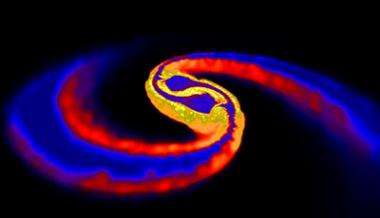
The merger of two neutron stars, shown in this snapshot from a computer simulation, creates gravitational waves that could be detected by sensitive instruments. Credit: Stephan Rosswog and Enrico Ramirez-Ruiz.

(PhysOrg.com) -- A pair of neutron stars spiraling toward each other until they merge in a violent explosion should produce detectable gravitational waves. A new study led by an undergraduate at the University of California, Santa Cruz, predicts for the first time where such mergers are likely to occur in the local galactic neighborhood.

According to Enrico Ramirez-Ruiz, associate professor of astronomy and astrophysics at UC Santa Cruz, the results provide valuable information for researchers at gravitational-wave detectors, such as the Laser Interferometry Gravitational-Wave Observatory (LIGO) in Louisiana and Washington. "This is a very important result, as it is likely to significantly alter how gravitational-wave observatories currently operate," Ramirez-Ruiz said.

Luke Zoltan Kelley, a UCSC undergraduate working with Ramirez-Ruiz, is first author of a paper describing the new findings, to be published in the December 10 issue of and currently available online.

A key prediction of Einstein's , gravitational waves are ripples in the fabric of space-time caused by the motions of massive objects. Scientists have yet to detect gravitational waves directly because they are so weak and decay rapidly, but a planned upgrade for LIGO (called Advanced LIGO) is expected to greatly increase its sensitivity. Compact binaries--which can consist of two neutron stars, two , or one of each--are among the best candidates for emitting gravitational waves that could be detected by LIGO or other current experiments.

Kelley investigated the implications of a key observation about compact binaries: The two objects are not only moving in orbit around each other, they are also typically speeding through space together, their center of mass moving with a velocity that can be well above 200 kilometers per second.

"By the time the two objects merge, they are likely to be located far away from the galaxy where they were born," Kelley said.

This has implications for efforts to observe mergers that emit gravitational waves. Scientists hope to match a detection at a gravitational-wave observatory with telescope observations of the corresponding merger event. The new study suggests that astronomers might not want to look in the nearest galaxies for these "optical counterparts" of .

"Our predictions show that the proposed use of galaxy catalogs for follow-up from possible gravity-wave detections will need to account for the possibility of mergers away from the observed galaxies," Ramirez-Ruiz said.

The "kick" that sends compact binaries sailing out of their home galaxies comes from a slight asymmetry in the supernova explosions that give birth to neutron stars and black holes. When a massive star explodes, its core collapses to form either a neutron star (a rapidly rotating ball of densely packed neutrons) or a black hole. According to Kelley, a one-percent asymmetry in the supernova explosion would result in a recoil velocity of about 1,000 kilometers per second (about 2 million miles per hour).

"That is around the maximum velocity observed for lone and pulsars," he said. "In binary systems, the net kick velocity to the center of mass is noticeably less, and still fairly uncertain, but is around 200 kilometers per second."

The researchers used a standard cosmological simulation of dark matter and the formation of structure in the universe to study how different kick velocities would affect the distribution of merging compact binaries. The simulation, run on a supercomputer at UCSC, showed the formation of halos of dark matter whose gravitational pull is thought to drive the formation of galaxies. The researchers populated the more massive halos with tracer particles representing compact binary systems. On separate runs, they gave the binaries different velocities.

After running the model for a simulated 13.8 billion years (the current age of the universe), Kelley found a region that looked like our local universe, with a galaxy the size of the Milky Way surrounded by a comparable set of neighboring galaxies. He then generated an image of the sky as it would appear to astronomers in the simulated universe, showing the locations of compact binaries and local galaxies.

The results showed that variations in kick velocity lead to marked differences in the distribution of compact binaries. If the merger of a compact binary occurs away from the bright background of a galaxy, it could be detected by a survey telescope such as the planned Large Synoptic Survey Telescope (LSST). The operators of gravitational-wave observatories would then know when and where to look in their data for a gravitational-wave signal, Ramirez-Ruiz said.

He and colleagues at UCSC, including theoretical astrophysicist Stan Woosley and graduate student Luke Roberts, are currently trying to work out what the optical signal of a compact-binary merger should look like. "Detecting the optical counterparts of gravitational-wave detections will be a lot easier if they are not within galaxies," Ramirez-Ruiz said.

Provided by University of California - Santa Cruz search and more info website

4.1 /5 (17 votes)  

Filter


Move the slider to adjust rank threshold, so that you can hide some of the comments.


Display comments: newest first

StandingBear
Dec 02, 2010

Rank: 1.5 / 5 (2)
Do gravitational waves decay rapidly or do they dissipate rapidly. Perhaps they are quite local in their effects. This would make more likely the developement of space deforming drives...not have to everywhere bend space to create local versions of an island outside the universe.
KwasniczJ
Dec 02, 2010

Rank: 1.4 / 5 (11)
Do gravitational waves decay rapidly or do they dissipate rapidly
IMO they're superluminal, so they're manifesting with sudden changes of CMB noise intensity in similar way, like the underwater sound wave manifest with noise at the water surface.

http://www.youtub...Ft5YV7uc
Shootist
Dec 02, 2010

Rank: 5 / 5 (5)
IMO they're superluminal, so they're manifesting with sudden changes of CMB noise intensity in similar way, like the underwater sound wave manifest with noise at the water surface.

http://www.youtub...Ft5YV7uc


And you have the nerve to complain about Dr. Manual's view of stellar dynamics?
KwasniczJ
Dec 02, 2010

Rank: 1 / 5 (7)
No idea is completely correct or wrong, the same applies both for mainstream supported theories, both for alternative ones. I'm just passing through theories like light ray through CMB noise while looking for optimal path minimizing the Lagrangian (i.e. the geodesics).

http://www.realcl...170.html
joelb
Dec 06, 2010

Rank: not rated yet
If gravity is nonlocal, then maybe gravity waves exist in another dimension... Just be careful, there gravity may be the strong force...
KwasniczJ
Dec 06, 2010

Rank: 1 / 5 (1)
..then maybe gravity waves exist in another dimension.....
Well, exactly. In 3D space we are seeing only chaotic projection of this harmonic motion constrained into tiny distance.

Try to imagine shadow of object regularly rotating in 3D (along all three axis at the same moment). The projection of its shadow in 2D will move irregularly - and it will be always smaller in average, then the original object.
Rank 4.1 /5 (17 votes)
Relevant PhysicsForums posts
  • revamping general concept and cosmological principle
    created17 hours ago
  • Transiting Exoplanet Light Curve
    createdMay 25, 2012
  • Math behind Theoretical Physics
    createdMay 24, 2012
  • Do we know whats at the center of galaxies yet?
    createdMay 23, 2012
  • Structure of the Milky Way?
    createdMay 20, 2012
  • What would it take to terraform Pluto and Charon?
    createdMay 19, 2012
  • More from Physics Forums - General Astronomy

More news stories

Dragon arrives at space station in historic 1st (Update 2)

The privately bankrolled Dragon capsule made a historic arrival at the International Space Station on Friday, triumphantly captured by astronauts wielding a giant robot arm.

Space & Earth / Space Exploration

created 20 hours ago | popularity 5 / 5 (8) | comments 11

Dragon makes history with space station docking

The private company SpaceX made history Friday with the docking of its Dragon capsule to the International Space Station, the most impressive feat yet in turning routine spaceflight over to the commercial ...

Space & Earth / Space Exploration

created 13 hours ago | popularity 4.8 / 5 (6) | comments 0

Aliens don't want to eat us, says former SETI director

Alien life probably isn’t interested in having us for dinner, enslaving us or laying eggs in our bellies, according to a recent statement by former SETI director Jill Tarter.

Space & Earth / Space Exploration

created 21 hours ago | popularity 4.8 / 5 (10) | comments 26

SKA super telescope to be built in Australia, South Africa (Update 2)

A long-running joust to host a radio telescope that would give mankind its farthest peek into the Universe ended on Friday with a Solomon-like judgement to split the site between Australia and South Africa.

Space & Earth / Astronomy

created 21 hours ago | popularity 5 / 5 (5) | comments 2

NASA sees Hurricane Bud threaten western Mexico's coast

NASA satellites are providing rainfall, temperature, pressure, visible and infrared data to forecasters as Hurricane Bud is expected to make a quick landfall in western Mexico this weekend before turning back ...

Space & Earth / Earth Sciences

created 15 hours ago | popularity not rated yet | comments 0


Of mice and mental models: Neuroscientific implications of risk-optimized behavior in the mouse

(Medical Xpress) -- Regardless of an organism’s biological complexity, every encephalized animal continuously makes under-informed behavioral choices that can have serious consequences. Despite its ubiquity, ...

Landmark calculation clears the way to answering how matter is formed

(Phys.org) -- An international collaboration of scientists, including Thomas Blum, associate professor of physics, is reporting in landmark detail the decay process of a subatomic particle called a kaon – ...

High-speed method to aid search for solar energy storage catalysts

Eons ago, nature solved the problem of converting solar energy to fuels by inventing the process of photosynthesis.

It's in the genes: Research pinpoints how plants know when to flower

Scientists believe they've pinpointed the last crucial piece of the 80-year-old puzzle of how plants "know" when to flower.

Researchers solve structure of human protein critical for silencing genes

In a study published in the journal Cell on May 24, Cold Spring Harbor Laboratory (CSHL) scientists describe the three-dimensional atomic structure of a human protein bound to a piece of RNA that "guides" the pr ...

MIT researchers devise new means to synchronize a group of robots (w/ Video)

(Phys.org) -- For several years, roboticists have been working out ways to get a group of robots to perform synchronized activities as demonstrated most often in dance routines. It’s not just about trying ...