Friend or foe? Google, indie book sellers team up
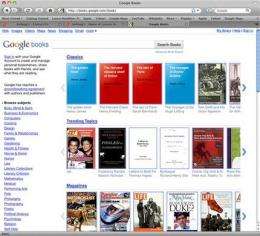
(AP) -- Struggling neighborhood books stores now have a new way to ring up sales, courtesy of a formidable new rival - Google. But it still may not be enough to help them keep their doors open.
The Internet search leader opened its long-awaited electronic book store Monday, competing against Amazon.com Inc. and further accelerating the shift of book distribution from brick-and-mortar stores to the Web.
It's the latest twist in a tumultuous new chapter for the book industry, one that will challenge traditional book retailers' ability to adapt and avoid the fate of music and video retailers that have been beaten by digital competition in the past five years.
Unlike Amazon or Apple Inc., Google Inc.'s entry is giving independent retailers a way to keep up with the times.
Google is allowing merchants to sell its inventory of 3 million electronic books through their own sites and bring in more money as they scramble to adjust to the rising popularity of e-readers such as Amazon's Kindle and computer tablets such as Apple's iPad.
More than 100 book retailers in 36 states already have agreed to team up with Google. They include Powell's in the Portland, Ore., area and online-only merchant Alibris.com.
"This will help give independent book stores a more level playing field," predicted Michael Tucker, who owns four small book stores in the San Francisco area and is president of the American Booksellers Association, a trade group.
Teaming up with Google still won't be enough to save all the book stores that still won't be able to bring enough revenue to remain open as more people embrace e-readers, predicted Forrester Research media analyst James McQuivey.
Over the past decade, the number of independent stores operated by the ABA's membership has fallen from 3,000 to 1,700, the ABA said. McQuivey expects hundreds more to close during the next decade.
The upheaval will occur as sales of e-readers, tablets and electronic books steadily rise during the next five years.
Forrester expects U.S. e-book sales to total $2.8 billion in 2015, up from nearly $1 billion this year. The research firm projects the number of e-readers and tablets in the U.S. will soar from more than 15 million this year to nearly 60 million in 2015.
Even larger book retailers are feeling the pressure to shake things up.
Activist investor William Ackman on Monday offered to finance a $963 million bid by Borders Group to buy rival Barnes & Noble Inc. Combined, the two retailers operate about 1,400 stores, many of which would presumably be closed if they were to combine forces.
Although most analysts doubted a deal would come together, the proposal underscores the challenges facing traditional book retailers as they look for ways to lower their costs.
Barnes & Noble already is making some headway in digital books with its Nook e-reader, a major selling point in any potential deal, said Morningstar analyst Peter Wahlstrom.
"The one growth area in the U.S. book industry is the digital push," Wahlstrom said.
Google's electronic book store, in the works for more than a year, draws upon a portion of the 15 million printed books that the Mountain View-based company has scanned into its computers since 2004.
About 4,000 publishers, including CBS Corp.'s Simon & Schuster Inc., Random House Inc. and Pearson PLC's Penguin Group, are also allowing Google to carry many of their recently released books in the new store.
Those publishing deals will ensure that most of the current best sellers are available in Google's store, said Amanda Edmonds, who oversaw the company's partnerships.
Millions more out-of-print titles will appear in Google's store, called eBooks, if the company can gain federal court approval of a proposed $125 million class-action settlement with U.S. publishers and authors.
The publishers and authors had sued Google, saying it scanned copyrighted books without getting permission.
The settlement has been under review for more than two years. It faces stiff opposition from rivals, consumer watchdogs, academic experts, literary agents and foreign governments. They worry that Google would get too much power to control prices for e-books.
If the settlement is rejected, those books cannot be sold in Google's new store.
Amazon.com, which started as an online bookseller, is among competitors trying to stop the settlement. The U.S. Justice Department has advised the judge overseeing the case that the settlement probably would violate antitrust and copyright laws.
Google's e-books will work on the Nook, Sony Corp.'s Reader devices and practically every other e-reading device except the Kindle. Google achieves this with the help of Adobe Inc.'s copy-protection system for e-books.
That system is already used by public libraries and smaller online bookstores, but hasn't seen much interest from the major players. Amazon.com, Barnes & Noble and Apple all have their own copy-protection systems.
Kindle owners also can sync their e-readers with a wide variety of other devices, although it isn't compatible with other e-readers such as the Nook.
Google plans to offer sharp discounts on many of its e-books but it will still pay publishers 52 percent of the list price for sales made on its site, unless another arrangement has been negotiated with an outside agency.
The formula means that even if Google elects to sell a book with a $10 list price for $6, the publisher would still get $5.20.
The revenue-sharing formula changes slightly when the electronic sales occur through one of the independent book merchants or other partners Google hopes to recruit. Google didn't disclose the precise split of these arrangements.
Although Google expects the lion's share of its eBooks revenue to be funneled to its partners, its portion of the sales could help the company develop another way to make money besides the Internet ads that bring most of its income.
The availability of eBooks also could help boost advertising sales by giving people another reason to come to Google's website.
McQuivey suspects that Google eventually may decide to sell ads alongside some of its books. If that happens, Google could afford to lower the prices of books even more and create more headaches for traditional retailers.
"In the long run, I don't think Google has a strong appetite to make it easier for book sellers to stay alive," McQuivey said.
More information: http://books.google.com
©2010 The Associated Press. All rights reserved. This material may not be published, broadcast, rewritten or redistributed.


