Researchers improve efficiency of low-cost solar cells
December 7, 2010 By Lisa Zyga
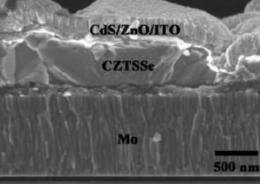
This image shows a cross-section of a CZTSSe thin film solar cell. The film exhibits densely packed grains, which leads to a high efficiency. Image credit: Qijie Guo, et al. ©2010 American Chemical Society.
(PhysOrg.com) -- As part of the recent progress in improving solar cells for widespread use, researchers from Purdue University have designed solar cells made of low-cost, abundant materials that are easily scalable and very stable. The researchers have increased the solar cells' total area efficiency to 7.2% and plan to make further improvements in the future.
The researchers, Qijie Guo, Grayson M. Ford, Wei-Chang Yang, Bryce C. Walker, Eric A. Stach, Hugh W. Hillhouse, and Rakesh Agrawal, have published their study on the improved solar cells in a recent issue of the Journal of the American Chemical Society. They fabricated the solar cells from copper-zinc-tin-chalcogenide (CZTSSe), which is an Earth-abundant material, using a solution-based thin-film deposition method. Previous research has shown that these methods can provide high yields at lower manufacturing costs compared to other methods.
The solar cell design is based on the researchers' earlier study in which they demonstrated that solar cells fabricated using CZTS nanocrystals are potentially viable, although they had efficiencies of less than 1%. Here, the researchers made significant improvements to the design by tuning the composition of the nanocrystals as well as developing a more robust thin-film coating method.
After synthesizing the nanocrystals and applying them on a substrate for a total film thickness of 1 micrometer, the researchers observed that the nanocrystal film featured large, densely packed grains, which leads to improved solar cell efficiency. In testing, the solar cells could achieve a total area efficiency of 7.2%. As coauthor Hugh Hillhouse explained, the total area efficiency refers to the entire cell, rather than just the active area.
"It is the total area efficiency that matters most," he told PhysOrg.com. Some people report an active area efficiency, which only includes areas that the light reaches. However, all thin film solar cells are made with metal contacts that block the light from reaching some areas. When you include this loss, we use the term total area efficiency. It is the most fair and important efficiency.
The 7.2% efficiency was reached after light soaking for 15 minutes under one-sun illumination; when the light was turned off, the efficiency dropped to 6.89%.
Light soaking simply means that we shine normal intensity simulated sunlight on the cell for a period of time before we make the measurement, Hillhouse said. Most likely, the light soaking allows photogenerated carriers to fill traps, shift the quasi-Fermi levels, and/or screen barriers created by band offsets. It doesnt present a problem since real solar cells are naturally light soaked they sit in the sun.
Although currently there are no CZTS or CZTSSe solar cells on the market for comparison, the solar cells in this study are very competitive with other fabrication methods.
The best cells formed by vacuum processes have only reached 6.7%, Hillhouse said. Typically, solar cells produced by vacuum-based processes have been more efficient, but also more expensive. For the case of CZTS, the solution phase approach (our nanocrystal route and IBMs hydrazine route) is more efficient.
One potential area for improvement for these solar cells lies in improving their low quantum efficiency for light of longer wavelengths (i.e., the near-infrared range). The researchers attempted to improve this efficiency by increasing the thickness of the absorber, although their initial experiments showed that thicker absorber layers also had increased resistance. In the future, they plan to optimize the fabrication for thicker films, which could further increase the overall efficiency.
There is a lot of compositional freedom in the CZTSSe system, and it is likely that the optimum compositions, device structure, and processing conditions have not yet been found but we are working on it, Hillhouse said.
More information: Qijie Guo, et al. Fabrication of 7.2% Efficient CZTSSe Solar Cells Using CZTS Nanocrystals. J. Am. Chem. Soc. ASAP. DOI: 10.1021/ja108427b
Copyright 2010 PhysOrg.com.
All rights reserved. This material may not be published, broadcast, rewritten or redistributed in whole or part without the express written permission of PhysOrg.com.
-
From lemons to lemonade: Reaction uses carbon dioxide to make carbon-based semiconductor,
28 comments
-
Thioridazine kills cancer stem cells in human while avoiding toxic side-effects of conventional cancer treatments,
3 comments
-
SpaceX private rocket blasts off for space station (Update),
41 comments
-
Climate scientists say they have solved riddle of rising sea,
30 comments
-
Scotland passes turbine test to harness tidal power,
40 comments
-
Density question
May 24, 2012
-
Mass transport originating from a point source at a solid gas interface
May 22, 2012
-
Ammonia dispersion in Air
May 22, 2012
-
Multi Choice Help
May 21, 2012
-
index of refraction and thickness of materials
May 18, 2012
-
Solar battery maintainer for car
May 17, 2012
- More from Physics Forums - Materials & Chemical Engineering
More news stories
Synthetic nano-waste does not disappear
(Phys.org) -- Tiny particles of cerium oxide do not burn or change in the heat of a waste incineration plant. They remain intact on combustion residues or in the incineration system, as a new study by Swiss ...
Nanotechnology / Bio & Medicine
19 hours ago |
5 / 5 (1) |
1
|
Nanotechnology for solar energy conversion systems
EU researchers extensively characterised the self-organisation of nanotubes and developed novel compositions particularly appropriate to solar energy conversion applications.
Nanotechnology / Nanomaterials
17 hours ago |
not rated yet |
0
Nano-structured polymer-based materials from scrap
EU researchers developed polymer blends and processing techniques facilitating recovery of scrap from industrial processes. Advances in this area have the potential to decrease costs and waste while protecting ...
Nanotechnology / Nanomaterials
18 hours ago |
not rated yet |
0
Dopant gives graphene solar cells highest efficiency yet
(Phys.org) -- By taking advantage of graphenes favorable electrical and optical properties, and then adding an organic dopant, researchers have achieved the highest power conversion efficiency yet for ...
Nanomedicine: Quantum dots appear safe in pioneering study on primates
A pioneering study to gauge the toxicity of quantum dots in primates has found the tiny crystals to be safe over a one-year period, a hopeful outcome for doctors and scientists seeking new ways to battle diseases ...
Nanotechnology / Bio & Medicine
May 20, 2012 |
4.3 / 5 (3) |
8
|
Of mice and mental models: Neuroscientific implications of risk-optimized behavior in the mouse
(Medical Xpress) -- Regardless of an organism’s biological complexity, every encephalized animal continuously makes under-informed behavioral choices that can have serious consequences. Despite its ubiquity, ...
Dragon arrives at space station in historic 1st (Update 2)
The privately bankrolled Dragon capsule made a historic arrival at the International Space Station on Friday, triumphantly captured by astronauts wielding a giant robot arm.
Landmark calculation clears the way to answering how matter is formed
(Phys.org) -- An international collaboration of scientists, including Thomas Blum, associate professor of physics, is reporting in landmark detail the decay process of a subatomic particle called a kaon ...
High-speed method to aid search for solar energy storage catalysts
Eons ago, nature solved the problem of converting solar energy to fuels by inventing the process of photosynthesis.
It's in the genes: Research pinpoints how plants know when to flower
Scientists believe they've pinpointed the last crucial piece of the 80-year-old puzzle of how plants "know" when to flower.
Researchers solve structure of human protein critical for silencing genes
In a study published in the journal Cell on May 24, Cold Spring Harbor Laboratory (CSHL) scientists describe the three-dimensional atomic structure of a human protein bound to a piece of RNA that "guides" the pr ...
Dec 07, 2010
Rank: 5 / 5 (3)
I like it.
Dec 07, 2010
Rank: not rated yet
Dec 07, 2010
Rank: not rated yet
Dec 07, 2010
Rank: 5 / 5 (5)
Dec 07, 2010
Rank: not rated yet
Dec 07, 2010
Rank: not rated yet
http://www.fao.or...tm#1.2.1
Dec 07, 2010
Rank: 1 / 5 (1)
http://www.alt-en...terials/
Unfortunatelly, zinc-selenium cells are known to be unstable, as the ultraviolet light causes photoreduction of selenium (zinc selenide turns grey, when illuminated).
Dec 07, 2010
Rank: 5 / 5 (1)
http://www.life.i...isit.htm
NB: Their proposal of "up to" 8% efficiency for sugar cane is directly contradicted in other documents, which state "about 3%".
Dec 07, 2010
Rank: not rated yet
http://fatknowled...els.html
Dec 07, 2010
Rank: not rated yet
Dec 07, 2010
Rank: not rated yet
NO plant can get near the energy output of an equivalent area of solar-electric generation. Solar thermal (trough) easily and cheaply achieves 15% Net Electricity out NOW, and the costs aren't terrible compared to fossil peaker turbines.
Biomass --> energy is a complete waste of time and resources.
Dec 07, 2010
Rank: 1 / 5 (2)
Dec 07, 2010
Rank: not rated yet
Dec 07, 2010
Rank: not rated yet
Dec 07, 2010
Rank: not rated yet
http://www.nrel.g...4440.pdf
Assessment of Parabolic Trough and Power Tower Solar Technology Cost and Performance Forecasts - Sargent and Lundy LLC Consulting Group Chicago, Illinois - NREL data
Dec 07, 2010
Rank: not rated yet
Dec 08, 2010
Rank: not rated yet
Dec 08, 2010
Rank: 5 / 5 (1)
You are on the wrong website. This is a science website not a teletubbies website
Dec 08, 2010
Rank: not rated yet
the phosphorous is still around. Don't have a cow man. It's in the rivers and oceans (particularly deltas,) where it can be harvested, given the near-infinite energy supply of the Sun.
With the exception of whatever quantities that many have been in spacecraft we've launched, the amount of phosphorous on earth is about the same it has been since earth existed. Heck, if you count meteors, it's actually gone up.
It's all there. Just need enough solar farms and you can mine, filter, recycle anything as often as you want.
Dec 08, 2010
Rank: 5 / 5 (1)
Japan and China have seriously claimed they want to do just that. Machio Kaku, a leading American physicist has proposed the same thing.
Dec 09, 2010
Rank: 5 / 5 (1)
Dec 09, 2010
Rank: not rated yet
It's certainly not cost effective compared to ground based coal plants, but could be usefull in emergency situations or in war.
Dec 11, 2010
Rank: not rated yet
Dec 12, 2010
Rank: not rated yet
Dec 15, 2010
Rank: not rated yet
Fraudic Psuedo-scientists, just want their pockets filled.