Alternating stacks of planar cations and dipyrrole-containing anions provides concept for new materials
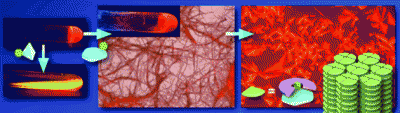
(PhysOrg.com) -- Pyrroles, which are rings containing one nitrogen and four carbon atoms, are essential components of our red hemoglobin as well as the green chlorophyll in plants. Japanese researchers led by Hiromitsu Maeda at Risumeikan University have now also used this molecular motif in the construction of new nanostructured materials: They combined planar pyrrole-containing negatively charged complexes with similarly planar, positively charged organic ions.
As the scientists report in the journal Angewandte Chemie, they were able to produce fibers and soft materials, such as supramolecular gels and liquid crystals.
Salts consist of cations and anionspositively and negatively charged particles. Most salts organize themselves into ordered crystals that are held together through the electrostatic attraction between the oppositely charged ions. However, there are also ionic liquids, which are salts that exist as melts at room temperature. The size and geometry of the ions involved prevent the formation of a strong crystal lattice.
Ionic liquid crystals are another interesting class of materials. Liquid crystals are fluid like a liquid, though the particles in them are arranged in an ordered state. In addition, there are other materials that are more organized but whose components maintain a certain degree of mobility. These are of interest for the development of ferroelectric memory devices.
The Japanese researchers selected planar ions to build up self-organized materials in which the charged components are stacked in an alternating fashion. The first component is a planar complex made from a small inorganic ion and an organic receptor (receptoranion complex). The critical structural element of the receptor contains two pyrroles bound into what is known as a π-conjugated environment. This means that some of the electrons are freely mobile as an electron cloud over a large area of the molecule. The ligand surrounds the anion on three sides.
The second component is a disk-shaped organic cation made from an aromatic ring system, which also has an electron cloud. Because of the electrostatic attraction between oppositely charged ions, and also attractive interactions between the electron clouds, these anions and cations always stack themselves into alternating columnar units.
Depending on the type of additional side-groups on the components, the columns organize into various structures, such as fibers, supramolecular gels, or liquid crystals. Such alternating stacks of oppositely charged components (charge-by-charge assembly) has proven to be a successful concept for the production of novel materials from organic ions.
More information: Hiromitsu Maeda, Oriented Salts: Dimension-Controlled Assemblies from Planar ReceptorAnion Complexes, Angewandte Chemie International Edition 2010, 49, No. 52, 1007910083, http://dx.doi.org/ … ie.201006356
Provided by
Wiley
-
From lemons to lemonade: Reaction uses carbon dioxide to make carbon-based semiconductor,
28 comments
-
Thioridazine kills cancer stem cells in human while avoiding toxic side-effects of conventional cancer treatments,
3 comments
-
SpaceX private rocket blasts off for space station (Update),
41 comments
-
Climate scientists say they have solved riddle of rising sea,
30 comments
-
Scotland passes turbine test to harness tidal power,
40 comments
-
High school chemistry EEI
6 hours ago
-
oxidation of I- by KMnO4
18 hours ago
-
Invesion temp
21 hours ago
-
Hybridization of SnCl3 -
21 hours ago
-
Electrons And Radiation
May 25, 2012
-
Acid Base Theories
May 24, 2012
- More from Physics Forums - Chemistry
More news stories
High-speed method to aid search for solar energy storage catalysts
Eons ago, nature solved the problem of converting solar energy to fuels by inventing the process of photosynthesis.
12 hours ago |
5 / 5 (2) |
1
|
Researchers demonstrate possible primitive mechanism of chemical info self-replication
(Phys.org) -- When scientists think about the replication of information in chemistry, they usually have in mind something akin to what happens in living organisms when DNA gets copied: a double-stranded molecule ...
19 hours ago |
5 / 5 (3) |
2
|
Building a better solar panel -- one molecule at a time
(Phys.org) -- One of the fundamental building blocks in modern chemistry, an organometallic chemical compound called ferrocene, has never been structurally defined - until now.
20 hours ago |
5 / 5 (3) |
0
|
From lemons to lemonade: Reaction uses carbon dioxide to make carbon-based semiconductor
(Phys.org) -- A materials scientist at Michigan Technological University has discovered a chemical reaction that not only eats up the greenhouse gas carbon dioxide, it also creates something useful. And, by ...
May 21, 2012 |
4.7 / 5 (88) |
28
|
New CO2-removing catalyst can take the heat
(Phys.org) -- The current method of removing the greenhouse gas carbon dioxide (CO2) from the flues of coal-fired power plants uses so much energy that no one bothers to use it. So says Roger Aines, principal ...
May 24, 2012 |
5 / 5 (7) |
7
|
Of mice and mental models: Neuroscientific implications of risk-optimized behavior in the mouse
(Medical Xpress) -- Regardless of an organism’s biological complexity, every encephalized animal continuously makes under-informed behavioral choices that can have serious consequences. Despite its ubiquity, ...
Dragon arrives at space station in historic 1st (Update 2)
The privately bankrolled Dragon capsule made a historic arrival at the International Space Station on Friday, triumphantly captured by astronauts wielding a giant robot arm.
Landmark calculation clears the way to answering how matter is formed
(Phys.org) -- An international collaboration of scientists, including Thomas Blum, associate professor of physics, is reporting in landmark detail the decay process of a subatomic particle called a kaon ...
It's in the genes: Research pinpoints how plants know when to flower
Scientists believe they've pinpointed the last crucial piece of the 80-year-old puzzle of how plants "know" when to flower.
Researchers solve structure of human protein critical for silencing genes
In a study published in the journal Cell on May 24, Cold Spring Harbor Laboratory (CSHL) scientists describe the three-dimensional atomic structure of a human protein bound to a piece of RNA that "guides" the pr ...
MIT researchers devise new means to synchronize a group of robots (w/ Video)
(Phys.org) -- For several years, roboticists have been working out ways to get a group of robots to perform synchronized activities as demonstrated most often in dance routines. Its not just about trying ...