Shining symbiosis: Bobtail squid and their bacteria buddies
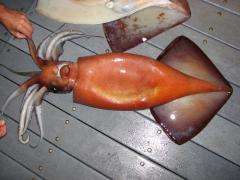
In deep ocean waters, it's sometimes difficult to hide from predators. That's why so many sea creatures have evolved extraordinary methods of disguise.
Cephalopods, such as octopus, squid and cuttlefish, are big on camouflage, by day or night. In fact, the Hawaiian bobtail squid has several means of stealthy self- preservation.
"During the day, if they are disturbed from the sand, they will come out, sit on the surface with a sand coat on them, trying to be invisible," says Margaret McFall-Ngai, professor of medical microbiology and immunology at the University of Wisconsin-Madison. "And, if that doesn’t work, they will eject ink. They themselves turn completely white, as transparent as they can be, and leave behind that blob of ink in the same size as they are."
With support from the National Science Foundation (NSF), McFall-Ngai and her team study another bobtail squid camouflage scheme; one that glows in the dark!
This small nocturnal animal has a mutually beneficial relationship with bacteria called Vibrio fischeri that live on the squid's underside. The bacteria allow the squid to produce light, which then allows the squid to escape from things that might want to eat it. "The squid emit ventral luminescence that is often very, very close to the quality of light coming from the moon and stars at night," explains McFall-Ngai.
So, for fish looking up from below for something to eat, the squid are camouflaged against the moon or the starlight because they don't cast a shadow.
"It's like a 'Klingon' cloaking device," she notes.
But the Vibrio fischeri don't stay in the squid continuously. Every day, in response to the light cue of dawn, the squid vents 90 percent of the bacteria back into the seawater. "And then, while it's sitting quiescent in the sand, the bacteria grow up in the crypt so that when [the squid] comes out in the evening, it will have a full complement of luminous Vibrio fischeri," says McFall-Ngai.
The key to the symbiotic relationship of the squid and bacteria is a "light organ."
"The light organ has remarkable morphological and anatomical similarities to the eye. It has a lens, an iris analog and reflective tissue," she explains.
Shortly after the squid eggs hatch, the juveniles "invite" the helpful bacteria inside.
Graduate research assistant Elizabeth Heath-Heckman does microscopic studies of juvenile squid, just a few days old. "There are some structures that are specific to a baby light organ, as opposed to an adult light organ," she says. "The juveniles have protrusions, called appendages that help to direct seawater, bringing bacteria to the light organ."
"The bacteria live inside the squid, but they don't live inside the squid's cells," continues Heath-Heckman. "So you have this sort of cave, this kind of nest that the squid makes for the bacteria."
So, what do the bacteria get out of this relationship? "Any time bacteria are in an environment where they can gain nutrients, and increase their population, it's a good place to be," explains McFall-Ngai.
This successful counter-illumination, anti-predatory strategy could lead to several applications for human benefit.
Materials science experts in the U.S. Air Force are studying possible improvements in camouflage through the reflective qualities of the squid-bacteria symbiosis. Scientists also want to know more about how the two species communicate.
"So at the very basic level, we're asking how animal cells talk to bacterial cells: what is the common language, and what is conserved over evolutionary history in that conversation?" continues McFall-Ngai, who also is trying to determine what kind of signal the baby squid use to initially attract the "good" bacteria. "How in the world does the animal know that this is a beneficial symbiont, and not a pathogen?" That's another aspect of the study that could help with human physiology and medicine.
Bobtail squid only live as long as a year, but there are healthy populations of them where McFall-Ngai and her colleagues collect the animals in Kaneohe Bay, off the Hawaiian island of Oahu. McFall-Ngai also says it's a fascinating animal to study.
"They really are beautiful animals. They are also a good size, not too big, not too small. At one point, someone said to me, 'study something the size of your thumb', and that's exactly the size that they are, but they really are exquisite," she adds.
And--brainy!
"They are relatives of the octopus, really smart animals. They are very likely smarter than fish, very large brains for body size," she notes.
As for the research in general, McFall-Ngai says she feels really lucky to be a scientist. "I think it has to be a gift for any scientist, to find yourself going through a career, a long career, and always being excited about what the next question is, and what the students are finding."
Provided by National Science Foundation


