Scientists advance the understanding of the big getting bigger
November 4, 2010

Scientists advance the understanding of the big getting bigger

Enlarge

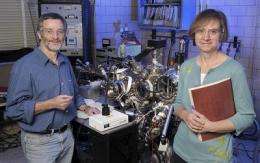
James Evans and Patricia Thiel, of Iowa State University and the US Department of Energy's Ames Laboratory, are using scanning tunneling microscope technology to study coarsening. Understanding the process could improve the stability of nanoscale technologies. Credit: Photo by Bob Elbert/Iowa State University

Patricia Thiel of Iowa State University and the Ames Laboratory put a box of tissues to the right, a stack of coasters to the middle and a trinket box to the left.

"Nature," she said of her table-top illustration, "doesn't want lots of little things." So Thiel grabbed the smaller things and slid them into a single pile next to the bigger tissue box. "Nature wants one big thing all together, like this."

Thiel, an Iowa State Distinguished Professor of Chemistry and a faculty scientist for the U.S. Department of Energy's Ames Laboratory, and James Evans, an Iowa State professor of physics and astronomy and a faculty scientist for the Ames Laboratory, describe that process in the Oct. 29 issue of the journal Science.

The paper, "A Little Chemistry Helps the Big Get Bigger," is in the journal's Perspectives section. It describes a process called coarsening. That's when "a group of objects of different sizes transforms into fewer objects with larger average size, such that 'the big get bigger,'" says the paper. Examples of the process include the geologic formation of gemstones, the degradation of pharmaceutical suspensions and the manufacture of structural steels.

Thiel and Evans were invited to write the paper after Thiel delivered a talk at an American Chemical Society meeting about their studies of coarsening, an emerging field in surface chemistry.

Thiel worked with Mingmin Shen, a former Iowa State doctoral student who is now a post-doctoral research associate at Pacific Northwest National Laboratory in Richland, Wash., on the experimental side of the coarsening research. Evans worked with Da-Jiang Liu, an associate scientist at the Ames Laboratory, on the theoretical side of the project.

The researchers, with the support of grants from the National Science Foundation, have been using technology – an instrument that allows them to see individual atoms – to study how coarsening happens on the surface of objects.

They've studied nanoscale particles grown on the surface of silver and how adding sulfur can increase coarsening. They're trying to learn the mechanism of that increase and understand the nature of the messengers that move atoms during the coarsening process.

What Thiel and Evans are looking for is a general principle that explains what they call additive-enhanced coarsening. To do that, Thiel said they still need to collect and analyze data from more coarsening systems.

Evans said a better understanding of the coarsening process can help researchers develop small structures – including nanoscale technologies, catalysts or drug suspensions – that resist coarsening and are therefore more durable. A better understanding could also help researchers manipulate coarsening to develop structures with a very narrow distribution of particle sizes, something important to some nanotechnologies.

"When we're building something on a small scale, for it to be useful, it has to be robust, it has to survive," Evans said. "And one thing we're looking at is the stability of the very tiny structures that are crucial to nanoscale technologies."

Provided by Iowa State University search and more info website


Rank 2 /5 (4 votes)
Relevant PhysicsForums posts
  • High school chemistry EEI
    created3 hours ago
  • oxidation of I- by KMnO4
    created15 hours ago
  • Invesion temp
    created18 hours ago
  • Hybridization of SnCl3 -
    created18 hours ago
  • Electrons And Radiation
    created23 hours ago
  • Acid Base Theories
    createdMay 24, 2012
  • More from Physics Forums - Chemistry

More news stories

High-speed method to aid search for solar energy storage catalysts

Eons ago, nature solved the problem of converting solar energy to fuels by inventing the process of photosynthesis.

Chemistry / Materials Science

created 8 hours ago | popularity 5 / 5 (2) | comments 1 | with audio podcast

Researchers demonstrate possible primitive mechanism of chemical info self-replication

(Phys.org) -- When scientists think about the replication of information in chemistry, they usually have in mind something akin to what happens in living organisms when DNA gets copied: a double-stranded molecule ...

Chemistry / Materials Science

created 16 hours ago | popularity 5 / 5 (3) | comments 2 | with audio podcast

Building a better solar panel -- one molecule at a time

(Phys.org) -- One of the fundamental building blocks in modern chemistry, an organometallic chemical compound called ferrocene, has never been structurally defined - until now.

Chemistry / Materials Science

created 17 hours ago | popularity 5 / 5 (3) | comments 0 | with audio podcast

From lemons to lemonade: Reaction uses carbon dioxide to make carbon-based semiconductor

(Phys.org) -- A materials scientist at Michigan Technological University has discovered a chemical reaction that not only eats up the greenhouse gas carbon dioxide, it also creates something useful. And, by ...

Chemistry / Materials Science

created May 21, 2012 | popularity 4.7 / 5 (88) | comments 28 | with audio podcast

New CO2-removing catalyst can take the heat

(Phys.org) -- The current method of removing the greenhouse gas carbon dioxide (CO2) from the flues of coal-fired power plants uses so much energy that no one bothers to use it. So says Roger Aines, principal ...

Chemistry / Materials Science

created May 24, 2012 | popularity 5 / 5 (7) | comments 7 | with audio podcast


Of mice and mental models: Neuroscientific implications of risk-optimized behavior in the mouse

(Medical Xpress) -- Regardless of an organism’s biological complexity, every encephalized animal continuously makes under-informed behavioral choices that can have serious consequences. Despite its ubiquity, ...

Dragon arrives at space station in historic 1st (Update 2)

The privately bankrolled Dragon capsule made a historic arrival at the International Space Station on Friday, triumphantly captured by astronauts wielding a giant robot arm.

Landmark calculation clears the way to answering how matter is formed

(Phys.org) -- An international collaboration of scientists, including Thomas Blum, associate professor of physics, is reporting in landmark detail the decay process of a subatomic particle called a kaon – ...

It's in the genes: Research pinpoints how plants know when to flower

Scientists believe they've pinpointed the last crucial piece of the 80-year-old puzzle of how plants "know" when to flower.

Researchers solve structure of human protein critical for silencing genes

In a study published in the journal Cell on May 24, Cold Spring Harbor Laboratory (CSHL) scientists describe the three-dimensional atomic structure of a human protein bound to a piece of RNA that "guides" the pr ...

MIT researchers devise new means to synchronize a group of robots (w/ Video)

(Phys.org) -- For several years, roboticists have been working out ways to get a group of robots to perform synchronized activities as demonstrated most often in dance routines. It’s not just about trying ...