Satellites reveal differences in sea level rises
November 24, 2010 By Phillip F. Schewe
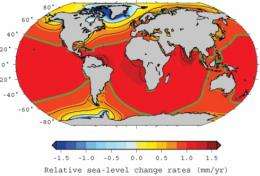
Relative sea-level change rates in millimeters per year. Credit: GRACE
Glaciers are retreating and parts of the ice sheets on Greenland and Antarctica are melting into the ocean. This must result in a rise in sea level, but by how much? A new measurement of the gravity everywhere around the globe with a pair of orbiting satellites provides the first ever map detailing the rises across different parts of the globe.
According to the new results, the annual world average sea level rise is about 1 millimeter, or about 0.04 of an inch. In some areas, such as the Pacific Ocean near the equator and the waters offshore from India and north of the Amazon River, the rise is larger. In some areas, such as the east coast of the United States, the sea level has actually dropped a bit over the past decade.
The surface of the sea is a constantly shifting fabric. To achieve a truer sense of how much the sea is changing in any one place, scientists measure the strength of gravity in that place. Measuring gravity over a patch of ocean or dry land provides an estimate of how much mass lies in that region. The measured mass depends on the presence of such things as mountains, glaciers, mineral deposits, and oceans.
If the gravity measurement for a place is changing, this could mean that the place is losing mass because of a retreating glacier or gaining mass if, as in the ocean surrounding Antarctica, new melt water is streaming in.
The Gravity Recovery and Climate Experiment, or GRACE for short, consists of a pair of satellites moving in an orbit that takes them over the South and North Poles. The two craft, nicknamed Tom and Jerry after the television cartoon characters, send constant signals to each other to determine their relative spacing to about 10 microns -- one-tenth the width of a human hair -- over a distance of 130 miles. If the first craft flies above a slightly more weighty area of the Earths' surface -- like a mountain range -- it will be tugged a bit out of place, an effect picked up by a change in the relative spacing of the craft.
In these way monthly gravity maps of pieces of land or ocean about 180 miles wide can be made with high precision. The new report for the years of 2003-09 looks at how much mass has been lost from land areas and how much mass has been gained by ocean areas.
One of the authors of the report, Riccardo Riva from the Delft University of Technology in the Netherlands, said that average annual rise in sea level rise due to meltwater entering the ocean is about 1 millimeter, but that an additional rise will come from that fact that as the average temperature rises so does the ocean temperature, which in turn causes the volume of the ocean to increase.
"The most important result of the new report is the measurement of the sea level changes for specific regions of the Earth that are based on direct and global measurements of mass change," Riva said.
Mark Tamisiea, who works at the National Oceanography Centre in Southampton, England, and was not involved in the GRACE work, believes the new report represents good research.
"As coastal sea level changes impact society, it is important for us to understand as much about the local differences from the global average as possible," Tamisiea said. "These results are one piece in that puzzle."
"GRACE is definitely the 'real deal' when it comes from measuring climate change from space," said Joshua Willis, an ocean expert at the Jet Propulsion Laboratory in Pasadena, Calif. "This work by Dr. Riva and company reminds us that the world's oceans don't behave like a giant bathtub. As the ice melts and the water finds its way back to the ocean, the resulting sea level rise won't be the same all over the world."
"These effects are still small in today's rising ocean, but as we look out over the next century, the patterns of sea level change due to melting ice will be magnified many times over as the ice sheets thin and melt," Willis said.
Looking at the actual map of sea level rises presents an ironic twist. Offshore the areas where melting ice is most rapidly falling into the ocean -- such as Greenland and Antarctica -- the sea level appears to be falling.
"The main reason for this is the rebound of the solid Earth," explained Riva. "Less ice causes the continents go up, and therefore sea level drops. Meltwater distributes around quite quickly, in most cases, so there is no accumulation due to that."
More information: The new GRACE results appear in the journal Geophysical Research Letters.
Provided by
Inside Science News Service
-
From lemons to lemonade: Reaction uses carbon dioxide to make carbon-based semiconductor,
28 comments
-
Thioridazine kills cancer stem cells in human while avoiding toxic side-effects of conventional cancer treatments,
3 comments
-
SpaceX private rocket blasts off for space station (Update),
41 comments
-
Climate scientists say they have solved riddle of rising sea,
30 comments
-
Scotland passes turbine test to harness tidal power,
40 comments
-
More human population = greater mass?
14 hours ago
-
Conversion from aircraft bearing to normal degrees
May 23, 2012
-
Interpretation/Analysis of the Lab results(HEPA filter)
May 22, 2012
-
Has anyone here attended the The Urbino Summer School in Paleoclimatology?
May 22, 2012
-
Earthquakes: Mag 6 N. Italy and Mag 5.6 W. Bulgaria
May 21, 2012
-
determining time frame for most recent geological layers
May 17, 2012
- More from Physics Forums - Earth
More news stories
Dragon arrives at space station in historic 1st (Update 2)
The privately bankrolled Dragon capsule made a historic arrival at the International Space Station on Friday, triumphantly captured by astronauts wielding a giant robot arm.
Space & Earth / Space Exploration
15 hours ago |
5 / 5 (8) |
11
Dragon makes history with space station docking
The private company SpaceX made history Friday with the docking of its Dragon capsule to the International Space Station, the most impressive feat yet in turning routine spaceflight over to the commercial ...
Space & Earth / Space Exploration
8 hours ago |
4.8 / 5 (6) |
0
Aliens don't want to eat us, says former SETI director
Alien life probably isnt interested in having us for dinner, enslaving us or laying eggs in our bellies, according to a recent statement by former SETI director Jill Tarter.
Space & Earth / Space Exploration
16 hours ago |
4.8 / 5 (10) |
24
SKA super telescope to be built in Australia, South Africa (Update 2)
A long-running joust to host a radio telescope that would give mankind its farthest peek into the Universe ended on Friday with a Solomon-like judgement to split the site between Australia and South Africa.
16 hours ago |
5 / 5 (5) |
2
NASA sees Hurricane Bud threaten western Mexico's coast
NASA satellites are providing rainfall, temperature, pressure, visible and infrared data to forecasters as Hurricane Bud is expected to make a quick landfall in western Mexico this weekend before turning back ...
Space & Earth / Earth Sciences
10 hours ago |
not rated yet |
0
Of mice and mental models: Neuroscientific implications of risk-optimized behavior in the mouse
(Medical Xpress) -- Regardless of an organism’s biological complexity, every encephalized animal continuously makes under-informed behavioral choices that can have serious consequences. Despite its ubiquity, ...
Landmark calculation clears the way to answering how matter is formed
(Phys.org) -- An international collaboration of scientists, including Thomas Blum, associate professor of physics, is reporting in landmark detail the decay process of a subatomic particle called a kaon ...
High-speed method to aid search for solar energy storage catalysts
Eons ago, nature solved the problem of converting solar energy to fuels by inventing the process of photosynthesis.
It's in the genes: Research pinpoints how plants know when to flower
Scientists believe they've pinpointed the last crucial piece of the 80-year-old puzzle of how plants "know" when to flower.
Researchers solve structure of human protein critical for silencing genes
In a study published in the journal Cell on May 24, Cold Spring Harbor Laboratory (CSHL) scientists describe the three-dimensional atomic structure of a human protein bound to a piece of RNA that "guides" the pr ...
MIT researchers devise new means to synchronize a group of robots (w/ Video)
(Phys.org) -- For several years, roboticists have been working out ways to get a group of robots to perform synchronized activities as demonstrated most often in dance routines. Its not just about trying ...
Nov 24, 2010
Rank: 3.4 / 5 (5)
There are no glaciers on the east coast of the US, but there are melting glaciers on the west coast, where sea level seems to be rising. His theory doesn't 'hold water'.
Personally I think this sounds a bit suspicious. How are they sure that they are measuring a change in water on the gound, and not a change in density/pressure/humidity/thickness of the atmosphere?
Is anyone here familiar with this concept of using gravity in this way? I would sure like to have a more detailed conversation about this technique.
Doesn't it take more than two satelites to measure position in a three dimensional space?
Nov 24, 2010
Rank: 2.9 / 5 (8)
I think the data is accurate, so it's definitely a candidate for selective data disposal to effectively continue the GW revenue stream.
Otherwise the models used to predict sea level rise on the US east cost, and in the Arctic, would be called into question, which would further validate the entire conspiracy that says that the models on which this multi-$billion industry is built are flawed. That would not be good for the eugenics, er... I mean, over-population agenda, especially given the revelations that the entire population of the world could live comfortably in ANY ONE of a number of U.S. states.
Better yet, we need to find a way to use this to the advantage of the GW cause. How about this one... the melt is causing land masses to inflate which could lead to potentially severe geological events, with unforeseen consequences.
Nov 24, 2010
Rank: 3 / 5 (2)
http://grace.jpl....ewsID=32
So the data isn't actually as accurate as it should be yet.
There seem to be quite a few different overlapping effects that account for changes in gravity, besides sea level change. After spending some time over at the JPL site and graphing some of the raw data myself, I see some interesting things.
Graph this data yourself and run a linear trend line, and I see a significantly flatter trend in this data for the oblateness of the earth than they show on their graph of the same data. The sigma graph is also curious in relation to the actual data.
ftp://podaac.jpl....egree_2/
Nov 24, 2010
Rank: 5 / 5 (4)
There's a few other mitigation factors that the abstract doesn't talk about. You have the massive amounts of fresh water that are dammed up in the northern hemisphere, (to the point where it may actually affect the spin speed of the earth a miniscule amount).
Then you have the thermal expansion of the water, which will naturally be higher on average around the equator which the above map seems to indicate. Then you have changes in thermohaline currents, etc.
It's a complex thing to examine. One piece of info I got, which is very important to a lot of the debate questions involved, is the fact that it appears our former measurements of sea level rise were off by 50% on the high side. That changes a lot of the research out there currently, and drastically affects a lot of precipitation models.
Nov 24, 2010
Rank: 3 / 5 (1)
For instance, the atlantic conveyer belt wich transports water from the atlantic round greenland to the beringstrait and the pacific, as it does so, the water cools down and shrinks in volume in northern atlantic/east coast of usa and will start to warm up/expand once passed through the beringstraight supplemented with the extra meltwater from a rising greenland, wich put a lot of extra volume into the pacific and might partially offset the glacial effects on the westcoast.
Nov 24, 2010
Rank: 5 / 5 (4)
In one sense there is nothing wrong with that, you have data on gravity and want to convert it to data on sea level rise, that is what you do. But the article here ignores the difference, while the original journal article doesn't. For example, estimates of sub-sea water temperatures are pretty rough, and they don't seem to have dealt at all with salinity gradients.
Net result, it is a good start at estimating sea levels from GRACE data integrated with other sources, but there is still a lot of work to do.
Nov 24, 2010
Rank: 1.3 / 5 (12)
It may have been panned by the critics, but it looks like "Waterworld" got it right.
But I am so disappointed in the President. He promised that the seas would start receding now that He was Risen.
Nov 24, 2010
Rank: 1 / 5 (2)
"Net result, it is a good start at estimating sea levels from GRACE data integrated with other sources, but there is still a lot of work to do"
Maybe those two statements explain each other? The previous sea level estimates could still be more accurate than this work, but I really don't think anyone knows for sure right now. Sea level is SO difficult to measure globally. This certainly flies in the face of everything people here have argured with me about here in regard to the clear evidence that sea level here in Charleston South Carolina hasn't risen in recorded history. People here have called me an idiot for saying that, but the evidence is impossible to deny. This study would support the simple observations I can make by walking down to the historical sights and looking around.
Nov 24, 2010
Rank: 3 / 5 (2)
I expect a similar result, in terms of earth-shaking new data, as the STEREO and other new solar observatories begin to return meaningful data sets. There's going to be a few bad days for people who have been over-confident in current climate theory in the not so distant future I think.
It's just common sense. Nobody ever really studied global climate until the past couple of decades. It's a science in its early stages of maturity, and it's a bear in terms of complications and spotty data. We don't even know if we are measuring all the important parts yet, much less figuring out how to accurately measure them once we identify them, and then get a good long data set to derive trends over the noise.
Have a great, and safe, Thanks Giving everyone.
Nov 24, 2010
Rank: 5 / 5 (1)
Nov 24, 2010
Rank: 3 / 5 (2)
Geez, it's called sarcasm. I thought that would be obvious.
Nov 24, 2010
Rank: 5 / 5 (6)
Considering the majority of ignorant posters on this forum, nothing is obvious.
Nov 24, 2010
Rank: 2 / 5 (4)
Nov 24, 2010
Rank: 3.7 / 5 (6)
Probably because they're commonly thought of as synonyms.
Nov 25, 2010
Rank: 5 / 5 (3)
http://www.univer...xpected/
The result will be the ability to go back and check and verify GRACE and improve the data already taken. GOCE will also be able to serve as the benchmark for the use of laser and microwave altitude measurements.
http://earth.eo.e..._en.html
The uncertainties as pointed out by both SH and GS will be quantified and reduced over the next few years. We can expect to much better understand the changes in gravitation and sea level. The questions of the sea temperature profiles are also being worked out by combining the satellite information with actual profile measurements by a number of different means. What we see here is among the first of the articles refining the H2O balance. Great Stuff.
Nov 25, 2010
Rank: 3 / 5 (2)
Nov 25, 2010
Rank: 5 / 5 (1)
Nov 25, 2010
Rank: 3 / 5 (2)
Nov 26, 2010
Rank: 5 / 5 (2)
1) measuring ocean "levels" using gravity takes no account of increases due to reductions in density, eg. a) increased water temperature b) reduced water salinity. What these satellites are measuring is very questionablely directly related to ocean level rises.
2) Making conclusions on worldwide climate from observations of ocean levels on a single N. Carolina beach is entirely pointless. Any indicators could be entirely swamped by several factors such as crustal rebound, plate interactions, deep mantle activity, etc. etc.
3) We've only pushed the atmosphere's GHG levels significantly above normal for a very few years, perhaps 3 decades. Expecting any results of that to be definitely measurable yet indicates a poor grasp of reality.
Nov 26, 2010
Rank: 3 / 5 (2)
At that point, one must start taking an "insurance protection" attitude and start implementing ways to halt the process until enough is known "without a doubt" to make rational decisions.
Nov 27, 2010
Rank: 5 / 5 (1)
That's EXACTLY what I found, by calculating a geographically-weighted average from tide station data. (A simple median gives the same result.)
IPCC-favored researchers correct sea level trends upward in locations where glacial isostatic rebound causes coastal sea levels to fall, but they don't correct sea level trends downward where land subsidence due to water/oil/gas wells cause sea level to rise (perhaps because it's harder to model). So their corrections exaggerate the global avg sea level rise by ~50%.
James Hansen et al claim global sea level rose at 1.7 or 1.8 mm/year during the last century, and that the rate is accelerating. But the best tide station data shows coastal sea levels rose an avg of only ~1.1 mm/year during the last century, and the rate has NOT measurably accelerated in response to increasing atmospheric CO2 emissions.
See: http://burtonsys.com/GMSL
Nov 29, 2010
Rank: 1 / 5 (1)
Actually physics says that there are many factors in global temperature other than ghg's, and the relative roles of each are still poorly understood.
The longest and most complete ice core records show a natural trend where warming happens before CO2 increase, and cooling happens despite high CO2 levels. The ice cores are one of the biggest anti-AGW talking points.
That's an opinion. I disagree. We have a limited amount of money. Do we spend it on GHG's? Or do we spend it on medicine, education, food, crime, security, water, energy, theoretical sciences, transportation, land conservation, etc? Why spend billions when it may be a waste?
Nov 29, 2010
Rank: not rated yet
Nov 29, 2010
Rank: 1 / 5 (1)
The variance between models and observation is most likely due to assumptions about thermal expansion of the oceans. I believe the models assume that the whole ocean will warm and expand, but in reality it's starting to look like it's only the surface of the ocean that's warming, so expansion isn't a big factor. Since thermal expansion is assumed in the models to account for about half of the total sea level rise, that would account for the variance nicely. That doesn't mean that's the answer, but it's possible. This study merely points out the already known fact that more research is needed before any predictions can be made. They need to either confirm of deny these results, but it's exceedingly difficult to callibrate this kind of measurement, so it may be years before they have a confident answer. I think this release is premature really.