Robotic arm shaped like an elephant's trunk (w/ Video)
November 25, 2010 by Lin Edwards report

Robotic arm shaped like an elephant's trunk (w/ Video)

Enlarge

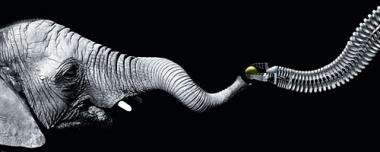
Image credit: Festo.

(PhysOrg.com) -- A German automation company has come up with a new design for a flexible robotic arm, taking inspiration from the trunk of an elephant.

Festo, based in Denkendorf in Germany, worked with the Fraunhofer Institute for Manufacturing Engineering and Automation in Stuttgart to design the , known as the "Bionic Handling Assistant," as a project of Festo’s Bionic Learning Network. The arm was designed specifically to be safe when interacting with humans, which the company believes will make it useful in locations such as medical centers, plants, mechanical repair workshops, schools, and in the home.

This video is not supported by your browser at this time.

Inspired by the elephant's trunk -- a high-tech helper for industry and the home Team from Festo and Fraunhofer IPA nominated for "Deutscher Zukunftspreis 2010"

The trunk-like arm is made of soft, compliant segments that were created from a polyamide using 3D printing technology, and is driven by a pneumatic system of tiny air chambers lining the interior of the arm. The air chambers are arranged in two rows and are inflated sequentially to provide the required movements. The arm is arranged in three segments to provide S-curve dexterity, and because the air chambers in the segments can be inflated separately, sections of the arm can be made to bend in opposite directions. The gripper is moved by means of air chambers in a fourth segment of the arm, known as the hand axis.

The arm has numerous resistance sensors that detect collisions and limit its movements when it senses contact, and this should make it safe for human interaction.

This video is not supported by your browser at this time.

The gripper at the end of the arm has a novel shape consisting of three fin-shaped fingers constructed from compartments that collapse when the fingers enclose an object, trapping it. The FinGripper design means very little force is required to grasp objects, again reducing any risk of injury. The FinGripper is already being tested on production lines, and three different sizes are being developed, to handle objects from a grapefruit size down to hazelnut size.

The Bionic Handling Assistant has been nominated for an award in the Deutscher Zukunftspreis (German Future Award). Previous robots designed by the Bionic Learning Network include other examples of biomimicry such as penguins, jellyfish, aquatic rays and flying fins.

This video is not supported by your browser at this time.


More information: http://www.festo.c … orp/9617.htm

© 2010 PhysOrg.com

4.9 /5 (17 votes)  

Filter


Move the slider to adjust rank threshold, so that you can hide some of the comments.


Display comments: newest first

cmn
Nov 25, 2010

Rank: 5 / 5 (2)
We know who is really behind this: Dr. Octavius.
DamienS
Nov 25, 2010

Rank: 3.7 / 5 (3)
This is a fantastic leap in egg-handling technology! But seriously, the design is rather cool as were some of the other bio-mimetic designs briefly shown.
trekgeek1
Nov 25, 2010

Rank: not rated yet
We know who is really behind this: Dr. Octavius.


That was the first thing I thought of when the video started. "I'll get you Spidey"!
Eco_R1
Nov 26, 2010

Rank: not rated yet
damn i had a imagined a design like this about a year ago, but with elctro magnets instead of pneumatics... should stop dreaming and start doing!
nanotech_republika_pl
Nov 26, 2010

Rank: not rated yet
Such Bionic Handling Assisstant would be nice at a molecular scale, for handling atoms or molecules instead of eggs. Or even at micro scale for handling organells or cells.
zevkirsh
Nov 27, 2010

Rank: not rated yet
i'd like to see this thing programmed to discipline other robots, and perhaps small children, by boxing them on the head.
neiorah
Nov 29, 2010

Rank: not rated yet
I like this design because it allows fluid movement. I wonder how much weight it can carry? How much can it curl? Just the specs please
Rank 4.9 /5 (17 votes)
Relevant PhysicsForums posts

More news stories

Yahoo kills 'Livestand' just 6 months after debut

(AP) -- Yahoo is killing a tablet magazine called Livestand just six months its debut on the iPad.

Technology / Business

created 8 hours ago | popularity not rated yet | comments 1

Computers excel at identifying smiles of frustration (w/ Video)

(Phys.org) -- Researchers at the Massachusetts Institute of Technology (MIT) in the US have trained computers to recognize smiles, and they have turned out to be more adept at recognizing smiles of frustration ...

Technology / Computer Sciences

created 21 hours ago | popularity 4 / 5 (2) | comments 1 | with audio podcast report

Yahoo! ditches digital newsstand for iPads

Yahoo! shuttered its fledgling digital newsstand for iPads on Friday in what it said was the start of a product purge intended to make the floundering Internet pioneer more nimble.

Technology / Internet

created 9 hours ago | popularity not rated yet | comments 0

Facebook IPO debacle raises investor dander

The spate of complaints and investigations over the Facebook stock offering suggests big institutions had an edge over small investors, raising questions about the process.

Technology / Business

created 10 hours ago | popularity not rated yet | comments 0

Apple CEO Cook gives up $75M in stock dividends

(AP) -- Apple CEO Tim Cook is giving up $75 million in dividends on restricted stock that the company is awarding to all of its employees.

Technology / Business

created 13 hours ago | popularity 1.8 / 5 (4) | comments 2


Of mice and mental models: Neuroscientific implications of risk-optimized behavior in the mouse

(Medical Xpress) -- Regardless of an organism’s biological complexity, every encephalized animal continuously makes under-informed behavioral choices that can have serious consequences. Despite its ubiquity, ...

Dragon arrives at space station in historic 1st (Update 2)

The privately bankrolled Dragon capsule made a historic arrival at the International Space Station on Friday, triumphantly captured by astronauts wielding a giant robot arm.

Landmark calculation clears the way to answering how matter is formed

(Phys.org) -- An international collaboration of scientists, including Thomas Blum, associate professor of physics, is reporting in landmark detail the decay process of a subatomic particle called a kaon – ...

High-speed method to aid search for solar energy storage catalysts

Eons ago, nature solved the problem of converting solar energy to fuels by inventing the process of photosynthesis.

It's in the genes: Research pinpoints how plants know when to flower

Scientists believe they've pinpointed the last crucial piece of the 80-year-old puzzle of how plants "know" when to flower.

Researchers solve structure of human protein critical for silencing genes

In a study published in the journal Cell on May 24, Cold Spring Harbor Laboratory (CSHL) scientists describe the three-dimensional atomic structure of a human protein bound to a piece of RNA that "guides" the pr ...