Marsupial embryo jumps ahead in development
November 29, 2010

Marsupial embryo jumps ahead in development

Enlarge

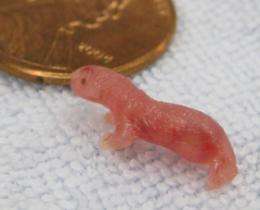
Any embryonic short-tailed opossum finishes its development outside the womb. | Anna Keyte

(PhysOrg.com) -- Long a staple of nature documentaries, the somewhat bizarre development of a grub-like pink marsupial embryo outside the mother's womb is curious in another way.

Duke University researchers have found that the developmental program executed by the marsupial embryo runs in a different order than the program executed by virtually every other vertebrate animal.

"The limbs are at a different place in the entire timeline," said Anna Keyte, a postdoctoral biology researcher at Duke who did this work as part of her doctoral dissertation. "They begin development before almost any other structure in the body."

Biologists have been pursuing the notion that limb development is triggered by other organ systems coming on line first, but this study shows the marsupial's limbs begin development without such triggers.

"Development is probably more flexible than we might have known otherwise," said biology professor Kathleen Smith. Their study animals were gray short-tailed opossums (Monodelphis domestica) native to Brazil and Bolivia, but the same should hold true for any marsupial, Smith said.

For the undeveloped embryo to be able to drag itself across the mother's belly from the birth canal to the teat, it needs a formidable pair of forelimbs. To get them, its developmental program has been rearranged to start building the forelimbs much sooner.

"A lot of these genes were turned on earlier than you'd see in a mouse or a chick," Keyte said. The researchers were also able to show that the forelimbs received cells from a much larger part of the developing embryo than is normally seen in other . What surprised the researchers was that the to establish the hind limbs also appeared to be turned on early.

sets up the pattern of where each of the four limbs will be, but the marsupial's forelimbs grow much faster than the hind limbs because the embryo devotes more of its scarce number of early cells to building those structures, Smith said. The plans are in place for the hind limbs, but not the bricks to build them.

The embryo emerges from the mother with burly forearms that include bones and well developed muscles, while the hind limbs are small and rubbery.

Blind, hairless and with an incomplete brain, a marsupial embryo is shockingly underdeveloped to be living outside the womb. But the system obviously works for marsupials.

"There are probably 50 explanations for why marsupials develop outside the womb, and none of them are very good," Smith said. It's pretty clear however that the external gives the female a lot more control over her reproduction. If conditions change or she runs out of food, the marsupial mother can easily terminate an external pregnancy.

More information: "Developmental origins of precocial forelimbs in marsupial neonates," Anna L. Keyte and Kathleen K. Smith. Development 137, 4283-4294 (2010) doi:10.1242/dev.049445

Provided by Duke University search and more info website

Filter


Move the slider to adjust rank threshold, so that you can hide some of the comments.


Display comments: newest first

jtdrexel
Nov 30, 2010

Rank: not rated yet
Looks like a gummy bear!
Rank 5 /5 (7 votes)
Relevant PhysicsForums posts

More news stories

It's in the genes: Research pinpoints how plants know when to flower

Scientists believe they've pinpointed the last crucial piece of the 80-year-old puzzle of how plants "know" when to flower.

Biology / Biotechnology

created 5 hours ago | popularity 4 / 5 (5) | comments 0 | with audio podcast

Researchers solve structure of human protein critical for silencing genes

In a study published in the journal Cell on May 24, Cold Spring Harbor Laboratory (CSHL) scientists describe the three-dimensional atomic structure of a human protein bound to a piece of RNA that "guides" the pr ...

Biology / Cell & Microbiology

created 5 hours ago | popularity 5 / 5 (3) | comments 0 | with audio podcast

Copy of the genetic makeup travels in a protein suitcase

Scientists from the Institute for Physical and Theoretical Chemistry at the University of Bonn have succeeded for the first time in the real time filming of the transport of an important information carrier in biological ...

Biology / Cell & Microbiology

created 11 hours ago | popularity not rated yet | comments 0 | with audio podcast

Study uncovers secret to speedy burrowing by razor clams

(Phys.org) -- If you look at a razor burrowing clam sitting in a bucket, you’d never guess that it could burrow itself down into the soil, much less do it with any speed. Razor clams look like fat straws, ...

Biology / Plants & Animals

created 14 hours ago | popularity not rated yet | comments 3 | with audio podcast report

'Transformer' protein makes different sized transport pods

These spheres may look almost identical, but subtle differences between them revealed a molecular version of the robots from Transformers. Each sphere is a vesicle, a pod that cells use to transport materials ...

Biology / Cell & Microbiology

created 11 hours ago | popularity not rated yet | comments 0


Of mice and mental models: Neuroscientific implications of risk-optimized behavior in the mouse

(Medical Xpress) -- Regardless of an organism’s biological complexity, every encephalized animal continuously makes under-informed behavioral choices that can have serious consequences. Despite its ubiquity, ...

Dragon arrives at space station in historic 1st (Update 2)

The privately bankrolled Dragon capsule made a historic arrival at the International Space Station on Friday, triumphantly captured by astronauts wielding a giant robot arm.

High-speed method to aid search for solar energy storage catalysts

Eons ago, nature solved the problem of converting solar energy to fuels by inventing the process of photosynthesis.

Landmark calculation clears the way to answering how matter is formed

(Phys.org) -- An international collaboration of scientists, including Thomas Blum, associate professor of physics, is reporting in landmark detail the decay process of a subatomic particle called a kaon – ...

MIT researchers devise new means to synchronize a group of robots (w/ Video)

(Phys.org) -- For several years, roboticists have been working out ways to get a group of robots to perform synchronized activities as demonstrated most often in dance routines. It’s not just about trying ...

Researchers demonstrate possible primitive mechanism of chemical info self-replication

(Phys.org) -- When scientists think about the replication of information in chemistry, they usually have in mind something akin to what happens in living organisms when DNA gets copied: a double-stranded molecule ...