Invasive species -- the biggest threat to fish in the Mediterranean basin
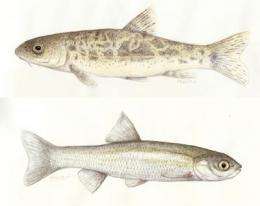
An international team led by the Forest Technology Centre of Catalonia has carried out the first large-scale study of the threats facing freshwater fish in the Mediterranean basin. Invasive species, along with over-exploitation of water resources, are the most important pressures, and those that expose fish to the greatest risk of extinction.
"The continental fish of the Mediterranean basin are one of the most threatened biological groups in the world", Miguel Clavero, lead author of the study and a researcher from the Landscape Ecology Group of the Forest Technology Centre of Catalonia, tells SINC.
The study, which has been published in the journal Diversity and Distributions, looks at the geographical distribution of the manmade factors (pressures) with a negative impact on biodiversity and their relationship to the degree of threat faced by endemic freshwater fish communities in the Mediterranean basin. The study combined information on the pressures affecting 232 fish species and their distribution range.
"The Iberian Peninsula is one of the areas in which invasive species have the greatest impact on native fish", explains Clavero. His team has studied the commonest pressures, such as pollution, water extraction, invasive species, reservoirs, agriculture and over-fishing.
By relating the distribution of these pressures with the degree of threat faced by the fish in each area, the researchers have shown that "fish communities are exposed to the greatest threat of extinction when the most significant pressures are the impact of invasive species and over-exploitation of water resources", the expert says.
Clavero says "these two pressures are the leading causes of biodiversity loss among continental fish in the Mediterranean region". The results bear out those of other studies on a smaller geographic scale carried out in various parts of the Mediterranean.
"We also have notorious examples in Spain of the negative effects of the over-exploitation of water resources, as is the case in the upper basin of the Guadiana (including the Tablas de Daimiel wetlands)", the scientist adds.
The biggest analysis of the Mediterranean basin
The research team compiled the information evaluating the conservation status of endemic continental fish species in the Mediterranean basin drawn up by the International Union for the Conservation of Nature (IUCN) Centre for Mediterranean Cooperation.
The scientists calculated the number of fish species affected by each type of pressure in 10x10 km areas in the Mediterranean basin. "This allowed us to describe the geographical variation in the impacts caused by the various pressures, which could then be related to the extinction risk for the fish communities", explains Clavero.
The team used data on two geographical scales (aside from the 10x10 km areas, they also analysed complete river basins), as well as two complementary indicators on extinction risk, based on the IUCN categories of threat.
More information: Clavero, Miguel; Hermoso, Virgilio; Levin, Noam; Kark, Salit. "Geographical linkages between threats and imperilment in freshwater fish in the Mediterranean Basin" Diversity and Distributions 16(5): 744-754, Sept 2010. DOI:10.1111/j.1472-4642.2010.00680.x
Provided by FECYT - Spanish Foundation for Science and Technology


