Invading weed threatens devastation to western rangelands
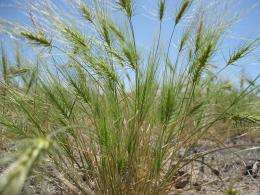
A new field study confirms that an invasive weed called medusahead has growth advantages over most other grass species, suggesting it will continue to spread across much of the West, disrupt native ecosystems and make millions of acres of grazing land almost worthless.
The research, by scientists from Oregon State University and the Agricultural Research Service, was one of the most comprehensive studies ever done that compared the "relative growth rate" of this invasive annual grass to that of other competing species in natural field conditions.
It found that medusahead has a faster growth rate, a longer period of growth and produced more total biomass even than cheatgrass – another invading species that is a major problem in its own right, but not as devastating as medusahead.
"Medusahead is now spreading at about 12 percent a year over 17 western states," said Seema Mangla, a researcher in the OSU College of Forestry. "Once established, it's very hard to get rid of. It displaces native grasses and even other invasive species that animals can still eat. Unless we do more to stop it, medusahead will take over much of the native grassland in the West.
"This is a devil species," she said.
Research is identifying some other grass species, including crested wheatgrass and Sandberg's bluegrass, that may be able to compete with medusahead, reduce its spread and preserve the grazing value of lands, Mangla said. They are also studying new ways of restoring medusahead-infested areas. But so far, medusahead has received very little attention compared to other threats such as cheatgrass, even though it ultimately poses a far greater threat to ecosystems across the West.
Cheatgrass is a serious problem on more than 50 million acres, Mangla said, but grazing animals can still eat it. The new study makes it clear that cheatgrass and native grasses may all eventually be replaced by medusahead, which eliminates more than 80 percent of the grazing value of land.
Experts at the Oregon Department of Agriculture say that once land is invaded by medusahead, it becomes largely worthless, incapable of supporting native animals, birds or livestock.
The sharp and twisting points on the tips of medusahead injure the eyes and mouths of animals, and give the plant its name - based on the female monster in Greek mythology that had hair composed of writhing snakes. The plant takes up other soil resources and its deep root system soaks up limited moisture. It creates fuel for wildfires, has a high silicon content that wears away the teeth of animals, is virtually inedible, and it prevents many other plants from germinating.
"Annual grass invasion is driving one of the largest changes in vegetation structure ever documented," the researchers wrote in their new study. "This conversion has major negative impacts on ecosystem function, wildlife and fire regimes.
"We expect that medusahead will continue to invade both native perennial and less-undesirable invasive annual grasslands, because of its higher relative growth rate and extended period of growth," they reported.
Medusahead is not a new problem, only a rapidly worsening one. Native to the Mediterranean region, it was imported to the United States in the late 1880s and has gradually established footholds since then.
It's now found on about 2.5 million acres in the U.S. – much less than other invading species such as cheatgrass – but it's widespread in the Pacific Northwest and most of Oregon, including the Willamette Valley. Its impact on ecosystems when established is far greater than some other species, experts say, and it has evolved many traits that allow it to invade North America.
"For too long we've treated these invasive species as something you just mow, spray with herbicides, or chop out somehow, and then forget about them," Mangla said. "That just treats the symptoms but doesn't get to the underlying problem. If we're going to stop something like medusahead, we have to better understand its ecology and find ways to compete with it."
The new study – one of the first of its type – is a step toward that, she said. Researchers now have a better target to aim at, in identifying plants that have some ecological characteristics similar to medusahead, and are useful species that may be able to better compete with it once they are established.
"However, this plant is easier to keep out than it is to get rid of," Mangla said. "The time to stop it from taking over the West is now, before it becomes much more widely established. And it has not gotten the attention it deserves."
This research was just published in the Journal of Arid Environments. It was done by OSU and the Eastern Oregon Agricultural Research Center, which is a joint cooperative between the OSU Agricultural Experiment Station and the Agricultural Research Service. This project was part of an area-wide program managing annual grassland ecosystems by the USDA-ARS. It included two years of field studies in 2008 and 2009 near Burns, Ore., in which medusahead growth in specific plots was compared to that of other species.
"Our results suggest that the continued invasion and dominance of medusahead onto native grasslands will continue to increase in severity," the researchers wrote in their report.
Provided by Oregon State University


