Moving holograms: From science fiction to reality (w/ Video)
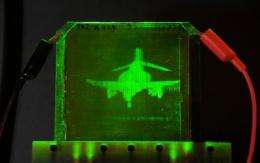
This is a refreshable, holographic image of an F-4 Phantom Jet created on a photorefractive polymer at the College of Optical Sciences, the University of Arizona. Credit: gargaszphotos.com/University of Arizona
Remember the Star Wars scene in which R2D2 projects a three-dimensional image of a troubled Princess Leia delivering a call for help to Luke Skywalker and his allies? What used to be science fiction is now close to becoming reality thanks to a breakthrough in 3D holographic imaging technology developed at the University of Arizona College of Optical Sciences.
A team led by optical sciences professor Nasser Peyghambarian developed a new type of holographic telepresence that allows the projection of a three-dimensional, moving image without the need for special eyewear such as 3D glasses or other auxiliary devices. The technology is likely to take applications ranging from telemedicine, advertising, updatable 3D maps and entertainment to a new level.
The journal Nature chose the technology to feature on the cover of its Nov. 4 issue.
This video is not supported by your browser at this time.
Traditional holograms are printed much in the same way a poster or a painting are, in that once the image is printed on a surface, it is permanent. But a technological breakthrough at the University of Arizona College of Optical Sciences has brought the possibility of full color, rewritable, holographic displays and televisions one step closer to reality.
"Holographic telepresence means we can record a three-dimensional image in one location and show it in another location, in real-time, anywhere in the world," said Peyghambarian, who led the research effort."Holographic stereography has been capable of providing excellent resolution and depth reproduction on large-scale 3D static images," the authors wrote, "but has been missing dynamic updating capability until now."
"At the heart of the system is a screen made from a novel photorefractive material, capable of refreshing holograms every two seconds, making it the first to achieve a speed that can be described as quasi-real-time," said Pierre-Alexandre Blanche, an assistant research professor in the UA College of Optical Sciences and lead author of the Nature paper.
The prototype device uses a 10-inch screen, but Peyghambarian's group is already successfully testing a much larger version with a 17-inch screen. The image is recorded using an array of regular cameras, each of which views the object from a different perspective. The more cameras that are used, the more refined the final holographic presentation will appear.
That information is then encoded onto a fast-pulsed laser beam, which interferes with another beam that serves as a reference. The resulting interference pattern is written into the photorefractive polymer, creating and storing the image. Each laser pulse records an individual "hogel" in the polymer. A hogel (short for holographic pixel) is the three-dimensional version of a pixel, the basic units that make up the picture.
The hologram fades away by natural dark decay after a couple of minutes or seconds depending on experimental parameters. Or it can be erased by recording a new 3D image, creating a new diffraction structure and deleting the old pattern.
This video is not supported by your browser at this time.
Holographic display shows images of researchers in a remote location. Note that in the first image the researcher is smiling; the next time the image is refreshed after several seconds, he's not smiling anymore.
Peyghambarian explained: "Let's say I want to give a presentation in New York. All I need is an array of cameras here in my Tucson office and a fast Internet connection. At the other end, in New York, there would be the 3D display using our laser system. Everything is fully automated and controlled by computer. As the image signals are transmitted, the lasers inscribe them into the screen and render them into a three-dimensional projection of me speaking."Nasser Peyghambarian is a researcher at the University of Arizona. This is a refreshable, holographic image of an F-4 Phantom Jet created on a photorefractive polymer at the College of Optical Sciences, the University of Arizona. Credit: gargaszphotos.com/The University of Arizona
The overall recording setup is insensitive to vibration because of the short pulse duration and therefore suited for industrial environment applications without any special need for vibration, noise or temperature control.One of the system's major hallmarks never achieved before is what Peyghambarian's group calls full parallax: "As you move your head left and right or up and down, you see different perspectives. This makes for a very life-like image. Humans are used to seeing things in 3D."
The work is a result of a collaboration between the UA and Nitto Denko Technical, or NDT, a company in Oceanside, Calif. NDT provided the polymer sample and media preparation. "We have made major advances in photorefractive polymer film fabrication that allow for the very interesting 3D images obtained in our upcoming Nature article," said, Michiharu Yamamoto, vice president at NDT and co-author of the paper.
This video is not supported by your browser at this time.
Laser pulses record image of an F4 Phantom fighter jet on a new holographic display developed by researchers at the University of Arizona and Nitto Denko Technical Corp.
Potential applications of holographic telepresence include advertising, updatable 3D maps and entertainment. Telemedicine is another potential application: "Surgeons at different locations around the world can observe in 3D, in real time, and participate in the surgical procedure," the authors wrote.The system is a major advance over computer-generated holograms, which place high demands on computing power and take too long to be generated to be practical for any real-time applications.
Currently, the telepresence system can present in one color only, but Peyghambarian and his team have already demonstrated multi-color 3D display devices capable of writing images at a faster refresh rate, approaching the smooth transitions of images on a TV screen. These devices could be incorporated into a telepresence set-up in near future.
Provided by
University of Arizona
-
From lemons to lemonade: Reaction uses carbon dioxide to make carbon-based semiconductor,
28 comments
-
Every black hole contains a new universe: A physicist presents a solution to present-day cosmic mysteries,
216 comments
-
New silicon memory chip developed,
16 comments
-
Thioridazine kills cancer stem cells in human while avoiding toxic side-effects of conventional cancer treatments,
3 comments
-
SpaceX private rocket blasts off for space station (Update),
41 comments
-
Rotational Inertia of a disc
22 minutes ago
-
How does B=μH really work?
47 minutes ago
-
I need help with understanding of Inertia of a slender rod and plate?
3 hours ago
-
Voltage and current in a series circuit
4 hours ago
-
Force on the top hinge of an open door
5 hours ago
-
Specular reflection from moving mirrors
8 hours ago
- More from Physics Forums - General Physics
More news stories
Landmark calculation clears the way to answering how matter is formed
(Phys.org) -- An international collaboration of scientists, including Thomas Blum, associate professor of physics, is reporting in landmark detail the decay process of a subatomic particle called a kaon ...
12 hours ago |
4.8 / 5 (9) |
24
|
Is a classical electrodynamics law incompatible with special relativity?
(Phys.org) -- The laws of classical electromagnetism that were developed in the 19th century are the same laws that scientists use today. They include Maxwell’s four equations along with the Lorentz la ...
Lying in wait for WIMPs: Researchers seek to dramatically increase sensitivity of Large Underground Xenon detector
Although it's invisible, dark matter accounts for at least 80 percent of the matter in the universe. No one knows what it is, but most scientists would bet on weakly interacting massive particles, or WIMPs.
May 23, 2012 |
4 / 5 (5) |
13
|
Cloak of invisibility: Engineers use plasmonics to create an invisible photodetector
A team of engineers at Stanford and the University of Pennsylvania has for the first time used "plasmonic cloaking" to create a device that can see without being seen - an invisible machine that detects light. It is the first ...
May 21, 2012 |
4.8 / 5 (16) |
7
|
Hall effect at the speed of light: How can you demonstrate relativistic effects with your mobile phone?
The relativistic Hall effect describing objects rotating at speeds comparable with the speed of light has been reported.
May 21, 2012 |
4.3 / 5 (3) |
8
It's in the genes: Research pinpoints how plants know when to flower
Scientists believe they've pinpointed the last crucial piece of the 80-year-old puzzle of how plants "know" when to flower.
High-speed method to aid search for solar energy storage catalysts
Eons ago, nature solved the problem of converting solar energy to fuels by inventing the process of photosynthesis.
Researchers solve structure of human protein critical for silencing genes
In a study published in the journal Cell on May 24, Cold Spring Harbor Laboratory (CSHL) scientists describe the three-dimensional atomic structure of a human protein bound to a piece of RNA that "guides" the pr ...
Of mice and mental models: Neuroscientific implications of risk-optimized behavior in the mouse
(Medical Xpress) -- Regardless of an organism’s biological complexity, every encephalized animal continuously makes under-informed behavioral choices that can have serious consequences. Despite its ubiquity, ...
Dragon arrives at space station in historic 1st (Update 2)
The privately bankrolled Dragon capsule made a historic arrival at the International Space Station on Friday, triumphantly captured by astronauts wielding a giant robot arm.
Math predicts size of clot-forming cells
UC Davis mathematicians have helped biologists figure out why platelets, the cells that form blood clots, are the size and shape that they are. Because platelets are important both for healing wounds and in strokes and other ...

Nov 03, 2010
Rank: 2 / 5 (1)
What is Patent Infringement ?
http://colossalst...ment.pdf
Looks like they tried designing around Colossal by using chromatophores, but Colossal using "photon induced electric field switching" has 2 Patents on it and the website has been around for eleven years giving plenty of time for these folks to study and attempt a design around.
Once they go non-contact with their functionality they will clearly be in patent violation country.
Nov 03, 2010
Rank: 3.3 / 5 (3)
Nov 03, 2010
Rank: 3 / 5 (2)
Nov 03, 2010
Rank: 1 / 5 (1)
grass for the proper time to go after their prey.
Nov 03, 2010
Rank: 4 / 5 (2)
Nov 04, 2010
Rank: 3.5 / 5 (2)
It's probably part of the nature of the polymer, itself.
Nov 04, 2010
Rank: 2 / 5 (1)
Nov 07, 2010
Rank: 5 / 5 (1)
IANAPL, and besides patent law is littered with case law where the judge or jury did not understand the technology. But one of the things that can cause a patent to be invalidated is abandonment. This doesn't mean what you might expect. Say A has a patent on some process, and B comes along years later to patent an improvement that makes it practical. Does B need a license from A in order to use the combined product? Can depend on what A has been doing since his or her patent was issued. If he has not been trying to improve his process or product, he may be found to have abandoned the patent.
Oh, also one thing that patent owners tend to misunderstand. If I 'practice' your patent in order to study it or improve it, that is not infringement. If I sell my product, or a product made using your product that may be infringement.