What makes flies attack?
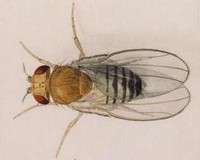
Drosophila melanogaster. Credit: Carnegie Institution of Washington publication
Pity the poor female fruit fly. Being a looker is simply not enough, it seems. If you're to get a date, much less a proposal, you must also smell and act like a girl. Otherwise, you might just have a fight on your hands. Read more in next week's issue of the online, open access journal PLoS Biology.
As with most animals, Drosophila face the problem of distinguishing between a potential mate and a potential competitor. If, when meeting a second fruit fly, a male fly thinks "female," he'll begin courting her. But if he senses another male, he'll fight. What triggers these sex-specific responses? According to new research by scientists at Harvard Medical School, it's pheromone profiles and behavioral patterns. The researchers discovered the separate and combined effects of smell and action by manipulating the expression of a gene that produces a protein that both governs the sex specificity of fruit fly pheromones and the sex-linked behavior cues in a fly brain. The results show that not only pheromonal but also behavioral cues can serve as triggers of aggression, underscoring the importance of behavioral feedback in the manifestation of social behavior.
Would a male fruit fly ever attack a female of the species? A research team led by María de la Paz Fernández and Yick-Bun Chan in the laboratory of Edward Kravitz, the George Packer Berry Professor of Neurobiology at Harvard Medical School, used Drosophila as a model system in which to address this question. In fruit flies, sex is cell specific, yet the sex of cells and tissues can be changed by altering the expression of genes that determine their sexual identity. One of these genes, called transformer, makes a protein that is active in females but not in males.
For their investigation, the researchers first chose to masculinize females by inhibiting the expression of transformer. When the pheromone profile for females was masculinized, the researchers found that males would attack the newly altered females despite having copulated with them, indicating that pheromonal cues alone could label another fly as a competitor. Likewise, males attacked females that had been masculinized for both smell and behavior.
But the researchers were surprised to discover that males also attacked "aggressive females"flies that still looked and smelled female but had been genetically altered to display male-like behavior. When the researchers turned the tables by triggering transformer in males so as to feminize both pheromone and behavior profiles, control males showed no aggression toward the transformed males and instead began to court them. These results demonstrate that by presenting different types of sensory cues, the behavioral response of a male can be switched.
"Future studies will aim at unraveling the neuronal circuitry that governs this type of decision-making behavior, as such decisions are essential for survival. With the powerful genetic methods available in fly neurobiology, it should be possible to dissect the decision-making circuitry at far greater levels of detail than have heretofore be possible on other species," said Kravitz.
More information: Fernandez MP, Chan Y-B, Yew JY, Billeter J-C, Dreisewerd K, et al. (2010) Pheromonal and Behavioral Cues Trigger Male-to-Female Aggression in Drosophila. PLoS Biol 8(11): e1000541. doi:10.1371/journal.pbio.1000541
Provided by
Public Library of Science
-
From lemons to lemonade: Reaction uses carbon dioxide to make carbon-based semiconductor,
28 comments
-
Every black hole contains a new universe: A physicist presents a solution to present-day cosmic mysteries,
215 comments
-
New silicon memory chip developed,
16 comments
-
Thioridazine kills cancer stem cells in human while avoiding toxic side-effects of conventional cancer treatments,
3 comments
-
SpaceX private rocket blasts off for space station (Update),
41 comments
-
What does exophillic and endophillic mean in terms of mosquito and their control?
May 24, 2012
-
Semen stains glows under black lights (uv light)?
May 23, 2012
-
Question on Human Chromosome 2
May 23, 2012
-
How important is composition of TBST in diluting antibodies and Western Blotting?
May 22, 2012
-
Does the medulla monitor blood pH
May 20, 2012
-
What physically constitutes memory?
May 17, 2012
- More from Physics Forums - Biology
More news stories
Copy of the genetic makeup travels in a protein suitcase
Scientists from the Institute for Physical and Theoretical Chemistry at the University of Bonn have succeeded for the first time in the real time filming of the transport of an important information carrier in biological ...
3 hours ago |
not rated yet |
0
|
Study uncovers secret to speedy burrowing by razor clams
(Phys.org) -- If you look at a razor burrowing clam sitting in a bucket, youd never guess that it could burrow itself down into the soil, much less do it with any speed. Razor clams look like fat straws, ...
'Transformer' protein makes different sized transport pods
These spheres may look almost identical, but subtle differences between them revealed a molecular version of the robots from Transformers. Each sphere is a vesicle, a pod that cells use to transport materials ...
4 hours ago |
not rated yet |
0
A new invading sea crab reaches the Ebro Delta
Originally endemic to the Atlantic Coast of North America, over the past 30 years Dyspanopeus sayi has been involuntarily introduced in the UK, France, the Netherlands, the Black Sea and the Adriatic Sea. A ...
4 hours ago |
not rated yet |
0
A mating dance with Popeye arms
A research team at Bielefeld University headed by the evolutionary biologist Dr. Holger Schielzeth is now studying how far a comparable mechanism is involved in mate choice among locusts. The male Siberian ...
3 hours ago |
not rated yet |
0
Skp2 activates cancer-promoting, glucose-processing Akt
HER2 and its epidermal growth factor receptor cousins mobilize a specialized protein to activate a major player in cancer development and sugar metabolism, scientists report in the May 25 issue of Cell.
Math predicts size of clot-forming cells
UC Davis mathematicians have helped biologists figure out why platelets, the cells that form blood clots, are the size and shape that they are. Because platelets are important both for healing wounds and in strokes and other ...
Early physical therapist treatment associated with reduced risk of healthcare utilization and reduced overall healthcare
A new study published in Spine shows that early treatment by a physical therapist for low back pain (LBP), as compared to delayed treatment, was associated with reduced risk of subsequent healthcare utilization and lower ...
Pancreatectomy OK without downstaging from therapy
(HealthDay) -- Pancreatectomy improves median survival in pancreatic cancer patients even when presurgical neoadjuvant therapy does not lead to radiographic downstaging of tumors, according to a study published ...
Flesh-Eating bacteria no cause for panic, experts say
(HealthDay) -- Despite scary headlines by the score, most people don't have to fear that they'll be the next victim of the so-called flesh-eating bacteria disease, experts say.
Of mice and mental models: Neuroscientific implications of risk-optimized behavior in the mouse
(Medical Xpress) -- Regardless of an organism’s biological complexity, every encephalized animal continuously makes under-informed behavioral choices that can have serious consequences. Despite its ubiquity, ...
Nov 27, 2010
Rank: not rated yet