Dutch study suggests Wi-Fi possibly harmful to trees
November 24, 2010 by Lin Edwards report

tree

Enlarge

Image: Wikipedia.

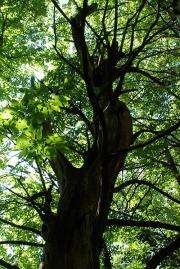
(PhysOrg.com) -- A new study carried out in the Netherlands suggests radiation from Wi-Fi networks may be damaging trees and affecting the growth of other plants near routers.

Scientists from Wageningen University were asked to carry out the study five years ago after local officials in Alphen aan den Rijn noted that ash trees planted near a were suffering from bleeding bark, cracks, lumps, discolorations, and their leaves were dying. No bacterial or viral infection could be identified in the trees.

The researchers, led by Dr. A.A.M. van Lammeren, exposed small ash trees and other plants to six sources of radiation at frequencies varying from 2412 to 2472 MHz and a capacity of 100 mW EIRP, the range common for . The plants were placed at distances varying from 50 to 300 cm for a period of more than three months. The results revealed that in trees closest to the Wi-Fi source the upper and lower epidermis (skin) of the leaves developed a metallic luster and began to die off.

A survey of trees in urban areas in the Netherlands showed 70 percent of all deciduous trees had similar symptoms, compared to only 10 percent five years ago, while in wooded areas away from urban centers trees were unaffected.

Reports on the study may inflame concerns in some over locating wireless routers in schools and fears radiation from them may affect humans as well as , but the scientists concerned stress the findings are preliminary and no far-reaching conclusions can be made. The researchers say larger scale research is needed over a longer period to confirm the findings. It is unclear whether the experiments ruled out other possible factors such as the presence of more pollution in urban areas than forests. The study also acknowledges that other research carried out elsewhere has shown Wi-Fi has no detrimental effects.

The study will be the subject of a conference in the Netherlands in February next year.

More information: Wageningen University original (Dutch): http://www.wagenin … en101120.htm

© 2010 PhysOrg.com

3.5 /5 (21 votes)  

Filter


Move the slider to adjust rank threshold, so that you can hide some of the comments.


Display comments: newest first

Kiljoy616
Nov 24, 2010

Rank: 4.6 / 5 (5)
Oh not this again. So this means that IT personnel should be dropping like flies all over. Nope I am still here my kid is still here and so is the rest of my family oh yes the plants in my house still here. I am all for the report but come on how far from the source did the plants have to be, is this happening all over the world or just there? Need some real data.
geokstr
Nov 24, 2010

Rank: 2 / 5 (8)
Another reason why we simply must kill off 80% of the homo sapiens sapiens who are raping Gaia and go back to the Stone Age. Our intellectual betters can then on occasion Hummer or Learjet from their villas on the Crimean and administer their blessings upon us peasants in our mud huts.
CarolinaScotsman
Nov 24, 2010

Rank: 5 / 5 (7)
Dutch EMF disease?
Modernmystic
Nov 24, 2010

Rank: 3 / 5 (4)
This stuff is priceless...
Eikka
Nov 24, 2010

Rank: 5 / 5 (2)
This is another case of publishing shocking preliminary results to generate public fear, and then when it eventually turns out to nothing, the correction gets hardly any facetime on the media.

All becacuse scared people want to give you more money to study the danger, despite dozens of studies and decades of experience turning out nothing.
otto1932
Nov 24, 2010

Rank: 1.4 / 5 (19)
Another reason why we simply must kill off 80% of the homo sapiens sapiens who are raping Gaia and go back to the Stone Age. Our intellectual betters can then on occasion Hummer or Learjet from their villas on the Crimean and administer their blessings upon us peasants in our mud huts.
Humans will routinely be subjected to all sorts of radiation both here and in space which they will have to endure. Exposing us now begins to weed out the more susceptable strains and gives us time and insurance money to develop and test treatments. This is much of the reason for the excessive above-ground nuke testing in the last century.

Hospitals are laboratories.
El_Nose
Nov 24, 2010

Rank: 1 / 5 (2)
i wonder if anyone has look at the foundations of the radiation sources. Its probably that the sources are using a foundation that is releasing a poison into the ground that has been undetected... since it mainly effects trees that signals to me that unless the earth is very shallow the issue is actually around 5 ft below ground or farther.
KomMaelstrom
Nov 24, 2010

Rank: 2.3 / 5 (3)
I'm sure that nearly everything we do is harmful to something, however that's the life cycle constantly changing the environment. Flaws are exploited, causing new growth for one species while another dies off. Are we also not considering the radiation poisoning everything living downwind power lines?
This is small fry....
DamienS
Nov 24, 2010

Rank: 3 / 5 (4)
Exactly what mechanism are they proposing for the purported damage? WiFi does not produce ionizing radiation (by a long, long way), which would be harmful to living things, so what's the mechanism?
deev
Nov 25, 2010

Rank: 1 / 5 (1)
[part 2/ if makes it through]There are other aspects of vegetative stress on the property: a giant aggressive rosebush for years near that Norway, probably in the same plume of radiation descending on our yard, has turned sickly; there have been leaf deformities never seen all our years here on grape vine & pear tree; one fir tree sheltered mostly from that plume, has newly browned-out spots ONLY where the branches poke out around a north wall thus directly exposed to this new emitter. Wake up! Synthetic xenobiotic radiation like this is a universal bio-/enviro-stressor, and must be turned back starting now, lest everything with cells in its body eventually succumb in one way or another. All over our city, now further densely e-smogged with "smart" utility meters just activated this year, we have noticed accelerated tree stress this year, whereas In local ravines where radiation tends to be much lower there are few or no signs of this defoliation etc. [cont. if poss.]
deev
Nov 25, 2010

Rank: 1 / 5 (2)
[3/3]
Open your eyes, pay attention to your own symptoms and those of people around you, clue in & tell everyone you can, so as to effect drastic corrective change as speedily as possible. Another current anecdote: black raspberry bush part exposed to new "smart" electricity meter radiation (different locality, stronger transmission, higher frequency) had exposed cane leaves wrinkle and turn yellow and yield inedible-tasting fruit, canes sheltered just fine.
deev
Nov 25, 2010

Rank: not rated yet
[post 1/3]
Much more than wifi at issue. A recent collection of papers should be of interest, http://dl.dropbox...43525/An ICEMS Monograph 2010.pdf . So little notice is taken of people's & animals' suffering from EM assaults, let this documented tree suffering be a wedge into the comprehensive issues for the uninitiated, kept in the dark by interests who like that ignorance just fine. Some of our observations:

We have lived in the same location for over 20 years. We have been until last fall relatively distant in our urban setting from cell phone base station antennae (400 & 800m). Last fall at 200m a "low power" new 2.1-something gHz transmitter was aimed our way (and the general ambient level is of course up as well with more & more wireless mania dependencies). A Norway maple previously resplendent (at least 15 of those years) suddenly this spring became defoliated by half ONLY on the side facing the mast (photos available).[split post]
El_Nose
Nov 26, 2010

Rank: not rated yet
Did I really get voted a 1 for asking an intelligent legitamite question... without so much as a reason why my comment was so foolish.
geokstr
Nov 26, 2010

Rank: 1.5 / 5 (2)
Well, as a result of this fabulous "study", I'm sure that at least Switzerland will ban WiFi. After all, they passed laws giving equal rights to broccoli and turnips.
neiorah
Nov 29, 2010

Rank: not rated yet
The adverse affects of WiFi is a possibility. It would be wise of us to explore this further. Frequencies cook food so how is it impossible that higher frequencies damage plants. Plants and trees are not able to rebound as well as humans do so it stands to reason that if something is a miss, they would be the first to show the symptoms. You do not have to be a scientist to figure this out.
Rank 3.5 /5 (21 votes)
Relevant PhysicsForums posts

More news stories

Copy of the genetic makeup travels in a protein suitcase

Scientists from the Institute for Physical and Theoretical Chemistry at the University of Bonn have succeeded for the first time in the real time filming of the transport of an important information carrier in biological ...

Biology / Cell & Microbiology

created 2 hours ago | popularity not rated yet | comments 0 | with audio podcast

'Transformer' protein makes different sized transport pods

These spheres may look almost identical, but subtle differences between them revealed a molecular version of the robots from Transformers. Each sphere is a vesicle, a pod that cells use to transport materials ...

Biology / Cell & Microbiology

created 2 hours ago | popularity not rated yet | comments 0

A mating dance with Popeye arms

A research team at Bielefeld University headed by the evolutionary biologist Dr. Holger Schielzeth is now studying how far a comparable mechanism is involved in mate choice among locusts. The male Siberian ...

Biology / Plants & Animals

created 1 hour ago | popularity not rated yet | comments 0

Study uncovers secret to speedy burrowing by razor clams

(Phys.org) -- If you look at a razor burrowing clam sitting in a bucket, you’d never guess that it could burrow itself down into the soil, much less do it with any speed. Razor clams look like fat straws, ...

Biology / Plants & Animals

created 5 hours ago | popularity not rated yet | comments 2 | with audio podcast report

A new invading sea crab reaches the Ebro Delta

Originally endemic to the Atlantic Coast of North America, over the past 30 years Dyspanopeus sayi has been involuntarily introduced in the UK, France, the Netherlands, the Black Sea and the Adriatic Sea. A ...

Biology / Ecology

created 3 hours ago | popularity not rated yet | comments 0


New device allows pacemaker patients to safely undergo MRIs

For many, it's a medical conundrum: The very pacemaker keeping their heart in rhythm prevents them from undergoing an MRI to diagnose other ailments, because interaction between the two devices could prove deadly.

Common therapies for basal cell carcinoma offer similar survival

(HealthDay) -- For patients with superficial basal cell carcinoma (sBCC), treatment with imiquimod or photodynamic therapy (PDT) results in similar long-term tumor-free survival, according to a review published ...

One-fifth of healthy middle-aged men have low-grade murmur

(HealthDay) -- More than one-fifth of healthy middle-aged men have a low-grade systolic heart murmur that confers a nearly five-fold higher risk of future aortic valve replacement (AVR), according to a study ...

Cancer patients share web info with docs for insight, advice

(HealthDay) -- Cancer patients' primary goal in talking with their doctors about information they've found on the Internet is to get more insight and advice on the online information, new research indicates.

Of mice and mental models: Neuroscientific implications of risk-optimized behavior in the mouse

(Medical Xpress) -- Regardless of an organism’s biological complexity, every encephalized animal continuously makes under-informed behavioral choices that can have serious consequences. Despite its ubiquity, ...

Dragon arrives at space station in historic 1st (Update 2)

The privately bankrolled Dragon capsule arrived at the International Space Station for a historic docking Friday, captured by astronauts wielding a giant robot arm.