Detailed dark matter map yields clues to galaxy cluster growth
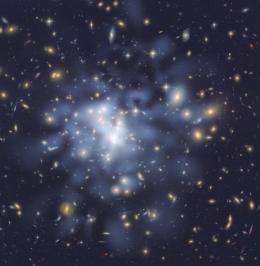
This is one of the most detailed maps of dark matter in our universe ever created. The location of the dark matter (tinted blue) was inferred through observations of magnified and distorted distant galaxies seen in this picture. Image credit: NASA/JPL-Caltech/ESA/Institute of Astrophysics of Andalusia, University of Basque Country/JHU
(PhysOrg.com) -- Astronomers using NASA's Hubble Space Telescope took advantage of a giant cosmic magnifying glass to create one of the sharpest and most detailed maps of dark matter in the universe. Dark matter is an invisible and unknown substance that makes up the bulk of the universe's mass.
The new dark matter observations may yield new insights into the role of dark energy in the universe's early formative years. The result suggests that galaxy clusters may have formed earlier than expected, before the push of dark energy inhibited their growth. A mysterious property of space, dark energy fights against the gravitational pull of dark matter. Dark energy pushes galaxies apart from one another by stretching the space between them, thereby suppressing the formation of giant structures called galaxy clusters. One way astronomers can probe this primeval tug-of-war is through mapping the distribution of dark matter in clusters.
A team led by Dan Coe at NASA's Jet Propulsion Laboratory in Pasadena, Calif., used Hubble's Advanced Camera for Surveys to chart the invisible matter in the massive galaxy cluster Abell 1689, located 2.2 billion light-years away. The cluster's gravity, the majority of which comes from dark matter, acts like a cosmic magnifying glass, bending and amplifying the light from distant galaxies behind it. This effect, called gravitational lensing, produces multiple, warped, and greatly magnified images of those galaxies, like the view in a funhouse mirror. By studying the distorted images, astronomers estimated the amount of dark matter within the cluster. If the cluster's gravity only came from the visible galaxies, the lensing distortions would be much weaker.
Based on their higher-resolution mass map, Coe and his collaborators confirm previous results showing that the core of Abell 1689 is much denser in dark matter than expected for a cluster of its size, based on computer simulations of structure growth. Abell 1689 joins a handful of other well-studied clusters found to have similarly dense cores. The finding is surprising, because the push of dark energy early in the universe's history would have stunted the growth of all galaxy clusters.
"Galaxy clusters, therefore, would had to have started forming billions of years earlier in order to build up to the numbers we see today," Coe explains. "At earlier times, the universe was smaller and more densely packed with dark matter. Abell 1689 appears to have been well fed at birth by the dense matter surrounding it in the early universe. The cluster has carried this bulk with it through its adult life to appear as we observe it today."
Mapping the Invisible
Abell 1689 is among the most powerful gravitational lensing clusters ever observed. Coe's observations, combined with previous studies, yielded 135 multiple images of 42 background galaxies.
"The lensed images are like a big puzzle," Coe says. "Here we have figured out, for the first time, a way to arrange the mass of Abell 1689 such that it lenses all of these background galaxies to their observed positions." Coe used this information to produce a higher-resolution map of the cluster's dark matter distribution than was possible before.
Coe teamed with mathematician Edward Fuselier, who, at the time, was at the United States Military Academy at West Point, to devise a new technique to calculate the new map. "Thanks, in large part, to Eddie's contributions, we have finally `cracked the code' of gravitational lensing. Other methods are based on making a series of guesses as to what the mass map is, and then astronomers find the one that best fits the data. Using our method, we can obtain, directly from the data, a mass map that gives a perfect fit."
Astronomers are planning to study more clusters to confirm the possible influence of dark energy. A major Hubble program that will analyze dark matter in gigantic galaxy clusters is the Cluster Lensing and Supernova survey with Hubble (CLASH). In this survey, the telescope will study 25 clusters for a total of one month over the next three years. The CLASH clusters were selected because of their strong X-ray emission, indicating they contain large quantities of hot gas. This abundance means the clusters are extremely massive. By observing these clusters, astronomers will map the dark matter distributions and look for more conclusive evidence of early cluster formation, and possibly early dark energy.
Provided by
JPL/NASA
-
From lemons to lemonade: Reaction uses carbon dioxide to make carbon-based semiconductor,
28 comments
-
Every black hole contains a new universe: A physicist presents a solution to present-day cosmic mysteries,
215 comments
-
New silicon memory chip developed,
16 comments
-
Thioridazine kills cancer stem cells in human while avoiding toxic side-effects of conventional cancer treatments,
3 comments
-
SpaceX private rocket blasts off for space station (Update),
41 comments
-
Transiting Exoplanet Light Curve
9 hours ago
-
Math behind Theoretical Physics
May 24, 2012
-
Do we know whats at the center of galaxies yet?
May 23, 2012
-
Structure of the Milky Way?
May 20, 2012
-
What would it take to terraform Pluto and Charon?
May 19, 2012
-
Whats is volume of mass at the centre of the sun
May 19, 2012
- More from Physics Forums - General Astronomy
More news stories
SAfrica stops short of being disappointed over SKA verdict
South Africa stopped short of expressing disappointment after it failed to win the bid to single-handily host the world's most powerful radio telescope.
Space & Earth / Space Exploration
31 minutes ago |
not rated yet |
0
Astronauts capture SpaceX's Dragon for station dock
Astronauts aboard the International Space Station reached out and caught SpaceX's Dragon capsule for docking at the orbiting lab on Friday in a historic first for commercial spaceflight.
Space & Earth / Space Exploration
27 minutes ago |
not rated yet |
0
Dragon arrives at space station in historic 1st (Update 2)
The privately bankrolled Dragon capsule arrived at the International Space Station for a historic docking Friday, captured by astronauts wielding a giant robot arm.
Space & Earth / Space Exploration
2 hours ago |
5 / 5 (3) |
4
SKA super telescope to be built in Australia, South Africa (Update 2)
A long-running joust to host a radio telescope that would give mankind its farthest peek into the Universe ended on Friday with a Solomon-like judgement to split the site between Australia and South Africa.
3 hours ago |
5 / 5 (1) |
2
Get ready for the transit of Venus
Scientists and amateur astronomers around the world are preparing to observe the rare occurrence of Venus crossing the face of the Sun on 5-6 June, an event that will not be seen again for over a hundred years.
Space & Earth / Space Exploration
4 hours ago |
5 / 5 (1) |
0
Apple CEO Cook gives up $75M in stock dividends
(AP) -- Apple says CEO Tim Cook is giving up $75 million in dividends on restricted stock.
More mental health care urged for kids who self-harm
(HealthDay) -- Doctors have long known that some kids suffering severe emotional turmoil find relief in physical pain -- cutting or burning or sticking themselves with pins to achieve a form of release.
Neck strength, cervical spine mobility don't predict pain
(HealthDay) -- Neither isometric neck muscle strength nor passive mobility of the cervical spine, two physical capacity parameters found to be associated with neck pain in other studies, predicts later neck ...
Cancer patients share web info with docs for insight, advice
(HealthDay) -- Cancer patients' primary goal in talking with their doctors about information they've found on the Internet is to get more insight and advice on the online information, new research indicates.
A mating dance with Popeye arms
A research team at Bielefeld University headed by the evolutionary biologist Dr. Holger Schielzeth is now studying how far a comparable mechanism is involved in mate choice among locusts. The male Siberian ...
P&G to add latches to make detergent packs safer
(AP) -- Procter & Gamble says it will change the design of packaging for its miniature laundry detergent product to deter children from eating the brightly colored packets that look like candy.
Nov 12, 2010
Rank: 1 / 5 (5)
http://www.presto...ndex.htm
Nov 12, 2010
Rank: 4.8 / 5 (8)
Inventing entirely new physics or religions to explain observations is as old as mankind. It might even be older than that...
However, The principle of Occam's Razor suggests that the simplest explanations are usually correct. While its true that various anti-gravity theories COULD be correct, its much simpler to explain dark matter as one of the number of possible stable particles with mass that don't interact with light.
Nov 12, 2010
Rank: 4.3 / 5 (3)
What? Simpler? No, the "possible stable particles with mass" you mention aren't really any simpler than the AGM alternatives.
I think a better response to Tim is - thank you for sharing your ideas in a concise way. We look forward to seeing publication of peer reviewed research demonstrating the predictive ability of your theories.
Commenters on this website throw out that hygiene tool WAY too frequently.
Nov 12, 2010
Rank: 5 / 5 (4)
Its a matter of opinion I suppose. I personally think that any one of the stable particles that are predicted with very simple extensions to the SM are preferable to creating a new particle that emits repulsive gravitons. Anti-gravity requires entirely new physics to explain.
Nov 12, 2010
Rank: 1 / 5 (3)
Nov 12, 2010
Rank: 1 / 5 (1)
Nov 12, 2010
Rank: 2.3 / 5 (3)
"Dark matter is an invisible and ....."
"The new dark matter observations may...."
????????
Nov 12, 2010
Rank: 3 / 5 (6)
"... to create one of the sharpest and most detailed maps of dark matter in the universe. Dark matter is an invisible and unknown substance ...."
Those two sentences contradict each other. They are mapping an effect, the cause of which is unknown. Dark matter is a theory to explain the effect. They are NOT mapping dark matter until we know what it is or if it even exists.
Nov 12, 2010
Rank: 4 / 5 (7)
One may indirectly observe something by observing its effects.
Nov 12, 2010
Rank: 1 / 5 (5)
A. Einstein: "Make everything as simple as possible, but not simpler"
The simplicity therefore cannot serve as an ultimate criterion of general truth. Many modern theories are actually quite abstract and complex.
The assumption, cosmic space is filled with sparse antimatter looks like unnecessary complication - but it explains, where the missing antimatter disappeared after Big Bang (between other). It explains, why we are observing 511 keV signal in contact of observable matter with dark matter. Many astronomers are believing by now, it's because dark matter particles decays into antimatter - but what if dark matter contain antimatter directly?
Why this simple assumption wasn't considered from its very beginning?
Nov 12, 2010
Rank: 4.5 / 5 (6)
yes, exactly... as the 'planet searchers' have shown on a cosmic scale ..
Is it now every few days that a planet is newly discovered by a 'wobble'?
Nov 12, 2010
Rank: 1 / 5 (4)
If you take the viewpoint that light looses energy/redshifts as it leaves a star, then you must also factor in that it is loosing a small amount of energy/redshifting every second that it exists as the giant gravity wells coming from galaxies and galactic clusters will always be playing on it.
So, for me, light that comes from a billion light years away is simply more redshifted because it is a billion years old and gravity has been riding on it's back the whole time.
This isn't to say that the universe isn't expanding, maybe it is, but I don't think it is doing the redshifting.
Nov 12, 2010
Rank: 1 / 5 (1)
Nov 12, 2010
Rank: 3.4 / 5 (5)
Tired light theory and its proponents are almost as tiring as the aether and EU nutjobs.
Nov 12, 2010
Rank: 1 / 5 (5)
Aether as in Dark Matter and all the crap they say exists but which has never even been seen or touched?
I can at least prove that lights looses energy in a gravity well. Can you do the same for dark energy? No.
Nov 12, 2010
Rank: 3.7 / 5 (6)
It may have escaped your attention, but this article is primarily about dark matter. That gravitational lensing occurs to the extent that it does (where there's insufficient luminous matter) is pretty strong evidence for dark matter. Galaxy rotation curves is another. Whereas tired light has been categorically debunked.
Nov 13, 2010
Rank: 1 / 5 (5)
It may have escaped your attention, but the same guys who claim that dark energy is pushing galaxies apart also needed dark matter for their equations to match up.
Lets just make some crap up to fit our math that obviously doesn't match reality.
Nov 13, 2010
Rank: 1 / 5 (3)
Nov 13, 2010
Rank: 3.5 / 5 (4)
Yes, but you can't say what it is when you don't KNOW what it is.
This article should say: "We are mapping gravitational effects that aren't explained by current theories and postulating the existence of dark matter to explain it. Dark matter may or may not cause this because current accepted theories not only don't explain what dark matter is, they can't say it even exists."
Gravitational effects are as much evidence of the existence of dark matter as cattle mutilations are evidence of Chupacabra.
Nov 13, 2010
Rank: 3.2 / 5 (6)
You can say what it is within the current broadly accepted framework. Dark matter is a placeholder name for matter which must have certain constrained characteristics - it's not a free-for-all. New observations help to place constraints on the range of dark matter candidates. So far, all the evidence points in this direction. Alternatives simply aren't compelling and aren't supported observationally. These unsupported alternatives include tired light and various MOND theories (which are at least plausible, unlike tired light). If there is a better alternative to dark matter, I'd like to hear about it (I really would).
Nov 13, 2010
Rank: 1 / 5 (7)
I guess if all we are allowed to say is what is in this list of "Broadly Accepted Framework" we don't really need to discuss or think about any of this any further.
Yep, just think what you are told to think. That is how science operates afterall.
Nov 13, 2010
Rank: 3 / 5 (4)
Which logical fallacy is that - Appeal to Ridicule or Straw Man?
Nov 13, 2010
Rank: 1.3 / 5 (6)
The logical fallacy that I am arguing with a fanatic that won't take any other possibility than that which is equated out in whatever Physics Bible he is reading.
I am not asking you to think for yourself, I am just pointing out that Dark Matter/Dark Energy isn't a fact, so you don't have to take it as such.
Nov 13, 2010
Rank: 3.7 / 5 (3)
You appear to be well versed in logical fallacies - you've just added Ad Hominem. I can only point out the current best fit thinking in cosmology, I cannot make you make sense of it. If you wish to cling to outdated notions, that is up to you. You certainly aren't unique in this respect on this board.
Nov 13, 2010
Rank: 1.3 / 5 (3)
Your problem could be that you think I cling to that theory, like you seem to the "accepted" theory.
I also support several other theories as possible alternate explanations for dark matter/energy.
Such as:
-Numerous Stellar Mass Blackholes for the extra mass.
-Gravity from an extra dimension tugging on our matter.
-Gravity from the past and the future tugging on present matter(and vice versa).
-A possible plateu for gravitational scaling causing it to be greater than we are able measure at longer distances.
I don't really understand why you have a problem with alternate theories when the thousands of scientists have used the same old equations for a century and still don't really understand how the forces of nature, especially gravity, work together at fundamental levels.
Nov 13, 2010
Rank: 5 / 5 (2)
I never said I had a problem with alternate theories. What I did say was that based on all available, measurable evidence to date, the overwhelming favourite, by far, is dark matter. None of the alternatives you list stands up to scrutiny, and they have been scrutinized.
* Stellar Mass BH - not enough of them to make a dent. They would have to be in impossible distributions and there would be associated radiation emissions.
* Gravity from extra dimensions - highly speculative at best, based on no real observational evidence.
* Gravity from the past and the future tugging on present matter - even more speculative.
* A plateu for gravitational scaling - that's a MOND theory. None of them are compatible with GR.
Nov 13, 2010
Rank: 5 / 5 (1)
Mea culpa. The paper appeared in the Astrophysical Journal
Nov 13, 2010
Rank: not rated yet
A version of the ApJ paper on A1689 is available here: http://hubblesite.../pdf.pdf
Nov 15, 2010
Rank: 3.5 / 5 (2)
Wrong, that is only true if you know what you are observing, if you don't know what it is you are just observing the effects and guessing as to what it is that causes them. For example, the sun was observed to rise and fall every day since man first started looking and the conclusion was that it was moving while the earth stood still.
Nov 16, 2010
Rank: not rated yet
Nov 20, 2010
Rank: not rated yet