Collisions of two galaxies may have formed Andromeda (w/ Video)
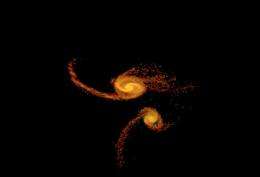
November 26, 2010 by Lin Edwards report

Collisions of two galaxies may have formed Andromeda (w/ Video)

Enlarge

Image credit: GEPI, Observatoire de Paris / NAOC

(PhysOrg.com) -- New computer simulations suggest the nearest galactic neighbors to our own Milky Way, the Magellanic Clouds and the Andromeda Galaxy, may have been shaped by the massive collision of two galaxies billions of years ago.

The Milky Way lies in a region known to astronomers as the “Local Group,” which consists of almost 40 galaxies, including the two biggest: and the Milky Way. Both are massive spiral galaxies.

Astronomers have thought the Andromeda Galaxy (Messier 31), which is around 2.5 million light-years away from Earth, was formed by a merging of two smaller galaxies or a combination of many smaller mergers, but the ideas had never been tested or dated before. So a team of researchers in France and China decided to model how the galaxy might have evolved.

This video is not supported by your browser at this time.

The simulations were carried out on high performance computers and used around eight million particles to simulate gas, dark matter, and stars. They modeled the gravitational and fluid interactions between the elements and found they could simulate the formation of Andromeda if two galaxies merged: one slightly larger than the Milky Way and the other around one third the size.

The astronomers, led by Dr. François Hammer of the Observatoire de Paris, were able to reproduce most of the properties of Andromeda, such as its huge central bulge, large, thin disk, massive ring of dust and gas, and huge stream of old stars. The computer simulation showed the two galaxies began to merge in a violent collision starting around 8.75 billion years ago with fusion occurring around 3.5 billion years later.

The collision must have been extremely violent to produce the massive angular momentum required to form the Andromeda Galaxy. It would have been the most dramatic and important event in the history of the Local Group.

The computer simulation also predicted the collision would have led to the formation of massive streams (called tidal tails) of long, thin areas of stars and interstellar gas with a total mass around a third that of the Milky Way.

The researchers think one such tail may have formed the Large and Small Magellanic Clouds, which are small, irregular, satellite galaxies apparently passing the Milky Way or orbiting at a distance of about 180,000 light years. If they did originate in the collision, they would have been ejected towards the at around a million kilometers per hour (620,000 mph).

Hammer and the team took the known peculiar velocities of the Magellanic Clouds and traced their positions back several billions of years, and found a number of solutions that had their origin in the Andromeda Galaxy.

The results support the hypothesis that spiral galaxies are mostly formed by collisions between galaxies, and the hypothesis that dwarf galaxies often originate from tidal tails formed by mergers. The findings may also affect the estimations of the amount of dark matter in .

The results of the research, which also involved scientists from the National Astronomical Observatory of China (NAOC), are published in Astrophysical Journal Letters and The Astrophysical Journal.

More information: -- F. Hammer et al (2010) Does M31 results from an ancient major merger ? ApJ 725 542. doi:10.1088/0004-637X/725/1/542

-- Y. B. Yang et al (2010) Could the Magellanic Clouds be tidal dwarves expelled from a past-merger event occurring in Andromeda? Astrophysical Journal Letters http://fr.arxiv.or … 0.2748v2.pdf

-- French press release: http://www.grandpu … rds-d-annees

© 2010 PhysOrg.com

4.8 /5 (16 votes)  

Filter


Move the slider to adjust rank threshold, so that you can hide some of the comments.


Display comments: newest first

Mercury_01
Nov 26, 2010

Rank: not rated yet
I hereby do postulate- (some privacy please)

Isnt it possible that this collision actually occurred between Andromeda and the edge of the milky way, and that weve both since recovered in a swirling loop and will eventually collide again?.
yyz
Nov 26, 2010

Rank: 5 / 5 (2)
I found this new theory of a strong interaction of a proto-Andromeda with another galaxy interesting as it comes on the heels of a separate study done last year that looked at a possible (weak) interaction between the Andromeda Galaxy and M 33. Based on an ongoing study of the environs of M 33 and M 31, astronomers began modeling various scenarios and comparing the results with what is observed. Although no unique solutions for an orbit were found, the computer model was able to match up with several observed anomalies present in the extended disk of M 31 and M 33. Earlier radio studies have also found signs of a past interaction based on study of neutral hydrogen in and around the two galaxies. The paper discussed above is in French, so I don't know if the M31-M33 interaction was discussed.

The paper here: http://arxiv.org/...98v1.pdf

Computer sim: http://www.youtub...m3LHlyrs
yyz
Nov 26, 2010

Rank: 5 / 5 (2)
"Isnt it possible that this collision actually occurred between Andromeda and the edge of the milky way, and that weve both since recovered in a swirling loop and will eventually collide again?."

Such an interaction would (at the least) leave behind telltale signs, such as tidal tails, that would betray such an interaction. Also, M31 and our galaxy are about the same mass. Any encounter this close would have greatly altered the appearance of both galaxies.

I should note that in my previous post, the mass of M 33 is about 1/3 that of Andromeda. Also, in the sims done up for that study, interactions with M 31's two dwarf satellite galaxies, M32 and M110, were not modeled. They have been implicated in the appearance of several features in M31 as well.
Tuxford
Dec 01, 2010

Rank: 1 / 5 (1)
Simulation seems a waste of effort in light of the news that galactic stars are streaming away from our galactic center, rather than around it. Also, suspect simulation assumes near infinite-distance gravitational influence, which seems implausible. Calls into question all these collision models. Ever wonder why all these observations seem to contradict each other????

http://www.physor...ays.html
KwasniczJ
Dec 01, 2010

Rank: 1 / 5 (3)
that galactic stars are streaming away from our galactic center, rather than around it
The stars are losing their mass during their evaporation into energy and solar wind, so it's nothing strange, if they're spiraling galaxy in outward direction - after all, on this principle the formation of epicycles and spiral galactic arms is based.

The Andromeda is known for being formed with pair of disks, which are intersecting mutually at low angle, so that the collision of galactic pair is preferred hypothesis here.
Rank 4.8 /5 (16 votes)
Related Stories
created May 19, 2008 comments 0

Antennae Galaxies

created Mar 19, 2010 comments 0

Origins of the Milky Way

Relevant PhysicsForums posts

More news stories

Dragon arrives at space station in historic 1st (Update 2)

The privately bankrolled Dragon capsule arrived at the International Space Station for a historic docking Friday, captured by astronauts wielding a giant robot arm.

Space & Earth / Space Exploration

created 1 hour ago | popularity 5 / 5 (3) | comments 3

SKA super telescope to be built in Australia, South Africa (Update 2)

A long-running joust to host a radio telescope that would give mankind its farthest peek into the Universe ended on Friday with a Solomon-like judgement to split the site between Australia and South Africa.

Space & Earth / Astronomy

created 2 hours ago | popularity 5 / 5 (1) | comments 1

Organic carbon from Mars, but not biological

(Phys.org) -- Molecules containing large chains of carbon and hydrogen--the building blocks of all life on Earth--have been the targets of missions to Mars from Viking to the present day. While these molecules ...

Space & Earth / Space Exploration

created 21 hours ago | popularity 4.4 / 5 (5) | comments 2 | with audio podcast

Aliens don't want to eat us, says former SETI director

Alien life probably isn’t interested in having us for dinner, enslaving us or laying eggs in our bellies, according to a recent statement by former SETI director Jill Tarter.

Space & Earth / Space Exploration

created 2 hours ago | popularity 5 / 5 (4) | comments 6

Research: Negative leakage could be key to reducing carbon emissions

(Phys.org) -- The unilateral efforts of a single country or region to reduce the emissions of greenhouse gases could reduce exports, increase imports and lead to higher emissions elsewhere – what economists call “leakage.” ...

Space & Earth / Environment

created 5 hours ago | popularity 5 / 5 (2) | comments 1


Inherited DNA change explains overactive leukemia gene

A small inherited change in DNA is largely responsible for overactivating a gene linked to poor treatment response in people with acute leukemia.

Copy of the genetic makeup travels in a protein suitcase

Scientists from the Institute for Physical and Theoretical Chemistry at the University of Bonn have succeeded for the first time in the real time filming of the transport of an important information carrier in biological ...

Cancer may require simpler genetic mutations than previously thought

Chromosomal deletions in DNA often involve just one of two gene copies inherited from either parent. But scientists haven't known how a deletion in one gene from one parent, called a "hemizygous" deletion, can contribute ...

Beyond oil, can Alaska be tapped as a source for renewable energy?

Alaska has massive hydro, wind, geothermal and other renewable resources, but the state's rural villages are chained to diesel and suffer oppressive energy costs they say threaten their existence. Lawmakers, energy experts ...

Implantable pain disk may help those with cancer

An estimated 3.5 million cancer patients around the globe are in severe pain from their disease, but many get no relief.

'Transformer' protein makes different sized transport pods

These spheres may look almost identical, but subtle differences between them revealed a molecular version of the robots from Transformers. Each sphere is a vesicle, a pod that cells use to transport materials ...