Should airplanes look like birds? Engineers envision more fuel-efficient design
November 21, 2010

Should airplanes look like birds?

Enlarge

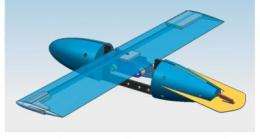
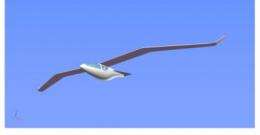
The modern airplane design works well, but from a fuel efficiency standpoint, could planes be designed more aerodynamically -- to lower drag and increase lift? Credit: RJ Huyssen/NU,RSA

Airplanes do not look much like birds -- unless you were to imagine a really weird bird or a very strange plane -- but should they? This question is exactly what a pair of engineers in California and South Africa inadvertently answered recently when they set about re-thinking the ubiquitous tube-and-wings aircraft architecture from scratch in order to make airplanes more fuel efficient.

The modern design works well, but from a standpoint, could planes be designed more aerodynamically -- to lower drag and increase lift? Geoffrey Spedding, an engineer at the University of Southern California, and Joachim Huyssen at Northwest University in South Africa, felt they could in theory, but they lacked experimental evidence. Now they have it.

Spedding and Huyssen have made a simple modular aircraft in three configurations: a flying wing alone, then wings plus body, and then wings plus body and a tail. It turns out that they had independently re-designed a bird shape, but without specific reference to anything bird-like. They will present their experimental data with these three designs, today at the American Physical Society Division of meeting in Long Beach, CA.

Should airplanes look like birds?
Enlarge

The modern airplane design works well, but from a fuel efficiency standpoint, could planes be designed more aerodynamically -- to lower drag and increase lift? Credit: RJ Huyssen/NU,RSA

They started with a configuration where the entire plane is one big wing. Then they added a body designed to minimize drag and, most critically, a small tail, which essentially serves to undo aerodynamic disturbances created by the body. Spedding and Huyssen analyzed the airflows and at various relative angles for the wings, body and tail, searching for ways to achieve greater lift (the better for carrying cargo) and lower drag (for higher fuel efficiency). They made the stipulation that for any given mission, the best plane is the one that generates the least drag.

The flying wings alone provide an ideal (but impractical) baseline, since it's hard to carry people or cargo in such a shape. The presence of a body, unfortunately, immediately lowers the lift and increases the drag. The addition of just the right kind of tail, however, can restore the lift, and reduce the drag, occasionally to nearly wing-only levels.

A few years ago a glider with the modest tail design was successfully test flown, but larger and commercial test prototypes have not yet been tried. Spedding recognizes that the design of real planes is necessarily a compromise of many engineering, economic and psychological constraints. Nevertheless, he believes much can be done to make planes more energy efficient in the future.

"The most important point is that we may be wasting large amounts of fossil fuel by flying in fundamentally sub-optimal aircraft designs," says Spedding. "At the very least, we can show that there exists an alternative design that is aerodynamically superior. One may argue that there is now an imperative to further explore this (and perhaps other) designs that could make a significant difference to our global energy consumption patterns."

More information: The presentation, "Should planes look like birds?" is on Sunday, November 21, 2010. Abstract: http://meetings.ap … Event/132371

Provided by American Institute of Physics

3.7 /5 (9 votes)  

Filter


Move the slider to adjust rank threshold, so that you can hide some of the comments.


Display comments: newest first

deatopmg
Nov 21, 2010

Rank: 5 / 5 (2)
Before embarking on a fools errand, these researchers should take a look a modern competition sailplane technology and performance.

Did their models consist of a LIFTING horizontal stabilizer?

"Show me a grad student with a new idea and I'll show you a grad student who hasn't read the literature"
Nik_2213
Nov 21, 2010

Rank: not rated yet
One nasty gotcha: Control surfaces must be sized to cope with an engine (or two) out and other failure modes such as cross winds and turbulence...
Bradfield
Nov 21, 2010

Rank: not rated yet
All very interesting but show me a bird that flies at 900 kilometres per hour. ..."Show me a grad student with a new idea ....." I agree with that.
Blicker
Nov 21, 2010

Rank: 5 / 5 (2)
They've been trying to design an aircraft that is more efficient? I thought that's what aircraft designers had been doing continuously for the last century. Are they saying that designers only try to slightly modify and evolve what they already have in steps and nobody in all this time has ever tried to just find out what is the most efficient design?

ormondotvos
Nov 21, 2010

Rank: 4 / 5 (1)
It's part of the new "scientists are all unrealistic eggheads" meme.
trekgeek1
Nov 21, 2010

Rank: not rated yet
There are trade offs in engineering. If you want to go fast, you probably can't do it efficiently. If you want to look and behave like a bird, you'll fly like one............slowly. There's a reason a fighter jet doesn't look like a bird and a reason a bird can't break the sound barrier.
eachus
Nov 21, 2010

Rank: 5 / 5 (2)
I was told by an aircraft designer around 1960 that the area rule for supersonic aircraft was the first fundamental improvement in aircraft design since the Wright brothers. He was more correct than he knew. The next improvement in jets was the turbofan, where larger slower blades move air more efficiently. It turned out that the formula for ideal blade edge speed was used by the Wright brothers in designing their propellers. The innovation beyond that? Replacing the tail assembly with forward canards. Also used by the Wright brothers.

To get a decent aircraft design which would not fall out of the sky if the pilot sneezed, the Wright brothers needed all the efficiency they could get, in wings, propellers, and control surfaces. If you look at the Gossamer Albatross, you will see the similarities--the main design issue was the same, too little power.

Will we ever see wasp-waisted transports with canards? Maybe. Beech has a nice GA plane with canards, and Concorde had them.
Ravenrant
Nov 22, 2010

Rank: 5 / 5 (1)
Old news and it isn't yet possible to duplicate a bird's aerodynamics.

It has been known for a long time that removing abrupt transitions, like where the wing meets the fuselage, and making them gradual like a birds body, improves aerodynamics. Howard Hughes did it with his H-1 and Lockheed did it with the SR71.

The reason we can't now and may never make a plane like a bird is because the bird instantly changes its shape as it flies. A plane can't do that and the parts that do move, like rudders, are hard to make move without abrupt transitions. A bird doesn't use ailerons, it moves its entire wing when gliding.
Crucialitis
Nov 22, 2010

Rank: not rated yet
So much nerd-rage in here. What's wrong with having a plane that flaps and a plane that jets?
eachus
Nov 22, 2010

Rank: not rated yet
So much nerd-rage in here. What's wrong with having a plane that flaps and a plane that jets?
Maybe an overdose of NIH (not invented here)? Again, back to the Wright brothers. Instead of flaps and ailerons, the Wright brothers used wing-warping. If you spend a few hours with a Wright airplane--the one in the French Air Museum is a later version than the one in the Smithsonian--you will see how the control wires distort the shape of the wings and airframe. Stick forward less lift, stick back more lift and the point of the lift moves forward on the wings to keep everything in balance.

There have been several "innovative" research aircraft projects that used overlapping sheets of aluminium with inflatable bladders underneath to get a similar effect. (But the curved metal sheets end up flexible in two dimensions, not three.)

Oh, and flapping wings are a trade-off between lift and propulsion. Separate propellers are better.
dinkster
Nov 22, 2010

Rank: 5 / 5 (1)
The reason we can't now and may never make a plane like a bird is because the bird instantly changes its shape as it flies. A plane can't do that and the parts that do move, like rudders, are hard to make move without abrupt transitions. A bird doesn't use ailerons, it moves its entire wing when gliding.


Not true, lots of planes use the entire wing surface for pitch, yaw, and roll, they call them 'wingerons' and 'pitcherons.' Also a few examples of morphing surfaces can be found on BMW concept cars as well as carrier class navy jets. It isn't a stretch at all to replicate the mechanics of a bird in flight. Most of the tech already exists.
Ravenrant
Nov 22, 2010

Rank: 5 / 5 (1)
Not true, lots of planes use the entire wing surface for pitch, yaw, and roll, they call them 'wingerons' and 'pitcherons.'


Wrong, it's just a bigger aileron, the junction where it moves will still have an abrupt transition instead of a smooth one and it's not a shape change, a bird can and does change the shape of its wing besides angle of attack. It can only be done with flexible materials as a previous poster said the Wright bros did with wood.
pnefdt23
Nov 23, 2010

Rank: 1 / 5 (1)
I think modern planes shouldn't look like birds,I believe we have the knowledge & technology to better the near perfect design of birds.I believe with a little bit of innovative design & mechanical engineering one can decrease by up to ± 99% or even eliminate the drag on any object stationery or in motion.
dinkster
Jan 11, 2011

Rank: not rated yet
Wrong, it's just a bigger aileron, the junction where it moves will still have an abrupt transition instead of a smooth one and it's not a shape change, a bird can and does change the shape of its wing besides angle of attack. It can only be done with flexible materials as a previous poster said the Wright bros did with wood.


Why again is an abrupt joint an absolute in design? Isn't the underlying bone structure of a bird's wing full of abrupt joints? There are wing designs that use spar tension to create controlled warping in the wing tips, much like what you are describing. Tension on the top center spar lifts the wing tip, tension on the bottom center spar lowers. The trailing edge spars can be used to adjust rotation around the center. Obviously not as dramatic as a birds wing, but the proof of concept is there.
Rank 3.7 /5 (9 votes)
Relevant PhysicsForums posts

More news stories

Alibaba.com $2.5B privatization bid approved

(AP) -- Chinese e-commerce firm Alibaba Group's $2.5 billion bid to take its Hong Kong-listed unit private was cleared Friday by minority shareholders, easing the way for CEO Jack Ma to gain more control over his company's ...

Technology / Business

created just added | popularity not rated yet | comments 0

Everyone knows it's windy . . .

... And now they have the data to prove it.  The middle of Lake Michigan is a vast, untapped reservoir of wind energy. The next step will be to find out if it can be harvested economically without harming ...

Technology / Energy & Green Tech

created 19 minutes ago | popularity not rated yet | comments 0

China fund may help Alibaba in Yahoo! bid: report

China Investment Corporation is in advanced talks to add up to $2 billion to the Alibaba Internet Group's efforts to buy back a stake from struggling Internet pioneer Yahoo!, the New York Times reported.

Technology / Business

created 46 minutes ago | popularity not rated yet | comments 0

Computers excel at identifying smiles of frustration (w/ Video)

(Phys.org) -- Researchers at the Massachusetts Institute of Technology (MIT) in the US have trained computers to recognize smiles, and they have turned out to be more adept at recognizing smiles of frustration ...

Technology / Computer Sciences

created 4 hours ago | popularity not rated yet | comments 1 | with audio podcast report

Solar plane ends first leg of intercontinental bid

The Swiss sun-powered aircraft Solar Impulse landed safely in Madrid early Friday at the end of the first leg of its attempt at an intercontinental flight without using a drop of fuel.

Technology / Energy & Green Tech

created 5 hours ago | popularity 5 / 5 (1) | comments 1


Landmark calculation clears the way to answering how matter is formed

(Phys.org) -- An international collaboration of scientists, including Thomas Blum, associate professor of physics, is reporting in landmark detail the decay process of a subatomic particle called a kaon – ...

Study uncovers secret to speedy burrowing by razor clams

(Phys.org) -- If you look at a razor burrowing clam sitting in a bucket, you’d never guess that it could burrow itself down into the soil, much less do it with any speed. Razor clams look like fat straws, ...

Dragon capsule on course for space station arrival

The privately bankrolled Dragon capsule approached the International Space Station for a historic docking Friday after sailing through a practice rendezvous the day before.

Rockefeller scientists pioneer new method to determine mechanisms of drug action

(Medical Xpress) -- Knowing that a drug works is great. Knowing how it works is a luxury. And until now, determining a drug’s mechanism of action has been a tedious and difficult process for scientists.

Synthetic nano-waste does not disappear

(Phys.org) -- Tiny particles of cerium oxide do not burn or change in the heat of a waste incineration plant. They remain intact on combustion residues or in the incineration system, as a new study by Swiss ...

Building a better solar panel -- one molecule at a time

(Phys.org) -- One of the fundamental building blocks in modern chemistry, an organometallic chemical compound called ferrocene, has never been structurally defined - until now.