Out of THEMIS, ARTEMIS: Earth's loss is moon's gain
October 27, 2010 By Robert Sanders

Two THEMIS probes redirected to moon to study magnetosphere, solar wind interactions

Enlarge

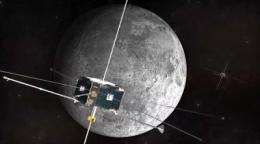
An artist's concept of one of the twin ARTEMIS probes in orbit around the moon. Formerly part of the THEMIS suite of five probes in Earth orbit, these two micro-satellites will now observe the solar wind's impact on the Earth's magnetic field at a much greater distance from Earth, and the wake left by the moon as it travels through the magnetosphere. Credit: NASA Goddard Space Flight Center

(PhysOrg.com) -- Two micro-satellites originally launched into Earth's orbit in 2007 by NASA have been redirected by University of California, Berkeley, scientists toward new orbits around the moon, extending study of the earth and moon's interaction with the solar wind.

The second of the two probes settled into a temporary "Lagrange-point" orbit on Friday, Oct. 22, inaugurating science operations for a new mission dubbed ARTEMIS – Acceleration, Reconnection, Turbulence, and Electrodynamics of the Moon's Interaction with the Sun.

Lagrange points are places where the gravity of Earth and the balance, creating a sort of gravitational parking lot for spacecraft. The two probes will remain there for six months before transitioning to their final, lunar orbits.

Over the next several years, ARTEMIS will help space scientists understand how the earth's magnetosphere is shaped by the strong solar wind at the distance of the moon and also how the moon's own tiny magnetic field interacts with the solar wind. Using simultaneous measurements of particles and electric and magnetic fields from two locations, ARTEMIS will provide the first three-dimensional perspective of how energetic particle acceleration occurs near the moon's orbit, in the distant magnetosphere, and in the solar wind.

"We currently know very little regarding the space environment of the moon, despite a number of existing and planned observatories there," said Vassilis Angelopoulos, principle investigator for the ARTEMIS mission and a professor of space physics at UCLA. "ARTEMIS is on stable orbits and can provide valuable information regarding the space environment, especially during the approaching solar maximum, as well as fully explore the earth's environment at lunar distances for the first time."

The two probes were originally part of NASA's five-probe THEMIS (Time History of Events and Macroscale Interactions during Substorms) mission, built and operated by UC Berkeley to orbit Earth and determine how storms in the earth's magnetic field disturb the colorful auroras in the Northern and Southern hemispheres.

THEMIS completed is primary mission in 2008 when Angelopoulos announced, "We discovered what makes the Northern Lights dance." The THEMIS team then proposed that the two outermost of the five probes use their extra fuel to propel themselves, via complex maneuvers around the moon and Earth, into lunar orbits – the first two-satellite mission to the moon. The maneuvers would also save the solar-powered spacecraft, which were spending more and more time in the earth's shadow and, for lack of power, in danger of freezing to death.
Two THEMIS probes redirected to moon to study magnetosphere, solar wind interactions
Enlarge

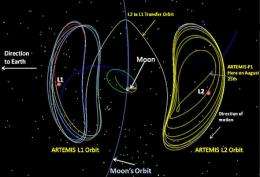
The two ARTEMIS probes will orbit for about six months around the Lagrange points near the moon before descending to final orbits around the moon. The Lagrange points are places where the gravity of the Earth and moon cancel one another, creating a sort of parking lot for satellites or debris. (Image: NASA Goddard Space Flight Center)

After approval from , Angelopoulos and his UC Berkeley team, which operates the fleet of satellites from the campus's Space Sciences Laboratory (SSL), began to reposition the two probes on July 20, 2009. The first probe (P1) settled into an orbit around the L2 Lagrange point, located on the far side of the moon, on Aug. 25, 2010, and is now joined by the second (P2) in orbit around the L1 Lagrange point between Earth and moon.

"ARTEMIS is going where no spacecraft have gone before," said Manfred Bester, director of operations at SSL. "We are exploring the Earth-moon Lagrange points for the first time."

Because the Lagrange points lie just outside Earth's magnetosphere, they are excellent places from which to study the solar wind. Particle and field sensors onboard the ARTEMIS probes have access to solar wind streams and storm clouds as they approach Earth, a possible boon to space weather forecasters. Moreover, working from opposite Lagrange points, the two spacecraft will be able to measure solar wind turbulence on scales never sampled by previous missions.

"ARTEMIS is going to give us a fundamental new understanding of the solar wind," predicted David Sibeck, ARTEMIS project scientist at the Goddard Space Flight Center in Maryland.

ARTEMIS will also explore the moon's plasma wake – a turbulent cavity carved out of the solar wind by the moon itself, akin to the wake just behind a speedboat. Sibeck called this "a giant natural laboratory filled with a whole zoo of plasma waves waiting to be discovered and studied."

Plasmas are hot, ionized clouds of gas that can carry electromagnetic and electrostatic waves.

Another target of the ARTEMIS mission is Earth's magnetotail. Like a wind sock at an airport, Earth's magnetic field is elongated by the action of the solar wind, forming a tail that stretches to the orbit of the moon and beyond. Once a month around the time of the full moon, the ARTEMIS probes will follow the moon through the magnetotail.

"We are particularly hoping to catch some magnetic reconnection events," says Sibeck. "These are explosions in Earth's magnetotail that mimic solar flares, albeit on a much smaller scale."

ARTEMIS might even see giant 'plasmoids' accelerated by the explosions hitting the moon during magnetic storms. Plasmoids are self-contained balls of plasma and magnetic field that can carom off reconfiguring planetary magnetic fields in space like billiard balls.

These far-out explorations may have down-to-Earth applications, Angelopoulos said. Plasma waves and reconnection events pop up on Earth, such as in experimental fusion chambers. Fundamental discoveries by ARTEMIS could help advance research in the area of clean renewable energy.

After six months at the Lagrange points, ARTEMIS will move in closer to the moon, at first only 100 kilometers from the surface, but eventually even closer. From point-blank range, the spacecraft will look to see what the solar wind does to a rocky world when there is no magnetic field to protect it.

"Earth is protected from solar wind by the planetary ," explained Angelopoulos. "The moon, on the other hand, is utterly exposed. It has no global magnetism."

Studying how the electrifies, alters and erodes the moon's surface could reveal valuable information for future explorers and give planetary scientists a hint of what's happening on other unmagnetized worlds around the solar system.

Orbiting the moon is notoriously tricky because of irregularities in the lunar gravitational field. Enormous concentrations of mass – mascons – hide just below the surface and tug on spacecraft in unexpected ways, causing them over time to veer out of orbit, Angelopoulos said. ARTEMIS will mitigate this problem using highly elongated orbits, ranging from tens of kilometers to 18,000 kilometers.

"We'll zip by the lunar surface for a brief time each orbit," explained Angelopoulos. "Most of the time we'll linger 18,000 kilometers away where we can continue our studies of the at a safe distance. But over several years, even the sparse low-altitude measurements add up to a sizeable dataset."

ARTEMIS will work in tandem with current missions, such as NASA's Lunar Reconnaissance Orbiter, LADEE (Lunar Atmosphere and Dust Environment Explorer) and Grail (Gravity Recovery and Interior Laboratory), and Chang'e 2, a Chinese unmanned probe, to prepare the ground for increased robotic exploration of the moon by future U.S. missions, including the international lunar network.

Provided by University of California -- Berkeley

4.7 /5 (7 votes)  

Filter


Move the slider to adjust rank threshold, so that you can hide some of the comments.


Display comments: newest first

Husky
Oct 27, 2010

Rank: not rated yet
The moon and earth may have a canceled out gravity tug at the lagrange points, but i would be interested to know what happens to atomic clocks/time dilation at these points?
PinkElephant
Oct 27, 2010

Rank: 5 / 5 (4)
@Husky,

Good question. First, there is always some degree of time dilation because we're all embedded in the gravitational well of the Sun, of our Galaxy, of our galactic super cluster, and so on. This is always in effect, as a kind of semi-constant background. But let's ignore it, for simplicity.

Secondly, theory says that time dilation in gravitational fields is a consequence of gravitational acceleration. (In other words, it occurs only in accelerated frames of reference.) The more acceleration, the more time dilation. Interestingly, there should be effectively no added time dilation at the center of the Earth, while dilation should be maximized at Earth's surface -- at least according to GR.

Lastly, at Lagrange points you aren't stationary: you're still orbiting the Earth. In all cases, your total time dilation (relative to an infinitely distant inertial observer) is always a function of both your speed and the magnitude of your acceleration.
GSwift7
Oct 28, 2010

Rank: 5 / 5 (1)
Yes, Pink is correct. It's called shell theory:

http://en.wikiped..._theorem

Also, as Pink pointed out, the gravity at a lagrangian point doesn't actually cancel out to zero. To understand it it helps to simplify the system down to only the Earth and Moon, and remember that the moon doesn't actually orbit the Earth exactly. In reality, the Earth and Moon are a bound pair which both orbit their shared center of gravity. The lagrangian point is where a very small object can also orbit that shared center of gravity between the two large objects. The satellite in the lagrangian point is not actually floating in zero gravity, it's in a kind of geostationary orbit around the Earth/Moon center of gravity.

As to the notion of finding a place where all gravity is actually canceled out on a universal scale, where you would have zero time dilation, there may be no such place 'inside' the universe. That's one of those big cosmology questions they agonize over.
Skeptic_Heretic
Oct 28, 2010

Rank: 5 / 5 (3)
As to the notion of finding a place where all gravity is actually canceled out on a universal scale, where you would have zero time dilation, there may be no such place 'inside' the universe. That's one of those big cosmology questions they agonize over.
Effectively there can't be a place of no gravity, at least not at this time. In order to have no gravitational interaction, you'd have to exist in an empty universe, but even then you'd be under the influence of your own microgravity.
GSwift7
Oct 28, 2010

Rank: not rated yet
Yes, quantum physics argues that such a point of zero mass/energy density is impossible because if such a point exists in the universe then the quantum state at such a point would be exactly zero, and quantum theory says that can't happen. At least that's how I understand what I've read. ...If quantum theory is complete enough to apply it to cosmological questions?
PinkElephant
Oct 28, 2010

Rank: 5 / 5 (2)
@GSwift7,
In reality, the Earth and Moon are a bound pair which both orbit their shared center of gravity.
True, although the Moon's mass is tiny compared to Earth's, and that common center of gravity is actually inside the Earth's surface.
The lagrangian point is where a very small object can also orbit that shared center of gravity between the two large objects.
False: not a single one of the Lagrange points coincides with the center of gravity. For instance, see here:

http://en.wikiped...ated.gif

The center of gravity is actually a bistable local peak in gravitational potential: should you place an object there, even a tiniest perturbation of the object's position will send it plummeting toward one of the co-orbiting bodies.
GSwift7
Oct 28, 2010

Rank: 5 / 5 (1)
Pink, read what I said again. You misunderstood what I said. I did not say that the lagrangian point IS the center of gravity. I said that the lagrangian point orbits the center of gravity. It follows the two large bodies around the center of gravity of the two large bodies. Yes, I know where the center of gravity is between the earth and the moon. Of course, as I said before, reducing this to a three-body system is helpful for illustrative purposes, but in reality, many other factors play in. I wasn't trying to correct you. Just expanding on what you said and saying some of the same things in different wording. Stop jumping on my case for no reason. I had the courtesy to actually read your post and I agree with everything you said. I didn't say anything that disagrees with what you said, and if you read my post more carefully, you'll see that I did explain it correctly.
PinkElephant
Oct 28, 2010

Rank: not rated yet
@GSwift7,

Ok, I see what you were trying to say.

I was confused by the phrase "The lagrangian point is where a very small object can also orbit that shared center of gravity". The wording seemed to imply that either the barycenter is coincident with a Lagrangian point (since objects parked at Lagrangians actually "orbit" the Lagrangian point), or that objects can orbit the barycenter *only* at Lagrange points (whereas in reality there's an infinite variety of possible orbits around the barycenter.) The latter being more obvious, I assumed you meant the former.
douglas2
Oct 31, 2010

Rank: not rated yet
time dilation is a function of the gravitational potential, not the field. The dilation does not cancel at the center of mass, or at any lagrange point, in fact it is greatest at the center of gravity, the bottom of the potential well.
Rank 4.7 /5 (7 votes)
Relevant PhysicsForums posts

More news stories

Research: Negative leakage could be key to reducing carbon emissions

(Phys.org) -- The unilateral efforts of a single country or region to reduce the emissions of greenhouse gases could reduce exports, increase imports and lead to higher emissions elsewhere – what economists call “leakage.” ...

Space & Earth / Environment

created 52 minutes ago | popularity 5 / 5 (1) | comments 0

Image: Carpenter's Flight

50 years ago today, Scott Carpenter flew the second American manned orbital flight on May 24, 1962.

Space & Earth / Space Exploration

created 1 hour ago | popularity not rated yet | comments 0

Nasa receives widespread concepts for future Mars missions

NASA's call to scientists and engineers to help plan a new strategy to explore Mars has resulted in almost double the amount of expected submissions with unique and bold ideas.

Space & Earth / Space Exploration

created 1 hour ago | popularity not rated yet | comments 0

Organic carbon from Mars, but not biological

(Phys.org) -- Molecules containing large chains of carbon and hydrogen--the building blocks of all life on Earth--have been the targets of missions to Mars from Viking to the present day. While these molecules ...

Space & Earth / Space Exploration

created 17 hours ago | popularity 4 / 5 (3) | comments 2 | with audio podcast

Private supply ship flies by space station in test (Update)

The world's first private supply ship flew tantalizingly close to the International Space Station on Thursday but did not stop, completing a critical test in advance of the actual docking.

Space & Earth / Space Exploration

created 21 hours ago | popularity 4.8 / 5 (9) | comments 7


New study should end debate over magnesium treatment for preventing poor outcome after haemorrhagic stroke

An international randomised trial and meta-analysis published Online First in The Lancet should put an end to the debate about the use of intravenous magnesium sulphate to prevent poor outcomes after haemorrhagic stroke. The in ...

Computers excel at identifying smiles of frustration (w/ Video)

(Phys.org) -- Researchers at the Massachusetts Institute of Technology (MIT) in the US have trained computers to recognize smiles, and they have turned out to be more adept at recognizing smiles of frustration ...

OmniVision tops up sensors for cameras, phones

(Phys.org) -- OmniVision has announced two high-resolution image sensors for the digital still and digital video camera market (DS/DVC) and higher end smartphones. In end-user language, it is a claim for superior ...

Progestin treatment for polycystic ovarian syndrome may reduce pregnancy chances

(Medical Xpress) -- The hormone progestin, often given as a first step in infertility treatment for polycystic ovary syndrome (PCOS), appears to decrease the odds of conception and of giving birth, according to a study by ...

Talking works: UB professor develops method to analyze creative problem solving

(Phys.org) -- Talk -- if it's the right kind -- can increase creativity, leading students to create useful, new ideas that solve problems, a University at Buffalo professor has found by using a statistical tool that he invented.

World 'no tobacco day' puts spotlight on dangers of smoking

It’s not just smokers who are at-risk when it comes to tobacco smoke exposure—and the health concerns of smoking cigarettes are not limited to the most known consequence: lung cancer.