Bouncing water droplets reveal small-scale beauty (w/ Video)
October 14, 2010 by Lisa Zyga
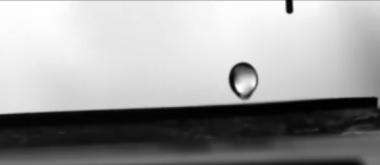
A clip of a bouncing water droplet from the video below. Credit: Aria and Gharib.
In the video below, scientists have captured the simple movements of water droplets on a superhydrophobic carbon nanotube surface. The video shows the water droplets as they bounce, slide, and roll across different structures made of the carbon nanotube arrays.
The scientists, Adrianus Aria and Morteza Gharib from the California Institute of Technology, used a high-speed camera at different frame rates to capture the water droplets.
The scientists controlled the exact size of the droplets with a syringe pump and released the droplets onto the surfaces using a flat-tipped needle. The droplets were illuminated from behind with a diffuse halogen light, demonstrating the artistic side of fluid dynamics.
This video is not supported by your browser at this time.
Water droplets bounce on superhydrophobic carbon nanotube arrays. Credit: Aria and Gharib.
More information: via: "Bouncing Water Droplet on a Superhydrophobic Carbon Nanotube Array." Adrianus I. Aria and Morteza Gharib. arXiv:1010.1351v1
© 2010 PhysOrg.com
-
From lemons to lemonade: Reaction uses carbon dioxide to make carbon-based semiconductor,
27 comments
-
Every black hole contains a new universe: A physicist presents a solution to present-day cosmic mysteries,
209 comments
-
New silicon memory chip developed,
16 comments
-
Computing experts unveil superefficient 'inexact' chip,
45 comments
-
SpaceX private rocket blasts off for space station (Update),
41 comments
-
Photons chances of combining with electrons
2 hours ago
-
How toxic is strontium 90 (lab use)?
6 hours ago
-
Room temperature superconductor
7 hours ago
-
Focusing magnetic field?
7 hours ago
-
Cross Product vs. Dot product
9 hours ago
-
DC Cable Loss
10 hours ago
- More from Physics Forums - General Physics
More news stories
Engineered materials: Custom-made magnets
A novel approach to designing artificial materials could enable magnetic devices with a wider range of properties than those now available. An international team of researchers have now extended the properties ...
50 minutes ago |
not rated yet |
0
Nanofluidics sorts DNA for cancer research
(Phys.org) -- Cornell nanotechnology researchers have devised a new tool to study epigenetic changes in DNA that can cause cancer and other diseases: a nanoscale fluidic device that sorts and collects DNA, ...
Nanotechnology / Bio & Medicine
4 hours ago |
5 / 5 (1) |
0
|
Non-invasive intracellular 'thermometer' with fluorescent proteins created
A team from the Institute of Photonic Sciences (ICFO) has developed a technique to measure internal cell temperatures without altering their metabolism. This finding could be useful when distinguishing healthy ...
Nanotechnology / Bio & Medicine
May 23, 2012 |
not rated yet |
0
|
Dopant gives graphene solar cells highest efficiency yet
(Phys.org) -- By taking advantage of graphenes favorable electrical and optical properties, and then adding an organic dopant, researchers have achieved the highest power conversion efficiency yet for ...
Nanomedicine: Quantum dots appear safe in pioneering study on primates
A pioneering study to gauge the toxicity of quantum dots in primates has found the tiny crystals to be safe over a one-year period, a hopeful outcome for doctors and scientists seeking new ways to battle diseases ...
Nanotechnology / Bio & Medicine
May 20, 2012 |
4.3 / 5 (3) |
8
|
Is a classical electrodynamics law incompatible with special relativity?
(Phys.org) -- The laws of classical electromagnetism that were developed in the 19th century are the same laws that scientists use today. They include Maxwell’s four equations along with the Lorentz la ...
Did ancient Mars have a runaway greenhouse?
Cosmic impacts that once bombed Mars might have sent temperatures skyrocketing upward on the Red Planet in ancient times, enough to set warming of the surface on a runaway course, researchers say.
The search for the earliest signs of Alzheimer's
(Medical Xpress) -- For the past five years, volunteers from the City of Berkeley and surrounding areas have come to Lawrence Berkeley National Laboratory to participate in an ongoing study thats changing ...
Robot monitors toxic red tides
A robotic device suspended under the ocean surface from a buoy off the New Hampshire coast is monitoring seawater for evidence of the red tide, clusters of microscopic plants that release toxins into fish ...
Pair call for public discourse on treating wastewater contaminated with birth control pill chemicals
(Phys.org) -- As people go about their daily lives, its easy to overlook the impact their lifestyle has on the environment. Resources are used and as a result of their use, certain elements are placed ...
Private supply ship flies by space station in test (Update)
The world's first private supply ship flew tantalizingly close to the International Space Station on Thursday but did not stop, completing a critical test in advance of the actual docking.
Oct 14, 2010
Rank: not rated yet
Oct 14, 2010
Rank: 5 / 5 (1)
Oct 15, 2010
Rank: not rated yet
High speed cameras are 'the microscopes of time', they reveal detail of motion that would otherwise be too small and invisible to the naked eye and almost always it seems the result is both fascinating and beautiful!
Oct 15, 2010
Rank: not rated yet