Engineered collision spills new Moon secrets (w/ Video)
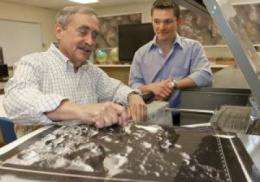
Peter Schultz and graduate student Brendan Hermalyn analyzed data from bits of the Moon’s surface kicked up by a NASA-engineered collision. They found unexpected complexity -- and traces of silver. Credit: Mike Cohea/Brown University
Scientists led by Brown University are offering the first detailed explanation of the crater formed when a NASA rocket slammed into the Moon last fall and information about the composition of the lunar soil at the poles that never has been sampled. The findings are published in a set of papers in Science stemming from the successful NASA mission, called LCROSS for Lunar CRater Observing and Sensing Satellite.
Mission control at NASA Ames sent the emptied upper stage of a rocket crashing into the Cabeus crater near the Moon's south pole last October. A second spacecraft followed to analyze the ejected debris for signs of water and other constituents of the super-chilled lunar landscape.
In one of the papers, Brown planetary geologist Peter Schultz and graduate student Brendan Hermalyn, along with NASA scientists, write that the cloud kicked up by the rocket's impact showed the Moon's soil and subsurface is more complex than believed: Not only did the lunar regolith the soil contain water, it also harbored other compounds, such as hydroxyl, carbon monoxide, carbon dioxide, ammonia, free sodium, and, in a surprise, silver.
Combined, the assortment of volatiles the chemical elements weakly attached to regolith grains gives scientists clues where they came from and how they got to the polar craters, many of which haven't seen sunlight for billions of years and are among the coldest spots in the solar system.
Schultz, lead author on the Science paper detailing the impact crater and the ejecta cloud, thinks many of the volatiles originated with the billions of years-long fusillade of comets, asteroids and meteoroids that have pummeled the Moon. He thinks an assortment of elements and compounds, deposited in the regolith all over the Moon, could have been quickly liberated by later small impacts or could have been heated by the sun, supplying them with energy to escape and move around until they reached the poles, where they became trapped beneath shadows of the frigid craters.
This video is not supported by your browser at this time.
Peter Schultz and graduate student Brendan Hermalyn analyzed data from bits of the Moon’s surface kicked up by a NASA-engineered collision. They found unexpected complexity -- and traces of silver. Credit: Mike Cohea and Richard Lewis, Brown University
"This place looks like it's a treasure chest of elements, of compounds that have been released all over the Moon," Schultz said, "and they've been put in this bucket in the permanent shadows."Schultz believes the variety of volatiles found in Cabeus crater's soil implies a kind of tug of war between what is being accumulated and what is being lost to the tenuous lunar atmosphere.
"There's a balance between delivery and removal," explained Schultz, who has been on the Brown faculty since 1984 and has been studying the Moon since the 1960s. "This suggests the delivery is winning. We're collecting material, not simply getting rid of it."
Astronauts sent as part of NASA's Apollo missions found trace amounts of silver, along with gold, on the near-side (Earth-facing side) of the Moon. The discovery of silver at Cabeus crater suggests that silver atoms throughout the moon migrated to the poles. Nevertheless, the concentration detected from Cabeus "doesn't mean we can go mining for it," Schultz said.
The crater formed by the rocket's impact within Cabeus produced a hole 70 to 100 feet in diameter and tossed up six-foot deep lunar material. The plume of debris kicked up by the impact reached more than a half-mile above the floor of Cabeus, high enough to rise into sunlight, where its properties could be measured for almost four minutes by a variety of spectroscopic instruments. The amount of ejecta measured was almost two tons, the scientists report. The scientists also noted there was a slight delay, lasting roughly one-third of a second, in the flash generated after the collision. This indicated to them that the surface struck may be different than the loose, almost crunchy surface trod by the Apollo astronauts.
"If it had been simply lunar dust, then it would have heated up immediately and brightened immediately," Schultz said. "But this didn't happen."
The scientists also noticed a one-half-mile, near-vertical column of ejecta still returning to the surface. Even better, the LCROSS spacecraft was able to observe the plume as it followed on the heels of the crashing rocket. Schultz and Hermalyn had observed such a plume when conducting crater-impact experiments using hollow spheres (that mimicked the rocket that crashed into Cabeus) at the NASA Ames Vertical Gun Range in California before the LCROSS impact.
"This was not your ordinary impact," Hermalyn said. "So in order to understand what we were going to see (with LCROSS) and maybe what effects that would have on the results, we had to do all these different experiments."
Even though the mission has been judged a success, Schultz said it posed at least as many questions as it answered.
"There's this archive of billions of years (in the Moon's permanently shadowed craters)," Schultz said. "There could be clues there to our Earth's history, our solar system, our galaxy. And it's all just sitting there, this hidden history, just begging us to go back."
Provided by
Brown University
-
From lemons to lemonade: Reaction uses carbon dioxide to make carbon-based semiconductor,
27 comments
-
Every black hole contains a new universe: A physicist presents a solution to present-day cosmic mysteries,
209 comments
-
New silicon memory chip developed,
16 comments
-
Computing experts unveil superefficient 'inexact' chip,
45 comments
-
SpaceX private rocket blasts off for space station (Update),
41 comments
-
Math behind Theoretical Physics
9 hours ago
-
Do we know whats at the center of galaxies yet?
10 hours ago
-
Structure of the Milky Way?
May 20, 2012
-
What would it take to terraform Pluto and Charon?
May 19, 2012
-
Whats is volume of mass at the centre of the sun
May 19, 2012
-
Galaxies moving faster than the speed of light?
May 18, 2012
- More from Physics Forums - General Astronomy
More news stories
Did ancient Mars have a runaway greenhouse?
Cosmic impacts that once bombed Mars might have sent temperatures skyrocketing upward on the Red Planet in ancient times, enough to set warming of the surface on a runaway course, researchers say.
Space & Earth / Space Exploration
45 minutes ago |
3.7 / 5 (3) |
0
|
Private supply ship flies by space station in test (Update)
The world's first private supply ship flew tantalizingly close to the International Space Station on Thursday but did not stop, completing a critical test in advance of the actual docking.
Space & Earth / Space Exploration
6 minutes ago |
not rated yet |
0
Ancient rocks provide critical clues about modern earthquakes
At first glance, there's nothing remarkable about the rocky Maine blueberry field in which University of Maine graduate student Nancy Price does her research. But those rocks are crucial to our understanding ...
Space & Earth / Earth Sciences
45 minutes ago |
not rated yet |
0
Colliding galaxy cluster unravelled
An international team of astronomers has used the International LOFAR Telescope from ASTRON, the Netherlands Institute for Radio Astronomy, to study the formation of the galaxy cluster Abell 2256.
56 minutes ago |
5 / 5 (1) |
0
Rapid coral death by a deadly chain reaction
(Phys.org) -- Most people are fascinated by the colorful and exotic coral reefs, which form habitats with probably the largest biodiversity. But human civilisation is the top danger to these fragile ecosystems ...
1 hour ago |
3 / 5 (2) |
3
|
Fungi shifted plant balance of power
Cooperating with fungi didn't just help the earliest plants spread across a barren, rocky landscape; it also played a decisive role in the rise of more complex plants with roots and leaves that make up most ...
The search for the earliest signs of Alzheimer's
(Medical Xpress) -- For the past five years, volunteers from the City of Berkeley and surrounding areas have come to Lawrence Berkeley National Laboratory to participate in an ongoing study thats changing ...
Researchers find a way to delay aging of stem cells
Stem cells are essential building blocks for all organisms, from plants to humans. They can divide and renew themselves throughout life, differentiating into the specialized tissues needed during development, ...
Study links mental health problems to poor prognosis in male cancer patients
Men suffering from psychiatric problems when diagnosed with cancer are more likely to die from the disease, according to a new study part-funded by the Wellcome Trust. The findings also reveal that those with ...
The myth of the disconnected telecommuter
(Phys.org) -- The assumption that employees who regularly telecommute will feel less attached to the organization they work for due to feeling isolated and disconnected is a myth, according to a study led ...
Formal recognition of PMDD will lift stigma for women
A decision to recognise premenstrual dysphoric disorder as a genuine psychiatric condition will finally provide validation for this awful and poorly understood syndrome and alleviate the stigma ...
Oct 21, 2010
Rank: 5 / 5 (5)
Oct 21, 2010
Rank: 2 / 5 (2)
too those tempted to say the dark side of the moon -- please know that all sides of the moon recieve light as it rotates and the dark side of the moon means that because the rotational period is equal to its revolutionary period we only see one side illuminated by sunlight.
Oct 21, 2010
Rank: 5 / 5 (4)
Oct 21, 2010
Rank: 1.7 / 5 (3)
Oct 21, 2010
Rank: 4 / 5 (1)
Oct 22, 2010
Rank: 4 / 5 (1)
Although several craters on the moons poles never receive sunlight the poles on the whole do receive as much as the rest of the moon.
Anyone know if the moon wobbles? and ifso, to what degree? (I'd assume it'd have to be a tiny one compared to the earths for there to be permanently dark craters)...
Oct 22, 2010
Rank: 4 / 5 (2)
Think about a total eclipse of the sun...
Oct 22, 2010
Rank: not rated yet
Also QD, yes, the moon does wobble very slightly. Not sure how much but it should be Google-able.
Graeme: The silver, as I understood from the NASA audio feed, is released in atomic form due to impacts and the atoms just "hop around" until they settle into a "cold sink" such as Cabeus crater, which has temperatures close to absolute zero. (Seriously! Some craters on the moon are the coldest known places in our solar system.) It isn't necessary that the craters be near the poles, although it helps. Some areas of the moon that receive a lot of sunlight can still have a lot of water trapped a few inches below the surface as permafrost.
Oct 31, 2010
Rank: not rated yet