Campaign to build 1837 Babbage's Analytical Engine
October 19, 2010 by Lin Edwards report

Campaign to build 1837 Babbage's Analytical Engine

Enlarge

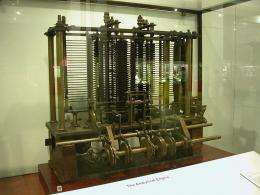
Trial model of a part of the Analytical Engine, built by Babbage, as displayed at the Science Museum (London).

(PhysOrg.com) -- A campaign based in the UK is hoping to construct Charles Babbage's steam-powered Analytical Engine, a prototype computer around the size of a steam locomotive, which Babbage designed in 1837. While elements of the engine have been constructed in the past a complete working model has never been built.

The idea was the brainchild of author, science blogger and programmer John Graham-Cumming, who wrote the Geek Atlas. He said the Engine was inspirational, since it was designed long before we had computers as we know them today, but he said that Babbage’s papers show the Engine was the first real general purpose computer, having an expandable memory, a central processing unit (which Babbage called the "mill"), microcode, and a printer and plotter. The computer was to be programmed via punch cards to carry out a variety of tasks.

Babbage, an engineer and mathematician, designed the Analytical Engine to be constructed of iron and brass. It was a successor to the Difference Engine, a massive machine made of brass, but which was a calculator rather than a true computer. Several versions of the Difference Engine have been built, including one at London’s Science Museum, made in the 1980s. Babbage created many designs for the Analytical Engine, and the current campaign is to construct the design named Plan 28.

The Analytical Engine would be built after Babbage’s blueprints, held at the Science Museum in London, have been digitized and fully deciphered. A three-dimensional simulation would then be created on computer to allow any problems to be overcome before physical construction begins.

Graham-Cumming said the machine would be a great educational resource that would help people understand how computers work. He also envisages holding competitions for people to write programs to run on the Engine. He said building the Engine would be a celebration of Charles Babbage’s achievements, and it would also be fantastic to use it to execute the code written especially for it by famous Victorian mathematician Ada Lovelace, who worked with Babbage on the Engine. Her code is intended to calculate the Bernoulli sequence of numbers, which she worked on until 1843, and is the first computer program.

This video is not supported by your browser at this time.

Graham-Cumming said he was initially worried there would not be enough supporters for building a driven by steam, with only 1 k of memory and “13,000 times slower than a ZX81”, but so far over 3,100 people have pledged support and donations of $10/₤10/€10 each to the non-profit Plan 28 campaign. About 50,000 supporters donating a total of around $640,000 are needed by the end of January 2011 to get the project off the ground. If the Engine is built, it will be donated to a museum such as the Science Museum.

More information: http://blog.jgc.org/

© 2010 PhysOrg.com

4.5 /5 (17 votes)  

Filter


Move the slider to adjust rank threshold, so that you can hide some of the comments.


Display comments: newest first

Husky
Oct 19, 2010

Rank: 5 / 5 (7)
i will donate for this, its not just because I like the artistic quality of steampunk brass and handcrafted clockwork mechanics, but because its a statement of human ingunuity, Davinci, Jules Verne, Babbage, some people thinking way ahead of their time, that should inspire us to look beyond horizons, take science to the next level and reaping its benefits for all mankind. Amen.
LariAnn
Oct 19, 2010

Rank: 5 / 5 (1)
I can imagine that the first interstellar starship engine design will, in the far future, be viewed the same was as we now view Babbage's Analytical Engine. The first one might seem like a brass and iron contraption compared to the sleek stardrives common in the 31st century . . .
Shootist
Oct 19, 2010

Rank: not rated yet
Campaign to build 1837 Babbage's Analytical Engine


Neat trick but I don't see how a bunch of spinning gears in a difference engine will teach anyone anything other than the advantages of good lubrication.
thales
Oct 19, 2010

Rank: 5 / 5 (3)
Campaign to build 1837 Babbage's Analytical Engine


Neat trick but I don't see how a bunch of spinning gears in a difference engine will teach anyone anything other than the advantages of good lubrication.


If nothing else, you can view it as a work of art. Think about all the art that sells for millions of dollars (or pounds, if you prefer). This art, in contrast to most traditional art, is both historical and functional!
DeeWizard
Oct 20, 2010

Rank: 4.7 / 5 (3)
As an engineering student I marvel at the fact that this machine/computer with all of its intricate parts was design solely in the mind and on paper. Today there isn't an engineer that would attempt this without the aid of a computer. Though our technology is advancing I think we are loosing our ability to think and truly design something new.
jsa09
Oct 20, 2010

Rank: not rated yet
I think it might be a good idea to hold competitions to design and build mechanical computers powered by steam. Talk about a good reason to tinker or think across a number of different fields.
brentrobot
Oct 21, 2010

Rank: 5 / 5 (3)
This kind of computer may become importante as technology moves to the nanoscale. I can well imagine a molecular nanobot based on these principles inside every cell of your body repairing and rewriting dna.
El_Nose
Oct 21, 2010

Rank: not rated yet
I gave you 5 stars but it's not that we can't design something new it that the things that are new that we design are of such intricate complexity compaired to the 19th century that the aid a computer saves us immence amounts of time. It probably took the better half of a year to work out on paper what Babbage did... design 28 implies that there are at least 27 others..
Rank 4.5 /5 (17 votes)
Relevant PhysicsForums posts

More news stories

Young alum creates iPad user experience improvement (w/ Video)

(Phys.org) -- When Daniel Hooper became frustrated with editing text on his iPad, he wrote an application that could revolutionize the way users select and arrange their words on tablets. 

Technology / Software

created 38 minutes ago | popularity 1 / 5 (1) | comments 0 | with audio podcast

Malware intelligence system enables organizations to share threat information

As malware threats expand into new domains and increasingly focus on industrial espionage, Georgia Tech researchers are launching a new weapon to help battle the threats: a malware intelligence system that ...

Technology / Computer Sciences

created 35 minutes ago | popularity not rated yet | comments 0

Fighting house fires with computer models

(Phys.org) -- Through advanced computer modelling of house fires, mechanical engineers at UNSW are giving fire fighters a new suite of tools to investigate and battle dangerous blazes in time for the traditionally ...

Technology / Computer Sciences

created 47 minutes ago | popularity not rated yet | comments 0

Yahoo seeks to shake up search, Web browsing

(AP) -- Joining the battle to redefine Internet search, Yahoo is taking aim with a new browser enhancement it calls "Axis."

Technology / Internet

created 5 hours ago | popularity not rated yet | comments 1

Device may inject a variety of drugs without using needles

Getting a shot at the doctor’s office may become less painful in the not-too-distant future.

Technology / Engineering

created 2 hours ago | popularity 5 / 5 (4) | comments 0 | with audio podcast


Rapid coral death by a deadly chain reaction

(Phys.org) -- Most people are fascinated by the colorful and exotic coral reefs, which form habitats with probably the largest biodiversity. But human civilisation is the top danger to these fragile ecosystems ...

Fungi shifted plant balance of power

Cooperating with fungi didn't just help the earliest plants spread across a barren, rocky landscape; it also played a decisive role in the rise of more complex plants with roots and leaves that make up most ...

Did ancient Mars have a runaway greenhouse?

Cosmic impacts that once bombed Mars might have sent temperatures skyrocketing upward on the Red Planet in ancient times, enough to set warming of the surface on a runaway course, researchers say.

The search for the earliest signs of Alzheimer's

(Medical Xpress) -- For the past five years, volunteers from the City of Berkeley and surrounding areas have come to Lawrence Berkeley National Laboratory to participate in an ongoing study that’s changing ...

USDA links gene flow between weedy and domesticated rice to rising carbon dioxide levels

(Phys.org) -- New research at the U.S. Department of Agriculture (USDA) confirms that rising levels of atmospheric carbon dioxide facilitate the flow of genes from wild or weedy rice plants to domesticated ...

Long-term meditation leads to different brain organization

(Medical Xpress) -- People who practice mindfulness meditation learn to accept their feelings, emotions, and states of mind without judging or resisting them. They simply live in the moment.