Bizarre X-shaped intruder linked to an unseen asteroid collision (w/ Video)
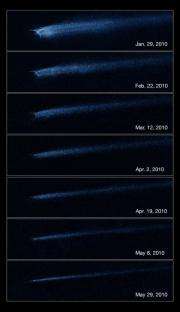
Last January astronomers thought they had witnessed a fresh collision between two asteroids when images from the NASA/ESA Hubble Space Telescope revealed a bizarre X-shaped object at the head of a comet-like trail of material.
"When I saw the Hubble image I knew it was something special," says astronomer Jessica Agarwal, who works for the European Space Agency in the Netherlands. "The nucleus seemed almost detached from the dust cloud and there were intricate structures within the dust."
After using Hubble to track the oddball body for five months, astronomers were surprised to find that they had missed the suspected smash-up by a year.
"We thought that this event had just occurred," says astronomer David Jewitt of the University of California in Los Angeles and leader of the Hubble observations. "We expected the debris field to expand dramatically, like shrapnel flying from a hand grenade. So we rushed to apply for Hubble time to watch the aftermath. But what happened was quite the opposite. We found that the object is expanding very, very slowly and that it started not a week, but nearly a year before our January observations."
By his calculations, the encounter happened in February or March 2009. Jewitt is still excited about the Hubble observations because they are the first snapshots of the aftermath of a suspected asteroid collision. Jewitt's results appear in the 14 October issue of the science journal Nature.
The peculiar object, dubbed P/2010 A2, was found in the asteroid belt, a reservoir of millions of rocky bodies between the orbits of Mars and Jupiter. Encounters between asteroids are assumed to be common, and destructive, but Jewitt estimates that modest-sized asteroids actually smash into each other roughly once a year. When the objects collide, they inject dust into interplanetary space. But until now, astronomers have relied on models to make predictions about the frequency of these collisions and the amount of dust they produce.
"These observations are important because we need to know where the dust in the Solar System comes from, and how much of it comes from colliding asteroids as opposed to 'outgassing' comets," Jewitt explains. "We can also apply this knowledge to the dusty debris discs around other stars, because these are thought to be produced by collisions between unseen bodies in the discs. Knowing how the dust was produced will yield clues about those invisible bodies."
The Hubble images, taken from January to May 2010 with Wide Field Camera 3, reveal a point-like object about 120 metres wide, with a long, flowing dust tail behind an X-shaped pattern of a kind that had never been seen before. The observations also show that the object retained its X-shape even as the debris field slowly expanded. Particle sizes in the tail are estimated to vary from about 1 millimetre to 2.5 centimetres in diameter.
The object in the Hubble image is the remnant of a slightly larger precursor body. Astronomers think a smaller rock, perhaps 3 to 5 metres wide, slammed into the larger one. The pair probably collided at high speed, at about 18 000 kilometres an hour, smashing and vaporising the small asteroid and stripping material from the larger one. Jewitt estimates that the violent encounter was as powerful as the detonation of a small atomic bomb.
Radiation pressure from the Sun then swept the debris behind the remnant asteroid, forming a comet-like tail. The tail contains enough dust to make a ball 20 metres wide, most of it blown out of the bigger body by the explosion that followed the impact.
The two asteroids were probably no strangers to collisions. They were themselves most likely relics from impacts between larger asteroids that occurred tens or hundreds of millions of years ago. The process that reduces asteroids from large to small bodies is known as collisional grinding and is thought to be one of the main processes by which asteroids are destroyed.
Astronomers do not have a good explanation for the X shape. The criss-crossed filaments at the head of the tail might suggest that the colliding asteroids were not perfectly symmetrical. Material would not then be ejected from the impact in a symmetrical pattern, just as a brick thrown into a lake makes a ragged splash. Larger particles in the X disperse very slowly and give this structure its longevity.
Although the Hubble images give compelling evidence for an asteroid collision, Jewitt says he still does not have enough information to rule out all alternative ideas. In one such scenario, a small asteroid's rotation increases from sunlight pressure and loses mass, forming the comet-like tail.
"Catching colliding asteroids on camera is difficult," Jewitt says, "because large impacts are rare, while small ones, such as the one that produced P/2010 A2, are exceedingly faint." The two asteroids whose remains make up P/2010 A2 were unknown before the smash-up because they were too faint to be noticed. The collision itself was unobservable because it happened when the asteroids were in the same direction as the Sun. About 10 or 11 months later, in January 2010, the Lincoln Near-Earth Research (LINEAR) Program Sky Survey spotted the comet-like tail produced by the collision. But only Hubble resolved the X pattern, offering unequivocal evidence that something stranger than a comet outgassing had occurred.
Jewitt is confident that future telescopes will find plenty of asteroid encounters. He expects the planned Large Synoptic Survey Telescope (LSST) to spot dozens of asteroid collisions shortly after they happen. The LSST is a wide-field survey observatory that will scan the sky weekly for transitory events such as supernovae and for the presence of near-Earth asteroids.
Astronomers plan to use Hubble again in 2011 to view the remnant asteroid. Jewitt and his colleagues hope to see how far the dust has been swept back by the Sun's radiation and how the mysterious X-shaped structure has evolved.
More information: Nature paper: www.spacetelescope.org/static/ … _papers/heic1016.pdf
Provided by ESA/Hubble Information Centre


