Biologist tracks spiders’ eyes to learn how tiny brains process information
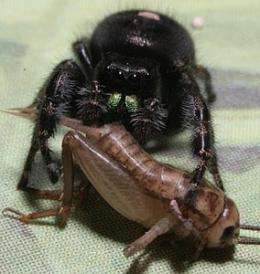
Over the next year, spiders watching videos of their prey are going to help biologist Elizabeth Jakob at the University of Massachusetts Amherst and her colleagues understand how animals choose which visual elements to attend to in their environments. She believes we are on the verge of gaining important new knowledge about how brains and specialized sensory systems work together to process visual information.
Jakob recently won a $145,028 National Science Foundation grant to develop and build an eye tracker especially designed for jumping spiders. An eye tracker measures eye positions and movement to pinpoint where the subject is looking, that is, attention. "It’s like having a window into a spider’s brain. It will allow us to see how they explore complex images and whether they’re looking for particular features," she explains.
Jumping spiders are very attentive animals who use vision to identify and capture prey, evaluate the male’s elaborate courtship dances, identify predators and find their way home to nest sites. Thus, they need to quickly sift all sorts of visual information and decide whether they are seeing a threat, a potential mate or a delicious treat.
This sorting through incoming stimuli is the same problem other animals face, including humans. For example, at any given time our senses may detect a clock ticking, an image on a computer screen and the feeling of our body in the chair. We must decide what to pay attention to at any given moment. Jakob says spiders face the same challenge, but with different equipment; eight eyes and a tiny brain that could fit on the head of a pin. They have specialized eyes to detect different information. Three pairs of secondary eyes, thought to be adapted for detecting motion, are rather simple, with a lens and immovable retina.
By contrast, the principal eyes have an elaborate structure. They face forward and have an immovable lens that’s part of the spider’s outer skeleton. The retina of each principal eye sits inside the head at the end of an eye tube. Densely packed with photoreceptors, the retina gives the spider high-resolution vision rivaling that of primates. However, its small size means it has a very narrow field of view, only about 10 degrees.
This constraint is overcome by a unique arrangement: Eye tubes that hold the retinas are controlled by muscles so the spider can aim its eye tubes like flashlight beams. It is these moveable principal eyes that the eye tracker is designed to study. Like eye trackers used to study human perception, the spider eye tracker will allow Jakob to project images, for example prey, to a spider and watch how her principal eyes examine the image.
A spider in the eye tracker is suspended by a small, removable cork hat attached to its head. A wire attached to the cork holds the spider in place during the 10-minute experiments. The spider is positioned in front of a lens through which it can see a projected image. To help the spider keep her balance and prevent her eight legs from flailing, she gets a little styrofoam ball to hold.
In the experiments, each animal will watch videos or animation of her usual prey species while Jakob and colleagues use an infrared beam in the eye tracker to pinpoint where the animal’s retina is focused and for how long. Spiders can’t see infrared, so they will not be aware of the beam. Jakob will study two different species of jumping spiders who have different hunting techniques: Fast-attacking Phidippus and the much slower hunter, Portia, to compare how the eyes interact and how the basic visual system is used in species with different behaviors. Results will be communicated on a website Jakob is developing in cooperation with the American Arachnological Society.
When complete, the tabletop eye tracking apparatus will be only the second setup in the world. The other is owned by Jakob’s collaborators, Robert Jackson and Duane Harland at the University of Canterbury, New Zealand. Other spider researchers in North America are eager to visit UMass Amherst to use this new tool, Jakob says.
Her NSF grant also funds studies designed to understand how information from the different eyes is combined together. The researchers will cover different sets of eyes with masks, and then present spiders with various stimuli displayed on an iPod Touch and record their behavior. "Jumping spiders are easily fooled by video images and will attack a video of a cricket as if it were real. This characteristic makes interesting experiments easy to design," Jakob says.
Used in conjunction with the eye tracker, the masking technique can also help determine whether the secondary eyes direct the movement of the principal eyes to different areas of the environment.
Provided by University of Massachusetts Amherst


