'Bigfoot of ants' found (again)
October 14, 2010 By Mick Kulikowski
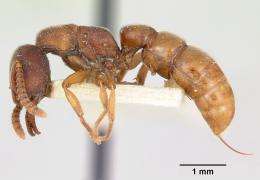
Amblyopone oregonensis. Image credit: Antweb.
(PhysOrg.com) -- Stop the presses: Bigfoot was spotted in Cary! It's probably not the Bigfoot you know, that 8-foot-tall beast also known as Sasquatch. Instead, it's the Bigfoot of ants, a species of ant so rarely seen that it makes blue moons seem common.
This ant Bigfoot was unknown until more than 60 years ago, when it was discovered by a biologist in Concord, N.C., and named as a new species by an eminent Harvard University biologist in 1949. It then disappeared until an NC State doctoral student in biology, Benoit Guenard, found a pair of ants under a rock outside his apartment complex in Cary, on a warm January day.
Unaware hed unearthed the legendary ant species, Guenard photographed the two ants and then gently placed them back under the rock, so they could make their way back to their queen.
No one has reported seeing the Bigfoot ants since.
A new species
In the late 1940s, a biologist named D. L. Wray found some ants within the ant genus Amblyopone around Concord, N.C. These ants, content to eat centipedes and live hidden underground or under leaves and rocks, had two known species in North America when Wray made his discovery Amblyopone oregonensis, which live predominantly in northwestern North America and Amblyopone pallipes, which live nearly everywhere else across the continent.
At least one of the ants collected by Wray in Concord was Amblyopone pallipes, as would be expected. But one of the ants didnt look like the others it had a rounder head, a smaller set of toothlike projections near its mandibles than in other species, and other differences. Wrays find came to the attention of one of the fathers of modern ant biology, Bill Brown, who worked at Harvard. Based solely on this one dead ant from Concord, Brown named a new species Amblyopone trigonignatha.
In ant-study circles, though, many have since questioned Browns judgment. Maybe what he had named was a mutant a weird individual of the common species of Amblyopone. In subsequent years, no one could find a single Amblyopone trigonignatha ant; it seemed nothing more than a pipe dream, a red-headed stepchild of the more common Amblyopone pallipes species.
Until, that is, NC States Guenard found a few slow-moving ants outside his apartment complex.
Messin with Sasquatch
Guenard doesnt take ants lightly. A specialist in ant ecology who studies under Dr. Rob Dunn, Guenard has spent hundreds of hours creating maps of every known ant genus in the world. Its a click on an ant genus and a map pops up to show you where it lives project that takes constant vigilance and a whole lot of knowledge and attention to detail. But when he saw the ants outside his apartment, Guenard didnt collect them. Maybe it was the warm (for January) day. Maybe he was feeling especially magnanimous. Maybe he wanted to spare his neighbors an exterminators bill. But instead of collecting the Bigfoot of ants, all Guenard took was some photographs.
At least, he says now with a wry smile, the photos were in focus.
Those pictures, though, revealed something interesting. Recently, an ant blogger such people do exist appropriately named Alex Wild found something unusual while trolling through Guenards online photos of the ants of North Carolina. Channeling the Harvard biologist Bill Brown, he saw individual ants that did not look like Amblyopone pallipes but instead looked like Browns rare ant, Amblyopone trigonignatha.
Wild sent an e-mail to Guenard and copied another ant specialist, Brian Fisher, at the California Academy of Sciences. Fisher concluded that the photos, indeed, captured Bigfoot.
Calling all myrmecologists
So Guenard renews the call to all myrmecologists those who undertake the scientific study of ants and any other naturalists, particularly those living in the Piedmont regions of North Carolina, Georgia and South Carolina, to look for more of what is still North Americas rarest ant.
Guenard, and the ant-studying community, still have lots of questions about the Bigfoot of ants. Why is this particular ant so hard to find? Why it is different from other species of the same genus? Why does it seem to be relatively active during the cool months of the year?
As can be expected, Guenard has spent an inordinate amount of his time looking for Bigfoot in the past few weeks.
So far hes had no luck finding Amblyopone trigonignatha. But he and an ant-collecting colleague did find two big colonies of the Proceratium silaceum ant, which feeds only on the eggs of spiders.
Dont worry, he collected them.
Provided by
North Carolina State University
-
From lemons to lemonade: Reaction uses carbon dioxide to make carbon-based semiconductor,
27 comments
-
Every black hole contains a new universe: A physicist presents a solution to present-day cosmic mysteries,
209 comments
-
New silicon memory chip developed,
16 comments
-
Computing experts unveil superefficient 'inexact' chip,
45 comments
-
SpaceX private rocket blasts off for space station (Update),
41 comments
-
Semen stains glows under black lights (uv light)?
15 hours ago
-
Question on Human Chromosome 2
18 hours ago
-
How important is composition of TBST in diluting antibodies and Western Blotting?
May 22, 2012
-
Does the medulla monitor blood pH
May 20, 2012
-
What physically constitutes memory?
May 17, 2012
-
How come some pathogenic micoorganisms are commensals in our body?
May 17, 2012
- More from Physics Forums - Biology
More news stories
Researchers film rare striped rabbit in Sumatra (w/ Video)
(Phys.org) -- With cameras set up in Sumatra looking for medium- and small-sized wild cats, such as leopards, a research group involving the University of Delaware's Kyle McCarthy, found images of something ...
50 minutes ago |
5 / 5 (2) |
0
Bees at risk from chemicals increase, scientists say
Pesticide use rose by 6.5% between 2005 and 2010, increasing the risk to bee populations, according to new research from the University of Reading launched today by Friends of the Earth.
53 minutes ago |
not rated yet |
0
Crowding causes cells to produce an orderly matrix of molecules
When researchers conduct experiments on the way cells grow and respond to outside cues, they tend to use solutions that are much more dilute than the crowded environments found inside living cells. Now, new ...
1 hour ago |
not rated yet |
0
|
Deep sea animals stowaway on submarines and reach new territory
Marine scientists studying life around deep-sea vents have discovered that some hardy species can survive the extreme change in pressure that occurs when a research submersible rises to the surface. The team's ...
8 hours ago |
5 / 5 (1) |
3
|
Commonly used pesticide turns honey bees into 'picky eaters'
Biologists at UC San Diego have discovered that a small dose of a commonly used crop pesticide turns honey bees into "picky eaters" and affects their ability to recruit their nestmates to otherwise good sources of food.
7 hours ago |
5 / 5 (1) |
1
|
Research team uncovers mechanism behind drugs that cause altered immunity
(Medical Xpress) -- An Australian research team has opened the door to understanding why certain drugs cause a so called altered immunity response when offered as treatment for certain specific ailments. In their paper published ...
New genetic method pinpoints geographic origin
(Medical Xpress) -- Understanding the genetic diversity within and between populations has important implications for studies of human disease and evolution. This includes identifying associations between genetic variants ...
Older African-Americans use religious songs to cope with stress, study shows
(Medical Xpress) -- New research from the University of North Carolina Chapel Hill School of Nursing has shown that older African-Americans use religious songs in a personal way to cope with stressful life events. Songs long ...
Nasa concludes wind tunnel testing to aid in SpaceX reusable launch system design
(Phys.org) -- NASA's Marshall Space Flight Center in Huntsville, Ala., completed wind tunnel testing for Space Exploration Technologies (SpaceX) of Hawthorn, Calif., to provide Falcon 9 first stage re-entry data for the company's ...
Study reveals who profits and who incur losses from provision of immediacy in the stock market
While mutual funds and issue of stocks cause price impact, hedge funds and repurchase of shares decrease this. The doctoral dissertation by Kalle Rinne, M. Sc. (Econ.), studies how demand and provision of immediacy affects ...
Automated image analysis arises from handcraft and machine learning
The amount of visual information increases with tremendous speed. The archives of television networks, image bank databases and social media in the web are all bursting with billions of pictures and more is produced ...
Oct 14, 2010
Rank: 1.7 / 5 (6)
Oct 14, 2010
Rank: 2.3 / 5 (3)
Oct 14, 2010
Rank: 5 / 5 (5)
Oct 14, 2010
Rank: 5 / 5 (4)
Oct 14, 2010
Rank: 4 / 5 (2)
not only that, but i have photos of it mating with a smaller male... :)
alas, no one cares since i dont have academia stamp...
i would call it a pole not a stick...
i also have lots of other images of all kinds of rare AND common
Oct 14, 2010
Rank: 5 / 5 (1)
Oct 14, 2010
Rank: 5 / 5 (2)
I know of several people who would be immediately interested. Can you pm me the picture and coordinates or where it was taken?
Oct 14, 2010
Rank: 3 / 5 (2)
Oct 14, 2010
Rank: 4 / 5 (3)
If you had read the article, you would know. Also, right next to the picture, it tells you it's an Amblyopone oregonensis, not A. trigonignatha, so it's not exactly an oversight.
Oct 15, 2010
Rank: 5 / 5 (1)
Oh and Rdavid, that would have been funny had you used "wear" you don't "where" costumes... come on people we're readers of an advanced scientific site (at least compared to most of the crap out there), we can at least shoot for proper terminology, and there's no need to be able to spell, because it tells you when you're wrong.
Oct 15, 2010
Rank: 5 / 5 (1)
i just sent you a PM where we can trade information, and such... thx!
Oct 16, 2010
Rank: not rated yet
The image wasn't showing when I read the article...it did this time :)
Oct 17, 2010
Rank: not rated yet
Years ago on the northern outskirts of Melbourne (Australia) an English tourist came across some large bull ants (about 1 1/4 to 1 1/2 inches long, 3 to 3.5 cms) thinking himself smart and superior he knocked the ash off his cigarette, took a draw on it to produce a nice red ember and tried to burn the ant. The ant simply grabbed the end of the cigarette and climbed onto the cigarette, this caused the heroic Pom to drop his cigarette and head back to the railway station pronto, he was intent on getting away from those ants.
Some hero?
Out of curiosity, I know there are some extremely tiny ants but where do the biggest ants come from?