Astronomers find weird, warm spot on an exoplanet
October 19, 2010

Astronomers find weird, warm spot on an exoplanet

Enlarge

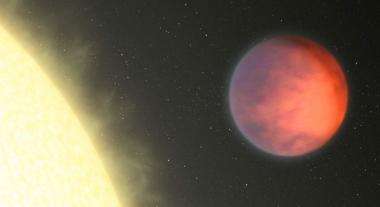
NASA's Spitzer Space Telescope has found that the hottest part of a distant planet, named upsilon Andromedae b, is not under the glare of its host star as might be expected. Image credit: NASA/JPL-Caltech

(PhysOrg.com) -- Observations from NASA's Spitzer Space Telescope reveal a distant planet with a warm spot in the wrong place.

The gas-giant planet, named upsilon Andromedae b, orbits tightly around its star, with one face perpetually boiling under the star's heat. It belongs to a class of termed hot Jupiters, so called for their scorching temperatures and large, gaseous constitutions.

One might think the hottest part of these planets would be directly under the sun-facing side, but previous observations have shown that their hot spots may be shifted slightly away from this point. Astronomers thought that fierce winds might be pushing hot, gaseous material around.

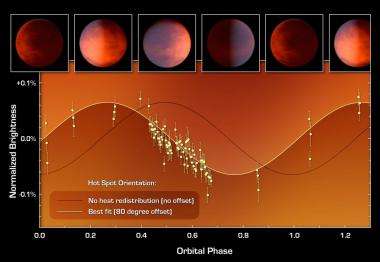
But the new finding may throw this theory into question. Using Spitzer, an infrared observatory, astronomers found that upsilon Andromedae b's hot spot is offset by a whopping 80 degrees. Basically, the hot spot is over to the side of the planet instead of directly under the glare of the sun.

"We really didn't expect to find a hot spot with such a large offset," said Ian Crossfield, lead author of a new paper about the discovery appearing in an upcoming issue of . "It's clear that we understand even less about the atmospheric energetics of hot Jupiters than we thought we did."
Astronomers find weird, warm spot on an exoplanet
Enlarge

This graph of data from NASA's Spitzer Space Telescope shows how astronomers located a hot spot on a distant gas planet named upsilon Andromedae b -- and learned that it was in the wrong place. NASA/JPL-Caltech/UCLA

The results are part of a growing field of exoplanet atmospheric science, pioneered by Spitzer in 2005, when it became the first telescope to directly detect photons from an exoplanet, or a planet orbiting a star other than our sun. Since then, Spitzer, along with NASA's , has studied the atmospheres of several hot Jupiters, finding water, methane, carbon dioxide and .

In the new study, astronomers report observations of upsilon Andromedae b taken across five days in February of 2009. This planet whips around its star every 4.6 days, as measured using the "wobble," or radial velocity technique, with telescopes on the ground. It does not transit, or cross in front of, its star as many other hot Jupiters studied by Spitzer do.

Spitzer measured the total combined light from the star and planet, as the planet orbited around. The telescope can't see the planet directly, but it can detect variations in the total infrared light from the system that arise as the hot side of the planet comes into Earth's field of view. The hottest part of the planet will give off the most infrared light.

One might think the system would appear brightest when the planet was directly behind the star, thus showing its full sun-facing side. Likewise, one might think the system would appear darkest when the planet swings around toward Earth, showing its backside. But the system was the brightest when the planet was to the side of the star, with its side facing Earth. This means that the hottest part of the planet is not under its star. It's sort of like going to the beach at sunset to feel the most heat. The researchers aren't sure how this could be.

This video is not supported by your browser at this time.

This animation illustrates an unexpected warm spot on the surface of a gaseous exoplanet. Image credit: NASA/JPL-Caltech

They've guessed at some possibilities, including supersonic winds triggering shock waves that heat material up, and star-planet magnetic interactions. But these are just speculation. As more hot Jupiters are examined, astronomers will test new theories.

"This is a very unexpected result," said Michael Werner, the Spitzer project scientist at NASA's Jet Propulsion Laboratory, Pasadena, Calif., who was not a part of the study. "Spitzer is showing us that we are a long way from understanding these alien worlds."

The Spitzer observations were made before it ran out of its liquid coolant in May 2009, officially beginning its warm mission.

Provided by JPL/NASA search and more info website

4.4 /5 (25 votes)  

Filter


Move the slider to adjust rank threshold, so that you can hide some of the comments.


Display comments: newest first

Quantum_Conundrum
Oct 19, 2010

Rank: 1.9 / 5 (13)
The Spitzer observations were made before it ran out of its liquid coolant in May 2009, officially beginning its warm mission


Why is this being published 17 months later?

Meh, they can't even explain what happens on Titan even with an orbiter and a lander on the darn thing.

Why should we expect any of these data about extra-solar planet's temperatures or composition to be accurate when they are so far away?
otto1932
Oct 19, 2010

Rank: 4.4 / 5 (13)
The Spitzer observations were made before it ran out of its liquid coolant in May 2009, officially beginning its warm mission


Why is this being published 17 months later?

Meh, they can't even explain what happens on Titan even with an orbiter and a lander on the darn thing.

Why should we expect any of these data about extra-solar planet's temperatures or composition to be accurate when they are so far away?
Why should we expect informed comments from someone who has no appreciation of how science is done, and no respect for the qualifications of the people who do it?
Husky
Oct 19, 2010

Rank: 5 / 5 (8)
as the planet is a close to host star orbiter, maybe there is violent dense stellar wind and that part gets the most headwind as it travels through the medium think of aurora on steroids, another contribution could be made on top of thart if the magnetic axis of the planet is not lined with the plane of the host star, so its aurorae would manifest on north-south poles spinning axis out of the usual plane
xanderjones
Oct 19, 2010

Rank: 3.3 / 5 (4)
@otta, yeah and he said "meh" too.

Ulg
Oct 19, 2010

Rank: not rated yet
It sort of reminds me of Tesla's work with induction heating in 1892 when in london he showed a large hoop as a transmitter and a sphere as receiver, only half of the sphere glowed bright from the inductive eddy currents- from the diagram he drew it would appear to have been the far side of the field source.
EvilGnome
Oct 19, 2010

Rank: 3 / 5 (1)
I might be entirely wrong, but to me, wouldn't the system appear brighter with combination of the sun and the reflection of the sun on the planet off-center. The sun would appear at the same brightness until something crosses its path and the planet would reflect excess light just off center from being on the opposite side of the sun, thus making the combination brighter.
omatumr
Oct 20, 2010

Rank: 2.2 / 5 (6)
Jupiter also generates excess heat.

How? Probably from spontaneous and/or induced nuclear fission reactions there.

Why? All of the actinide elements (Th, U, Pu, etc) that undergo spontaneous or induced fission were made by rapid neutron capture (r-process) in a supernova.

That same process produced Xe-136, the heaviest stable isotope of xenon.

The r-process occurred in the outer layer of the supernova where He was abundant.

Excess Xe-136 has been observed in carbon-rich inclusions of meteorites and in Jupiter's He-rich atmosphere. "Strange" xenon in meteorites and planets contains excess Xe-136.

The experimental measurements are summarized here: www.youtube.com/w...QSSHIe6k

With kind regards,
Oliver K. Manuel
Former NASA Principal
Investigator for Apollo
scidog
Oct 20, 2010

Rank: not rated yet
or just something on the surface that acts as a heat trap.
Changleen
Oct 20, 2010

Rank: not rated yet
Or is life.
kevinrtrs
Oct 20, 2010

Rank: 2 / 5 (2)
@EvilGnnome. I tend to agree with you. However, this quote might have something to do with how they determine the brightness of the planet at any point:
Spitzer was able to detect the faint glow of GJ 436b by watching it slip behind its star, an event called a secondary eclipse. As the planet disappears, the total light observed from the star system drops -- this drop is then measured to find the brightness of the planet at various wavelengths. The technique, first pioneered by Spitzer in 2005, has since been used to measure atmospheric components of several Jupiter-sized exoplanets, the so-called hot Jupiters, and now the Neptune-sized GJ 436b.

from here: http://www.physor...885.html

It's could of course also be that whereas the expectation is that the planet is tidally locked, it in fact is not. This might then give a different way of heating and cooling on the planet. Just a thought.
daqman
Oct 20, 2010

Rank: not rated yet
The answer may lie in the sentence: "The gas-giant planet, named upsilon Andromedae b, orbits tightly around its star, with one face perpetually boiling under the star's heat." This is surely an assumption based on the fact that tidal forces would stop rotation and lock one face pointing at the star.

One simple answer would be that this isn't true and the planet has a tilted axis of rotation that was almost parallel to the plane of the orbit with one pole pointed towards earth. The planet acts as a gyroscope with the same always pole facing earth (there would be precession but maybe not on the timescale of these measurements). The pole would be in permanent light/heat for half the year. In the late summer when that pole was hottest and would appear as a hot spot at one side of the star, just as seen in the observations.
Adriab
Oct 20, 2010

Rank: 5 / 5 (4)
Jupiter also generates excess heat.

How? Probably from spontaneous and/or induced nuclear fission reactions there.


More likely it is a more mundane form of heating from the contraction of the planet as it compresses from its own gravity. All the gas giants in our solar system produce at least some heat, and it is most likely due to this reason.
Donutz
Oct 20, 2010

Rank: 4.2 / 5 (5)
Why should we expect informed comments from someone who has no appreciation of how science is done, and no respect for the qualifications of the people who do it?


Yeah, there's this little thing called 'credibility', of which QC has none.
geordie_macdonald
Oct 20, 2010

Rank: not rated yet
hmmm if the hot spot is offset by 80 degrees, then my first question is: "In which direction?"

If it was 80 degrees toward the leading edge then I might guess that moving through the corona at 35,000 kph would cause some heating... no?

The other question which has been alluded to is this:
Can gas giants get tidally locked? Or does tidal locking only work with terrestrial bodies?

Olivia
Oct 25, 2010

Rank: not rated yet
Ok, is the hotspot constantly moving? If yes then it is really really strange. Perhaps infrareds bents through space more than visibles. that explains the 80 degree offset.
LKD
Oct 25, 2010

Rank: not rated yet
I am guessing this is like a thermal Jupiter red spot. A giant hurricane that eddies between the hot and cold sides.
Rank 4.4 /5 (25 votes)
Relevant PhysicsForums posts

More news stories

Nasa concludes wind tunnel testing to aid in SpaceX reusable launch system design

(Phys.org) -- NASA's Marshall Space Flight Center in Huntsville, Ala., completed wind tunnel testing for Space Exploration Technologies (SpaceX) of Hawthorn, Calif., to provide Falcon 9 first stage re-entry data for the company's ...

Space & Earth / Space Exploration

created 38 minutes ago | popularity 5 / 5 (1) | comments 0

Neil Armstrong gives rare interview - to accountant

The famously private Neil Armstrong, the first man to walk on the moon, has been coaxed into giving a rare interview -- with an Australian accountant.

Space & Earth / Space Exploration

created 3 hours ago | popularity 5 / 5 (1) | comments 3

Study shows how to keep a Mars tumbleweed rover moving on rocky terrain

New research from North Carolina State University shows that a wind-driven "tumbleweed" Mars rover would be capable of moving across rocky Martian terrain – findings that could also help the National ...

Space & Earth / Space Exploration

created 21 hours ago | popularity 3 / 5 (6) | comments 10 | with audio podcast

Kyoto Protocol architect 'frustrated' by climate dialogue

UN climate talks are going nowhere, as politicians dither or bicker while the pace of warming dangerously speeds up, one of the architects of the Kyoto Protocol told AFP.

Space & Earth / Environment

created 21 hours ago | popularity 3.5 / 5 (6) | comments 22

Dark shadows on Mars: Scene from durable NASA rover

(Phys.org) -- Like a tourist waiting for just the right lighting to snap a favorite shot during a stay at the Grand Canyon, NASA's Mars Exploration Rover Opportunity has used a low sun angle for a memorable ...

Space & Earth / Space Exploration

created 23 hours ago | popularity 5 / 5 (9) | comments 9 | with audio podcast


Research team uncovers mechanism behind drugs that cause altered immunity

(Medical Xpress) -- An Australian research team has opened the door to understanding why certain drugs cause a so called altered immunity response when offered as treatment for certain specific ailments. In their paper published ...

New genetic method pinpoints geographic origin

(Medical Xpress) -- Understanding the genetic diversity within and between populations has important implications for studies of human disease and evolution. This includes identifying associations between genetic variants ...

Researchers film rare striped rabbit in Sumatra (w/ Video)

(Phys.org) -- With cameras set up in Sumatra looking for medium- and small-sized wild cats, such as leopards, a research group involving the University of Delaware's Kyle McCarthy, found images of something ...

Bees at risk from chemicals increase, scientists say

Pesticide use rose by 6.5% between 2005 and 2010, increasing the risk to bee populations, according to new research from the University of Reading launched today by Friends of the Earth.

Older African-Americans use religious songs to cope with stress, study shows

(Medical Xpress) -- New research from the University of North Carolina Chapel Hill School of Nursing has shown that older African-Americans use religious songs in a personal way to cope with stressful life events. Songs long ...

Study reveals who profits and who incur losses from provision of immediacy in the stock market

While mutual funds and issue of stocks cause price impact, hedge funds and repurchase of shares decrease this. The doctoral dissertation by Kalle Rinne, M. Sc. (Econ.), studies how demand and provision of immediacy affects ...