Astronomers discover most massive neutron star yet known (w/ Video)
October 27, 2010

Astronomers discover most massive neutron star yet known

Enlarge

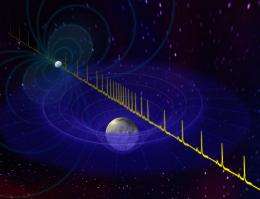
Pulses from neutron star (rear) are slowed as they pass near foreground white dwarf. This effect allowed astronomers to measure masses of the system. CREDIT: Bill Saxton, NRAO/AUI/NSF

(PhysOrg.com) -- Astronomers using the National Science Foundation's Green Bank Telescope (GBT) have discovered the most massive neutron star yet found, a discovery with strong and wide-ranging impacts across several fields of physics and astrophysics.

"This neutron star is twice as massive as our Sun. This is surprising, and that much mass means that several for the internal composition of neutron stars now are ruled out," said Paul Demorest, of the (NRAO). "This mass measurement also has implications for our understanding of all matter at extremely high densities and many details of nuclear physics," he added.

Neutron stars are the superdense "corpses" of massive stars that have exploded as supernovae. With all their mass packed into a sphere the size of a small city, their protons and electrons are crushed together into neutrons. A neutron star can be several times more dense than an , and a thimbleful of neutron-star material would weigh more than 500 million tons. This tremendous density makes neutron stars an ideal natural "laboratory" for studying the most dense and exotic states of matter known to physics.

This video is not supported by your browser at this time.

Explaining the Scientific Implications

The scientists used an effect of Albert Einstein's theory of General Relativity to measure the mass of the neutron star and its orbiting companion, a white dwarf star. The neutron star is a pulsar, emitting lighthouse-like beams of that sweep through space as it rotates. This pulsar, called PSR J1614-2230, spins 317 times per second, and the companion completes an orbit in just under nine days. The pair, some 3,000 light-years distant, are in an orbit seen almost exactly edge-on from Earth. That orientation was the key to making the mass measurement.

As the orbit carries the white dwarf directly in front of the pulsar, the radio waves from the pulsar that reach Earth must travel very close to the white dwarf. This close passage causes them to be delayed in their arrival by the distortion of spacetime produced by the white dwarf's gravitation. This effect, called the Shapiro Delay, allowed the scientists to precisely measure the masses of both stars.

"We got very lucky with this system. The rapidly-rotating pulsar gives us a signal to follow throughout the orbit, and the orbit is almost perfectly edge-on. In addition, the white dwarf is particularly massive for a star of that type. This unique combination made the Shapiro Delay much stronger and thus easier to measure," said Scott Ransom, also of NRAO.

The astronomers used a newly-built digital instrument called the Green Bank Ultimate Pulsar Processing Instrument (GUPPI), attached to the GBT, to follow the binary stars through one complete orbit earlier this year. Using GUPPI improved the astronomers' ability to time signals from the pulsar severalfold.

The researchers expected the neutron star to have roughly one and a half times the mass of the Sun. Instead, their observations revealed it to be twice as massive as the Sun. That much mass, they say, changes their understanding of a neutron star's composition. Some theoretical models postulated that, in addition to neutrons, such stars also would contain certain other exotic subatomic particles called hyperons or condensates of kaons.

"Our results rule out those ideas," Ransom said.

Demorest and Ransom, along with Tim Pennucci of the University of Virginia, Mallory Roberts of Eureka Scientific, and Jason Hessels of the Netherlands Institute for Radio Astronomy and the University of Amsterdam, reported their results in the October 28 issue of the scientific journal Nature.

Their result has further implications, outlined in a companion paper, scheduled for publication in the Astrophysical Journal Letters. "This measurement tells us that if any quarks are present in a neutron star core, they cannot be 'free,' but rather must be strongly interacting with each other as they do in normal atomic nuclei," said Feryal Ozel of the University of Arizona, lead author of the second paper.

There remain several viable hypotheses for the internal composition of neutron stars, but the new results put limits on those, as well as on the maximum possible density of cold matter.

The scientific impact of the new GBT observations also extends to other fields beyond characterizing matter at extreme densities. A leading explanation for the cause of one type of gamma-ray burst -- the "short-duration" bursts -- is that they are caused by colliding neutron stars. The fact that neutron stars can be as massive as PSR J1614-2230 makes this a viable mechanism for these gamma-ray bursts.

Such neutron-star collisions also are expected to produce gravitational waves that are the targets of a number of observatories operating in the United States and Europe. These waves, the scientists say, will carry additional valuable information about the composition of .

"Pulsars in general give us a great opportunity to study exotic physics, and this system is a fantastic laboratory sitting out there, giving us valuable information with wide-ranging implications," Ransom explained. "It is amazing to me that one simple number -- the mass of this neutron star -- can tell us so much about so many different aspects of physics and astronomy," he added.

More information: http://www.nrao.ed … cilities/gbt
http://www.nature. … re09466.html

Provided by National Radio Astronomy Observatory search and more info website

4.7 /5 (33 votes)  

Filter


Move the slider to adjust rank threshold, so that you can hide some of the comments.


Display comments: newest first

Amanullah
Oct 27, 2010

Rank: 5 / 5 (1)
epic
LariAnn
Oct 27, 2010

Rank: not rated yet
So this neutron star is twice as massive as our Sun - can the diameter of the body be determined? It must be pretty small in volume compared to our Sun. I'm also curious as to what kind of reaction is occurring on/in the neutron star so as to cause the radio-wave emissions.
Husky
Oct 27, 2010

Rank: 5 / 5 (3)
317 rotations a second of a trillions of tons massive ball, just imagine if you could use that rotation/magnetic field as a dynamo to power your civilisation, the sheer inertia of the system would power lightbulbs until the predicted big rip, speaking of which, could it be possible that if indeed spacetime is loosing coherence and the proton expected to decay, we still could survive the big rip when in close proximity of neutron stars/black holes of other massive objects that have a ferm gravitational grasp on its immediate surroundings and keeps space and civilisations orbiting around it from evaporating?
Resonance
Oct 27, 2010

Rank: 3.7 / 5 (3)
I'm confused.
I thought Chandrasekhar proved that the upper mass limit of a white dwarf was roughly 1.4 solar masses. I also thought it was accepted that a neutron star could have a mass of up to 3 or 4 solar masses. Can someone please inform me or give me an update? Thanks
that_guy
Oct 27, 2010

Rank: 5 / 5 (2)
If you calculate it, assuming the radius is about 7 mi, the surface is rotating at about 14k miles a second or appx 8% of the speed of light. talk about whiplash.
that_guy
Oct 27, 2010

Rank: 1.8 / 5 (5)
I'm confused.
I thought Chandrasekhar proved that the upper mass limit of a white dwarf was roughly 1.4 solar masses. I also thought it was accepted that a neutron star could have a mass of up to 3 or 4 solar masses. Can someone please inform me or give me an update? Thanks


you have a computer and access to google. Don't ask questions that will take you 2 minutes to answer on your own.
PinkElephant
Oct 27, 2010

Rank: 5 / 5 (3)
@LariAnn,
what kind of reaction is occurring on/in the neutron star so as to cause the radio-wave emissions
Oddly enough, neutron stars have a magnetic field, and these fields are much more powerful than a typical star. Any residual gas (or even interstellar dust) that gets ionized in the vicinity of the star, will spiral down the magnetic field lines onto one of the neutron star's magnetic poles -- analogous to the Aurora on Earth. This would form bright spots on the star's surface, as this matter impacts the surface at very high speeds. If the magnetic poles are not perfectly aligned with the rotational axis, then the bright spots will tend to spin around together with the rest of the surface: creating a "lighthouse" effect. This gets particularly accentuated if there's a companion star, whose stellar wind (or even upper atmosphere) becomes entrained into an accretion disk around the neutron star.
genastropsychicallst
Oct 28, 2010

Rank: 1 / 5 (4)
... indeed, but massiving was before Eris ...
Rank 4.7 /5 (33 votes)
Relevant PhysicsForums posts

More news stories

Nasa concludes wind tunnel testing to aid in SpaceX reusable launch system design

(Phys.org) -- NASA's Marshall Space Flight Center in Huntsville, Ala., completed wind tunnel testing for Space Exploration Technologies (SpaceX) of Hawthorn, Calif., to provide Falcon 9 first stage re-entry data for the company's ...

Space & Earth / Space Exploration

created 38 minutes ago | popularity 5 / 5 (1) | comments 0

Neil Armstrong gives rare interview - to accountant

The famously private Neil Armstrong, the first man to walk on the moon, has been coaxed into giving a rare interview -- with an Australian accountant.

Space & Earth / Space Exploration

created 3 hours ago | popularity 5 / 5 (1) | comments 3

Study shows how to keep a Mars tumbleweed rover moving on rocky terrain

New research from North Carolina State University shows that a wind-driven "tumbleweed" Mars rover would be capable of moving across rocky Martian terrain – findings that could also help the National ...

Space & Earth / Space Exploration

created 21 hours ago | popularity 3 / 5 (6) | comments 10 | with audio podcast

Kyoto Protocol architect 'frustrated' by climate dialogue

UN climate talks are going nowhere, as politicians dither or bicker while the pace of warming dangerously speeds up, one of the architects of the Kyoto Protocol told AFP.

Space & Earth / Environment

created 21 hours ago | popularity 3.5 / 5 (6) | comments 22

Dark shadows on Mars: Scene from durable NASA rover

(Phys.org) -- Like a tourist waiting for just the right lighting to snap a favorite shot during a stay at the Grand Canyon, NASA's Mars Exploration Rover Opportunity has used a low sun angle for a memorable ...

Space & Earth / Space Exploration

created 23 hours ago | popularity 5 / 5 (9) | comments 9 | with audio podcast


Research team uncovers mechanism behind drugs that cause altered immunity

(Medical Xpress) -- An Australian research team has opened the door to understanding why certain drugs cause a so called altered immunity response when offered as treatment for certain specific ailments. In their paper published ...

New genetic method pinpoints geographic origin

(Medical Xpress) -- Understanding the genetic diversity within and between populations has important implications for studies of human disease and evolution. This includes identifying associations between genetic variants ...

Researchers film rare striped rabbit in Sumatra (w/ Video)

(Phys.org) -- With cameras set up in Sumatra looking for medium- and small-sized wild cats, such as leopards, a research group involving the University of Delaware's Kyle McCarthy, found images of something ...

Bees at risk from chemicals increase, scientists say

Pesticide use rose by 6.5% between 2005 and 2010, increasing the risk to bee populations, according to new research from the University of Reading launched today by Friends of the Earth.

Older African-Americans use religious songs to cope with stress, study shows

(Medical Xpress) -- New research from the University of North Carolina Chapel Hill School of Nursing has shown that older African-Americans use religious songs in a personal way to cope with stressful life events. Songs long ...

Study reveals who profits and who incur losses from provision of immediacy in the stock market

While mutual funds and issue of stocks cause price impact, hedge funds and repurchase of shares decrease this. The doctoral dissertation by Kalle Rinne, M. Sc. (Econ.), studies how demand and provision of immediacy affects ...