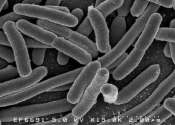
New way to improve antibiotic production
An antibiotic has been found to stimulate its own production. The findings, to be published in PNAS, could make it easier to scale up antibiotic production for commercialisation.
They're ba-ack! But in a new disease-fighting role. Viruses that infect and kill bacteria—used to treat infections in the pre-antibiotic era a century ago and in the former Soviet Union today—may have ...
Certain Streptococci increase their production of toxic shock syndrome toxin 1, sometimes to potentially dangerous levels, when aerobic bacteria are present in the vagina. But scientists from the University of Western Ontari ...
After two recent reports suggesting that exposing bacteria to tea tree oil may contribute to antibiotic resistance in humans, an international study - led by researchers at The University of Western Australia ...
(Phys.org)—Scientists have identified the chemical 'fingerprints' given off by specific bacteria when present in the lungs, potentially allowing for a quick and simple breath test to diagnose infections such as tuberculosis.
(Phys.org)—Researchers at the University of Cincinnati (UC) report that they have solved the crystal structure of a protein involved in holding bacterial cells together in a biofilm, a major development in their exploration ...
(Phys.org)—For the first time, researchers sequenced DNA molecules without the need for the standard pre-sequencing workflow known as library preparation.
(Phys.org)—A new study from Stanford's Department of Chemistry reveals that the cell wall structure of Staphylococcus aureus, a bacterium responsible for a broad range of diseases, depends on growth stage ...
(Phys.org)—An international team of researchers has uncovered how a molecular parasite responsible for playing a role in antibiotic-resistant disease, such as MRSA, can replicate and spread ability to cause ...
For decades, bacteria like the stubborn methicillin-resistant Staphylococcus aureus (MRSA) have concerned gym goers, hospital patients and staff, and parents of school children. MRSA is particularly worrisome because it is ...
Selenium is an inexpensive element that naturally belongs in the body. It is also known to combat bacteria. Still, it had not been tried as an antibiotic coating on a medical device material. In a new study, ...
Researchers have uncovered what makes one particular strain of methicillin-resistant Staphylococcus aureus (MRSA) so proficient at picking up resistance genes, such as the one that makes it resistant to vancomycin, the last ...
Antibiotic-resistant bacteria continue to be a global concern with devastating repercussions, such as increased healthcare costs, potential spread of infections across continents, and prolonged illness.
(Medical Xpress) -- An unusual case could tell researchers more about the genetic changes that occur when a common bacteria, normally carried without any problems, on rare occasions causes potentially life-threatening ...
Bioengineers at Tufts University School of Engineering have developed a new silk-based microneedle system able to deliver precise amounts of drugs over time and without need for refrigeration. The tiny needles can be fabricated ...