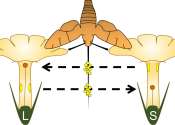
Caffeine enhances bee memory
(Phys.org) —Caffeine is the naturally occurring drug most widely used by humans. In nature, though, it is reported to act as a bitter and toxic deterrent to herbivores, preventing leaves and seeds from ...
Scientists see if bees 'are what they eat'
(Phys.org) —In a paper published today in the peer-reviewed science journal PLoS ONE, researchers have presented a new model to explore how changes in food availability might influence honeybee colony growth ...
Nearly one in three US honeybees lost in winter 2012-13
When cuddly bees influence the rules
It may be easier to show concern about cuddly animals like bees than about some of the millions of indigenous insect and microorganisms found in the European biodiversity.
Ecological knowledge offers perspectives for sustainable agriculture
The honey and the ivy: Why gardeners' foe is the bees' friend
Ivy, often maligned as a garden pest, is vital to honey bees and other pollinators seeking food in autumn, new research from the University of Sussex reveals.
EU set to ban pesticides blamed for decline of bees
Just what makes that little old ant… change a flower's nectar content?
Ants play a variety of important roles in many ecosystems. As frequent visitors to flowers, they can benefit plants in their role as pollinators when they forage on sugar-rich nectar. However, a new study ...
Cocktail of multiple pressures combine to threaten the world's pollinating insects
Researcher helps construct Lepidoptera family tree of life
A new international study co-authored by a University of Florida researcher describes one of the most comprehensive analyses of Lepidoptera evolutionary relationships to date, and could have broad implications in the fields ...
Metabolic fingerprinting: Using proteomics to identify proteins in gymnosperm pollination drops
Proteins are vital parts of living organisms, performing a variety of essential functions such as DNA replication, catabolizing reactions, and responding to stimuli. The complete set of proteins expressed in an organism at ...
Thousands of pesticides dodge US regulation
Thousands of pesticides are allowed onto the US market without rigorous safety testing, putting people, animals and crop pollinators like bees at risk, a US environmental group said Wednesday.
Happy honeybees: Student applying engineering research to agriculture
EU plans new bid to protect bees