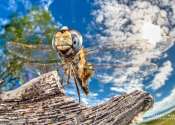
Lonely bees make better guests
Solitary bees are twice as likely to pollinate the flowers they visit as their more sociable counterparts, according to a new study.
Predators affect the carbon cycle, researchers show
A new study shows that the predator-prey relationship can affect the flow of carbon through an ecosystem. This previously unmeasured influence on the environment may offer a new way of looking at biodiversity management and ...
Global cooling as significant as global warming, research shows
A "cold snap" 116 million years ago triggered a similar marine ecosystem crisis to those witnessed in the past as a result of global warming, according to research published today in Nature Geoscience.
UCLA climate study predicts dramatic loss in local snowfall
By midcentury, snowfall on Los Angeles–area mountains will be 30 to 40 percent less than it was at the end of the 20th century, according to a UCLA study released today and led by UCLA climate expert Alex Hall.
US forest management policy must evolve to meet bioenergy targets
(Phys.org) —In order to keep pace with the burgeoning demand for renewable energy, forest management policy in the U.S. must change to address environmental sustainability issues, according to an article ...
Tropical vagrants bigger, stronger survivors
Landsat satellite looks back at El Paso, forward to a new mission
Landsat has seen a lot in its day. In one spot of desert, where the Rio Grande marks the border between the United States and Mexico, the satellite program captured hundreds of images of fields turning green with the season, ...
Study reveals leakage of carbon from land to rivers, lakes, estuaries and coastal regions
When carbon is emitted by human activities into the atmosphere it is generally thought that about half remains in the atmosphere and the remainder is stored in the oceans and on land. New research suggests ...
Alien invaders get a bad press
Drought, river fragmentation forcing endangered fish out of water, biologist finds
Greenhouse gas emissions still an issue
The amount of greenhouse gases (GHGs) released into the atmosphere as a result of human activities is cause for concern as evidence of major climate change begins to mount. A European research team spanning ...
A lucky catch: A tiny new fish, Haptoclinus dropi, from the southern Caribbean
A new species of tiny blenniiform fish has been discovered in the biodiversity rich waters of the southern Caribbean. Haptoclinus dropi is only around 2cm in length with a beautiful color pattern that includ ...
To save corals, save the forests, study says
Conservationists fighting to save coastal coral reefs should think first about combatting local deforestation rather than attacking the wider peril of global warming, suggests an unusual study published on ...
The intensity of land use doubled in the 20th century
The growth of green plants – which can be measured in terms of "net primary production", or NPP for short – provides the energetic foundation for all life on earth. The share of NPP appropriated by humans (HANPP) through ...