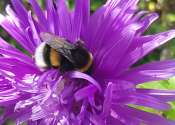
News tagged with bees
Blowing in the wind: How hidden flower features are crucial for bees
As gardeners get busy filling tubs and borders with colourful bedding plants, scientists at the Universities of Cambridge and Bristol have discovered more about what makes flowers attractive to bees rather than humans. Published ...
10 hours ago |
4 / 5 (3) |
0
|
Homecoming buzz: short-haired bees return to UK
(AP) -- A conservationist says she is releasing 100 short-haired bees into the wild, 20 years after they were wiped out in the British countryside.
21 hours ago |
not rated yet |
0
Commonly used pesticide turns honey bees into 'picky eaters'
Biologists at UC San Diego have discovered that a small dose of a commonly used crop pesticide turns honey bees into "picky eaters" and affects their ability to recruit their nestmates to otherwise good sources of food.
May 24, 2012 |
4.3 / 5 (4) |
1
|
Bees at risk from chemicals increase, scientists say
Pesticide use rose by 6.5% between 2005 and 2010, increasing the risk to bee populations, according to new research from the University of Reading launched today by Friends of the Earth.
May 24, 2012 |
5 / 5 (1) |
0
Research looks at impact on honeybees from chemicals and mites
(Phys.org) -- University of Florida honeybee researcher Jamie Ellis is interested in what happens to bees that encounter chemicals and Varroa mites but hes even more interested in how younger bees fare long-term ...
May 17, 2012 |
not rated yet |
0
Bee research breakthrough might lead to artificial vision
(Phys.org) -- An international research breakthrough with bees means machines might soon be able to see almost as well as humans.
May 14, 2012 |
5 / 5 (2) |
1
Honey bees study finds that insects have personality too
A new study in Science suggests that thrill-seeking is not limited to humans and other vertebrates. Some honey bees, too, are more likely than others to seek adventure. The brains of these novelty-seeking bees e ...
Mar 08, 2012 |
4.7 / 5 (7) |
0
|
Insect glands may illuminate human fertilization process
Insect glands are responsible for producing a host of secretions that allow bees to sting and ants to lay down trails to and from their nests. New research from Carnegie scientists focuses on secretions from glands in the ...
May 03, 2012 |
5 / 5 (3) |
0
|
Complex mathematical problem solved by bees
(PhysOrg.com) -- Bumblebees can find the solution to a complex mathematical problem which keeps computers busy for days.
Oct 25, 2010 |
4.6 / 5 (40) |
23
|
Bees outpace orchids in evolution
(PhysOrg.com) -- Orchid bees arent so dependent on orchids after all, according to a new study that challenges the prevailing view of how plants and their insect pollinators evolve together.
Sep 23, 2011 |
5 / 5 (3) |
0
|
Elephants ready to rumble at sound of bees (w/ Video)
(PhysOrg.com) -- For the first time elephants have been found to produce an alarm call associated with the threat of bees, and have been shown to retreat when a recording of the call is played even when there ...
Apr 26, 2010 |
4.3 / 5 (3) |
0
|
House-hunting honey bees work like complex brains: study
Swarms of bees and brains made up of neurons make decisions using strikingly similar mechanisms, says a new study in the Dec. 9 issue of Science.
Dec 08, 2011 |
5 / 5 (3) |
0
|
Selenium impacts honey bee behavior and survival
(Phys.org) -- Entomologists at the University of California, Riverside have a proof of concept that selenium, a nonmetal chemical element, can disrupt the foraging behavior and survival of honey ...
Apr 25, 2012 |
5 / 5 (3) |
0
|
Honeybee deaths linked to seed insecticide exposure
Honeybee populations have been in serious decline for years, and Purdue University scientists may have identified one of the factors that cause bee deaths around agricultural fields.
Jan 12, 2012 |
5 / 5 (18) |
25
|
'Swindon Honeybee' could save Britain's bees
(PhysOrg.com) -- Honey bee numbers have been declining almost everywhere due to a pesticide-resistant mite called Varroa. Now a beekeeper in Britain claims to have discovered a strain of bee that destroys ...
Bee
Andrenidae Apidae Colletidae Dasypodaidae Halictidae Megachilidae Meganomiidae Melittidae Stenotritidae
Apiformes
Bees are flying insects closely related to wasps and ants, and are known for their roles of producing honey and beeswax and pollination. Bees are a monophyletic lineage within the superfamily Apoidea, presently classified by the unranked taxon name Anthophila. There are nearly 20,000 known species of bees in nine recognized families, though many are undescribed and the actual number is probably higher. They are found on every continent except Antarctica, in every habitat on the planet that contains insect-pollinated flowering plants.
For more information about Bee, read the full article at
Wikipedia.
This text uses material from Wikipedia and is available under the GNU Free Documentation License.