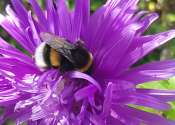
Caffeine enhances bee memory
(Phys.org) —Caffeine is the naturally occurring drug most widely used by humans. In nature, though, it is reported to act as a bitter and toxic deterrent to herbivores, preventing leaves and seeds from ...
(Phys.org) —In a paper published today in the peer-reviewed science journal PLoS ONE, researchers have presented a new model to explore how changes in food availability might influence honeybee colony growth ...
It may be easier to show concern about cuddly animals like bees than about some of the millions of indigenous insect and microorganisms found in the European biodiversity.
Ivy, often maligned as a garden pest, is vital to honey bees and other pollinators seeking food in autumn, new research from the University of Sussex reveals.
Fire blight is a serious threat to fruit trees. Now a quick test has been developed at the Vienna University of Technology, which can indicate the danger early - with the help of bees.
The rosemary season has ended, but sage is in full bloom. In the fragrant hills of the Peloponnese in southern Greece, after a few sharp turns along a path, Nikos Reppas' old car arrives at bee heaven: a ...
Scientists at Queen Mary, University of London and the Zoological Society of London (ZSL), have discovered why bees copy each other when looking for nectar – and the answer is remarkably simple.
The genus Megachile is a cosmopolitan group of solitary bees, often called leafcutter bees. This is one of the largest genera of bees, with well over 1,500 species in over 50 subgenera. A new species, Meg ...