NASA pondering a future grapple on the James Webb Space Telescope
May 31, 2007
James Webb Space Telescope
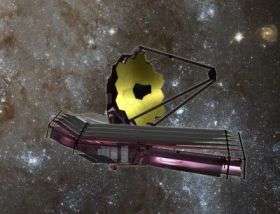
This is an artist's rendition of the James Webb Space Telescope orbiting the second Lagrange point (L2) of the Sun-Earth system. The L2 point is approximately 1.5 million kilometers (approximately 930,000 miles) from Earth, outside the orbit of the Moon. The region about L2 is a gravitational saddle point, where spacecraft may remain at roughly constant distance from the Earth throughout the year by small station-keeping maneuvers. Credit: NASA

When it launches in 2013 the James Webb Space Telescope will settle in an orbit roughly one million miles from the Earth. That distance is currently too far for any astronaut or any other existing NASA servicing capability to reach. Therefore, NASA is doing everything necessary to design and test the telescope on the ground using techniques that will ensure that it deploys and operates reliably in space.

However, NASA is looking into just how feasible it might be to perform emergency servicing operations on the Webb telescope if such a need were to arise and if such a servicing capability were to become available sometime in the future.

"We are currently studying the possibility of adding a lightweight grapple fixture to JWST," said John Decker, Deputy Associate Director of the JWST Project at NASA Goddard Space Flight Center, Greenbelt, Md. "A grapple fixture is a kind of a grab bar that would afford a means for a future manned or robotic servicing capability to safely attach to the telescope in space."

Once the engineers who are assessing the feasibility of adding the grapple feature have concluded the study, they will present the results to NASA Headquarters. At that time, there will be a determination as to whether the grapple feature will be added to the telescope. The assessment will finalize in 2008.

The James Webb Space Telescope is a 21st century space observatory that will peer back more than 13 billion years in time to understand the formation of galaxies, stars and planets and the evolution of our own solar system. It is expected to launch in 2013. The telescope is a joint project of NASA, the European Space Agency and the Canadian Space Agency.


Source: NASA/Goddard Space Flight Center

Explore further: Cassini imaging lead hopes for planet-wide celebration of the Pale Blue Dot

add to favorites email to friend print save as pdf

Related Stories

James Webb Telescope's last backbone component completed

Jun 14, 2013

(Phys.org) —Assembly of the backbone of NASA's James Webb Space Telescope, the primary mirror backplane support structure, is a step closer to completion with the recent addition of the backplane support ...

Black hole naps amidst stellar chaos

Jun 11, 2013

(Phys.org) —Nearly a decade ago, NASA's Chandra X-ray Observatory caught signs of what appeared to be a black hole snacking on gas at the middle of the nearby Sculptor galaxy. Now, NASA's Nuclear Spectroscopic ...

Recommended for you

Super-hurricane-force winds on Venus are getting stronger

15 hours ago

(Phys.org) —As the closest planet to Earth, Venus is a relatively easy object to observe. However, many mysteries remain, not least the super-rotation of Venus' atmosphere, which enables high altitude winds ...

ExoMars 2016 set to complete construction

19 hours ago

ESA's mission to Mars in 2016 has entered the final stage of construction with the signature of a contract today with Thales Alenia Space at the Paris Air & Space Show.

Australian team maps Moon's hidden craters

23 hours ago

Australian scientists Tuesday said they had identified a possible 280 additional craters on the Moon, a finding they said could shed light on the history of the Earth's natural satellite.

User comments : 0

More news stories

3D printing tiny batteries

(Phys.org) —3D printing can now be used to print lithium-ion microbatteries the size of a grain of sand. The printed microbatteries could supply electricity to tiny devices in fields from medicine to communications, ...