Samsung First to Mass Produce 16Gb NAND Flash Memory
Apr 30, 2007
Samsung First to Mass Produce 16Gb NAND Flash Memory

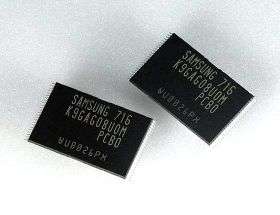
Samsung Electronics announced today that it has become the first to begin mass producing 16 gigabit NAND flash, the highest capacity memory chip now available. The company said it will fabricate the devices in 51 nanometers, the finest process technology to be used in memory mass production to date.

“In rolling out the densest NAND flash in the world, we are throwing open the gates to a much wider playing field for flash-driven consumer electronics,” said Jim Elliott, director, flash marketing, Samsung Semiconductor. “To minimize production costs and improve performance, we have applied the finest process technology a ‘half generation’ ahead of the industry, which is introducing 55nm and higher.”

Samsung’s 51nm NAND flash chips can be produced 60 percent more efficiently than those produced with 60nm process technology. Samsung achieved this new migration milestone just eight months after announcing production of its 60nm 8Gb NAND flash last August.

The new 16Gb chip which has a multi-level cell (MLC) structure can facilitate capacity expansion by offering 16 gigabytes (GBs) of memory in a single memory card. Furthermore, by applying the new process technology, Samsung has accelerated the chip’s read and write speeds by approximately 80 percent over current MLC data processing speeds.

NAND flash memory reads and writes data in units called “pages.” The 60nm NAND flash memory is designed with a 2 KiloByte (KB) page size, but the 51nm 16Gb version can process data in 4 KB pages, nearly doubling the data rate. The product also maintains the same 4 bit error-correcting code (ECC) capability as that of 60nm NAND, allowing customers to use existing system interfaces with only minor firmware upgrades. With its 4 bit ECC, Samsung eliminates the need to secure a better ECC capability to assure sufficient reliability, which would have required new costly controllers.

Samsung will offer an optimized suite of Flash software and firmware-incorporated storage devices for music phones and MP3 players to support 4KB pages. It also will provide a multi-plane performance optimization feature and wear-leveling for improved reliability. Memory cards and MP3 controllers to support the 4KB-page are already available,

Technology migration to 16Gb is expected to boost the recent explosive demand for high-density data storage in high-end music phones and the phenomenal trend toward user created content (UCC). As the demand for video content grows stronger by the day, products that feature extended recording time of high-resolution video footage, including mid-to-high-range digital cameras, will particularly benefit from the high capacity and performance of 16Gb NAND flash memory.

With support technology in place, demand for 16Gb NAND flash memory is expected to grow rapidly, pushing this new chip into the mainstream market beginning late this year. Aggregate global sales through 2010 are estimated to be US$21 billion.

Source: Samsung

Explore further: Finnish start-up launches smartphone to rival giants

add to favorites email to friend print save as pdf

Related Stories

Toshiba launches 19nm process NAND flash memory

Apr 21, 2011

(PhysOrg.com) -- Toshiba Corporation today announced that it has fabricated NAND flash memories with 19nm process technology, the finest level yet achieved. This latest technology advance has already been applied to 2-bit-per-cell ...

Elpida and Spansion develop 4-Gigabit NAND flash memory

Sep 02, 2010

Elpida Memory and Spansion today announced they have created the industry's first charge-trapping 1.8 V, 4-gigabit SLC (Single Level Cell) NAND Flash memory. This NAND memory, based on Spansion's MirrorBit charge-trapping ...

Recommended for you

Finnish start-up launches smartphone to rival giants

5 hours ago

A group of ex-Nokia employees who quit over the company's decision to abandon the planned MeeGo operating system in favour of Windows presented their own smartphone on Monday, hoping to rival the sector's ...

NEC phone is liquid-cooled and gender-specific

12 hours ago

(Phys.org) —Pink is the color of princess fairy-tale gowns, magic slippers, upscale cupcake icing, and everything else favorable to girls who just want to be girls. "Ladyphones" appear to be concepts for ...

Expectations high for next Xbox

13 hours ago

It's almost time for a new Xbox. Eight years have passed since Microsoft unveiled the Xbox 360, double the amount of time between the original Xbox debut in 2001 and its high-definition successor's launch ...

Congress gets mixed advice on regulating drones

May 17, 2013

(AP)—The growing use of unmanned surveillance "eyes in the sky" aircraft raises a thicket of privacy concerns, but the U.S. Congress is getting mixed advice on what, if anything, to do about it.

User comments : 0

More news stories

Finnish start-up launches smartphone to rival giants

A group of ex-Nokia employees who quit over the company's decision to abandon the planned MeeGo operating system in favour of Windows presented their own smartphone on Monday, hoping to rival the sector's ...

Expectations high for next Xbox

It's almost time for a new Xbox. Eight years have passed since Microsoft unveiled the Xbox 360, double the amount of time between the original Xbox debut in 2001 and its high-definition successor's launch ...

NEC phone is liquid-cooled and gender-specific

(Phys.org) —Pink is the color of princess fairy-tale gowns, magic slippers, upscale cupcake icing, and everything else favorable to girls who just want to be girls. "Ladyphones" appear to be concepts for ...

Congress gets mixed advice on regulating drones

(AP)—The growing use of unmanned surveillance "eyes in the sky" aircraft raises a thicket of privacy concerns, but the U.S. Congress is getting mixed advice on what, if anything, to do about it.

Practice makes perfect? Not so much

Turns out, that old "practice makes perfect" adage may be overblown. New research led by Michigan State University's Zach Hambrick finds that a copious amount of practice is not enough to explain why people ...